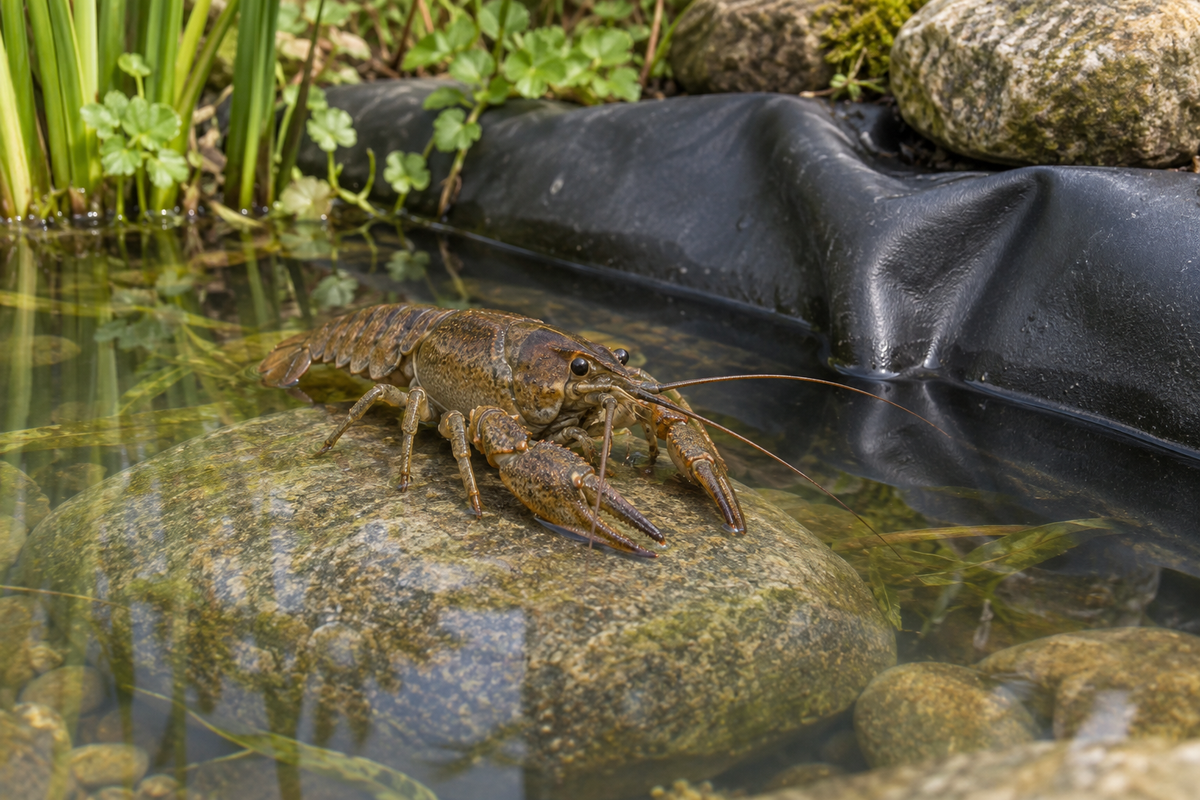
You’ve spotted a crayfish in the pond and the water level is dropping: the connection seems obvious. However, the presence of crayfish is not enough to prove that they have pierced the liner. Some species dig burrows and can destabilize banks. An actual perforation of your membrane must be observed and examined.
Before replacing the waterproofing or trying to eliminate the animals, you must answer three questions: where is the water going, what is the condition of the liner, and which species is present? This method avoids a costly repair that would leave the true cause of the leak intact.

What we know about damage caused by crayfish
Studies on invasive crayfish describe burrows in banks and erosion phenomena. Their impact depends notably on the species, population size, soil, and environment. An earthen bank and a properly supported pond membrane are not equivalent foundations.
In a natural pond, a burrow can contribute to the destabilization of a bank. In a lined pond, you must examine the membrane, its support, and its connections separately. A slump near the edge can put the waterproofing under tension or change the overflow level without the animal necessarily having cut the material.
The sources cited at the end of the article do not provide a comparative test that would allow one to declare a thickness of EPDM or PVC "crayfish-resistant." We therefore do not adopt a thickness threshold intended to guarantee this protection. The quality of the installation and on-site diagnosis remain essential.
A drop in level may have another origin
Start by looking at the elements that transport water out of the basin: waterfall, stream, hoses, fittings, and filter. A splash directed behind a stone or a slightly slumped waterfall edge can cause water loss without leaving a visible hole in the pond.
Also examine the margins. An area of soil or textile that connects the water to the outside can promote losses through capillary action. An edge that has become too low allows water to overflow locally. These defects can appear after construction work, moving stones, or settling.
Note the level at a comparable time with a fixed marker, as well as rainfall, top-ups, and equipment operation. Evaporation varies with wind, heat, and water features: an isolated drop does not allow a leak to be quantified. Avoid permanent automatic top-ups during the diagnosis, as they mask the actual trend.
Inspecting without putting fish in difficulty
An isolation test of the waterfall circuit can be useful, but it must preserve the filtration and aeration necessary for the fish. Do not leave a biological filter off for a long time to observe the level. If the same pump powers the entire system, have a method prepared that is adapted to your installation.
Do not let the pond drain until it "finds the height of the hole on its own." Monitor the remaining depth, pump intakes, and animals. A drop that seems to stop can guide the search; it does not constitute sufficient proof on its own.
Photograph damp areas on the outside, folds in the liner, wall penetrations, and changes in level. A simple plan with the pond, filter, and hoses is often more helpful than a very close-up photo of a trace that is difficult to locate.
Recognizing real damage to the membrane
Once the suspicious area is safely accessible, look for a cut, abrasion, puncture, or detached seam. Check what is underneath and above it: sharp stone, concentrated pressure point, root, old repair, or displaced element. A surface mark is not necessarily a puncture.
Do not scrape the liner with a sharp tool to check its resistance. Do not pull hard on a fold under tension. If the support seems hollow or slumped, the intervention must address this defect before applying a patch. A patch alone will not restore a bank to its original state.
To request useful advice, prepare the following information:
- type of membrane, brand if known, and approximate age;
- location of the defect relative to the water level;
- general and close-up photos, with a ruler next to the damage;
- change in level and recent work;
- photos of the animals observed, without concluding the species yourself.
How to protect the liner during construction or repair?
The bottom must be prepared to avoid sharp objects and pressure points. A suitable protective geotextile is placed under the membrane according to the manufacturer's instructions. It contributes to mechanical protection; it does not replace soil preparation or bank stability.

For a new project, compare protection needs with the EPDM membrane and geotextile pack. The choice is made according to the geometry, support, and site constraints. A thicker membrane laid on a poor base can remain vulnerable.
Decorative stones and baskets also require stable supports, compatible with the membrane. Avoid sharp edges in direct contact with the waterproofing. Keep the main junctions accessible: covering them permanently complicates future leak searches.
Repairing with a system compatible with the liner
EPDM and PVC do not necessarily use the same repair products. Identify the material before buying glue or tape. The requirements for cleaning, drying, temperature, overlap, and refilling depend on the chosen system.
A hardware-store tape presented as waterproof does not automatically constitute a durable repair in a living pond. Follow the manufacturer's instructions and check compatibility with immersion and the inhabitants. An aged membrane, several nearby defects, or a structural junction may justify professional intervention.
What to do with the observed crayfish?
Photograph the animal if it can be done without moving it. In Wallonia, the species present do not all have the same status. A serious identification requires several characteristics: color alone is insufficient. The regional portal dedicated to invasive species allows you to find appropriate information and contacts.
Do not release a crayfish into a stream, a neighboring pond, or another garden. Moving it can spread an undesirable species and diseases. Do not improvise trapping or chemical treatment either: ask for the procedure adapted to the species and the site.
Removing animals, when indicated, does not exempt you from checking the waterproofing. Conversely, repairing a leak does not necessarily resolve the presence of an invasive species. These are two problems to be examined with the competent parties.
Having your situation examined
To choose a protection or repair system, send photos of the liner and measurements of the pond to support@aquiflor.com. The goal is to identify the material and constraints before ordering. For the identification and management of a potentially invasive crayfish, rely on regional services.