Copper sulfate can affect certain aquatic organisms, but it is not a solution to be poured into a pond at random. Its effect depends on the product, the water composition, and the species present. A mistake can harm fish and invertebrates, while the massive destruction of algae can cause a lack of oxygen.
Faced with green water or filaments, start by identifying the phenomenon and analyzing the pond. A powder bought for another use, an old recipe, or the dosage used by a neighbor do not constitute a protocol adapted to your installation.

Why are there such different recommendations?
Documents on copper concern various contexts: aquaculture farming, marine aquariums, ornamental ponds, or the treatment of a specifically identified organism. Formulations and monitoring methods change. Instructions published for the farming of a particular species are not transferable to a garden pond populated by several species.
It is also necessary to distinguish the quantity of copper sulfate from the quantity of active copper. A concentration indicated for one cannot be copied for the other. Formulated products can have different compositions, even if their trade names all highlight copper.
This is why this article does not provide a recipe in grams per cubic meter. The decision requires a product adapted to the use, a reliable volume, analyses, and competent guidance. The low purchase cost of a raw material does not indicate the cost of a controlled intervention.
Effectiveness against algae does not guarantee pond safety
Copper can be toxic to fish and many invertebrates. Discreet organisms, such as zooplankton, however, contribute to the life of the body of water. Therefore, the disappearance of the green color is not enough to judge the overall effect of a treatment.
Sensitivity also depends on environmental conditions. Work by the University of Florida highlights, in particular, the importance of alkalinity in freshwater. Weakly buffered water requires special caution. Measuring only the pH does not allow for the evaluation of this characteristic.
The fate of copper in a system is complex: it can interact with dissolved substances, surfaces, and organisms. Publications on marine systems illustrate this difficulty, but their treatment concentrations must not be used as instructions for a freshwater pond.
Understanding pH, KH, GH, and alkalinity
The pH describes the acidity or basicity of water at a given moment. GH provides information on total hardness, mainly linked to calcium and magnesium. Alkalinity describes the ability to neutralize acids; the KH test used in aquariums is commonly used to assess buffering capacity in typical pond waters.
These parameters are linked in certain contexts but are not interchangeable. The result and the unit must accompany any request for advice. A value given in degrees and a value expressed in milligrams per liter of calcium carbonate equivalent cannot be compared directly.
Do not try to "make copper safe" by automatically adding a KH corrector. Modifying water chemistry is already an intervention that must be justified. If measurements seem inconsistent, have them verified before adding another product.
The risk of oxygen depletion after a rapid disappearance of algae
Algae produce oxygen when they photosynthesize, then their decomposition consumes oxygen. Significant destruction can therefore quickly change the pond's conditions. The risk becomes particularly concerning when there is a lot of biomass and fish.
A running pump does not prove that dissolved oxygen is sufficient everywhere. Check air intakes, diffusers, actual flow, and areas with little circulation. If the fish are having difficulty breathing, quickly contact a veterinarian or a fish health professional and immediately check the aeration.
A drop in oxygen and poisoning can show signs that look similar. Observation alone is not enough to choose between these hypotheses. Communicate the products used, quantities, times, and the evolution of the fish.
Which tests to plan for in a pond?
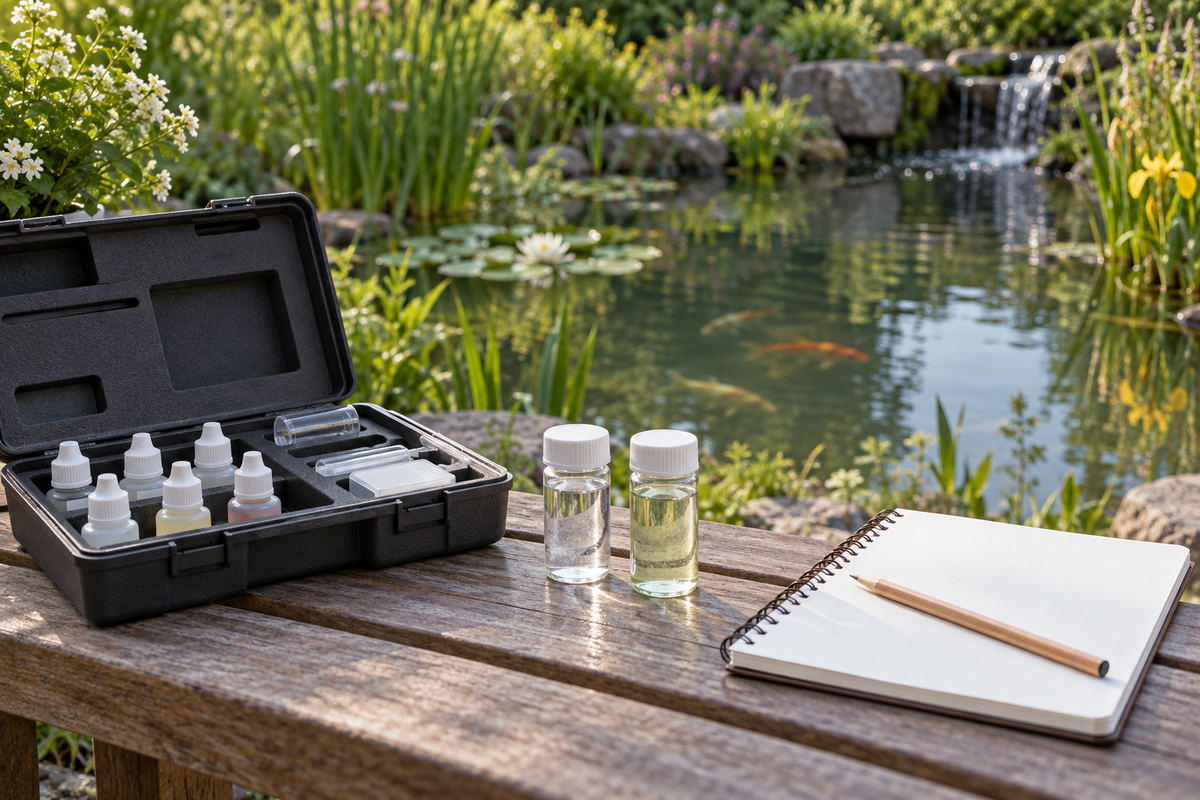
An analysis kit helps to document the environment, provided you know what it measures. The Sera Koi Aqua-Test Box from the Aquishop catalog notably includes pH, GH, KH, ammonium/ammonia, nitrites, nitrates, phosphates, iron, and copper tests.

A test intended for individuals has a measurement range and limits. Check its compatibility with the form of copper being tested for. A result that is difficult to read, or below the detection threshold, does not constitute a guarantee of safety for all species. A professional analysis may be necessary.
Keep a dated log. Also note the calculated volume, temperature, species, and added products. An irregularly shaped pond is not correctly dimensioned by only multiplying its maximum dimensions.
Verify the product and its use in Belgium
For a product used as a biocide, consult the official Belgian list and its authorization act. They allow you to verify the product concerned, the uses, the user category, and the applicable conditions. Authorization for another use or another market is not enough.
The label must remain the practical reference. Do not transpose instructions for a classic pool product to a living pond or a natural pool. In case of doubt about the status of a formulation, ask for confirmation from the supplier and the competent authority before use.
What avenues should be examined regarding algae?
Start with inputs: excessive food, leaves, soil runoff, or waste accumulation. Then check circulation, filtration, and their maintenance. For accessible filaments, gradual mechanical removal allows material to be removed from the pond.
Aquipond Greenstab can be studied as part of an adapted maintenance strategy. The manufacturer presents it as a formulation without copper compounds and without algaecide. This does not allow one to promise an immediate disappearance of algae nor to dispense with the instructions and water checks.
If the problem is primarily an excess of organic sludge, a PondoVac 4 vacuum can help remove deposits in a pond compatible with this method. Aquipond Bactovase targets the degradation of organic matter according to its conditions of use. None of these products are an antidote to copper.
What if cyanobacteria are suspected?
Unusual coloration, surface accumulations, or suspicious water require a specific evaluation. Some cyanobacteria can produce toxins. Keep people and animals away from suspicious water and follow local health guidelines; a clear appearance is not enough to authorize swimming.
For human exposure with symptoms, contact a doctor; for an animal, a veterinarian. Do not try to resolve this situation with an improvised anti-algae treatment.
Have you already added copper sulfate?
Keep the packaging and note the quantity, time, and estimated volume. Do not add a second treatment to "neutralize" the first without competent advice. In the presence of fish in distress, seek urgent help and provide the available measurements. Decisions regarding water renewal and discharge management must be adapted to the case.
To prepare a maintenance approach or choose your tests, send the pond characteristics to the Aquiflor team. A precise description of the problem allows for the search for a proportionate solution.
Sources
- University of Florida — Copper in freshwater aquaculture.
- University of Florida — Copper in marine systems, cited for mechanisms and transposition limits.
- University of Florida — Alkalinity and hardness.
- FPS Public Health — Belgian list of authorized biocides.
- SPW — Cyanobacteria and public health.
- Aquipond — Greenstab manufacturer information.