The best incense for your home depends first on your taste, the room, and the role you want the fragrance to play. A subtle woody note may be suitable for a moment of reading; a very prominent scent can quickly become overwhelming in a small living room. There is no universally superior incense, nor is there any incense that improves air quality when burned.
To choose, look at the olfactory family, the format, the usage duration, and the manufacturer's information. The object should remain an occasional pleasure, compatible with the people living in the house. Here is a simple method to compare without being guided solely by the packaging.

Start with the fragrance you actually enjoy
First, choose an olfactory direction rather than a long list of promises. The words used on the boxes provide clues, but the blends vary from one manufacturer to another. Two incenses advertised as sandalwood can have very different intensities and nuances.
| Advertised family | Commonly sought impression | Question to ask yourself |
|---|---|---|
| Woody | A warm or dry presence | Do you like woody scents in a room? |
| Floral | A more floral scent, sometimes sweet or powdery | Do you prefer an identifiable flower or a subtle blend? |
| Herbal | A plant-based or aromatic evocation | Do you like the scent without it becoming medicinal to your taste? |
| Resinous or spicy | A denser impression | Do you want a marked or very light presence? |
These descriptions are benchmarks for olfactory tasting, with no guaranteed therapeutic effect. A scent labeled as relaxing may please you but displease someone else. If you share the home, the choice is also made with the other occupants.
Stick, cone, or spiral: look at the intended use
The stick is easy to pair with a suitable holder and allows for choosing short or long formats. Some have a central core, others do not. Burning time depends on the product: compare the actual specifications rather than inferring them from the box size.
A cone requires a burner that can withstand heat at its base. A spiral can burn for a long time and requires monitoring for the entire duration. Decorative presentations with very visible smoke do not constitute an air quality criterion.
Resins on charcoal require specific equipment and precautions. For a first purchase, the simplicity of a format and its instructions counts for more than seeking a complicated ritual. Never use a holder that is not designed for the chosen combustion method.
Japanese incense: what this indication provides
The Japanese origin may refer to a manufacturing tradition and specific compositions. It does not by itself guarantee low intensity or harmlessness. Japanese collections include different fragrance families and several formats.
The manufacturer Nippon Kodo offers, among others, sandalwood, aloe wood, and floral or herbal blends. These examples show the diversity of the offer; they do not constitute a brand ranking or a list of references necessarily available at Aquishop.
When comparing, ask for the origin of the specific product, its composition when provided, and its usage duration. A clear description is more useful than a simple qualifier like "premium" or "authentic."
An option from the Aquishop catalog to set up a dedicated space
The Japanese light wood Buddhist altar offered in the catalog brings together a decorative set and accessories. Its description details beech wood craftsmanship, glass elements, a frame, an incense holder, and a box of "Forest Fragrance" Japanese incense.

The sheet mentions notes from chamomile, sage, and lavender essential oils. It presents a low-smoke incense. This mention describes the advertised visible smoke, without demonstrating an absence of air emissions.
The set may interest someone who also wants a decorative object and a space for reflection. If you are only looking for a few sticks, compare this need with the full contents of the set. Do not buy a larger set just to discover one scent.
"Natural" and "low smoke": keep the right benchmarks
Burning incense emits substances into the air, even when the ingredients have a plant origin. Studies by ADEME and Ineris describe gaseous and particulate emissions that vary according to products and usage conditions.
Discreet smoke can improve visual comfort, but it does not measure all pollutants. The absence of a strong burning smell does not prove the absence of exposure either. To preserve indoor air, reducing sources and proper ventilation remain the useful benchmarks.
Avoid using incense to sanitize a room, disinfect the air, or treat a respiratory problem. It scents a moment; it does not replace cleaning the source of an odor or medical advice.
Adapt the choice to the occupants and the room
In a small volume, a scent can quickly become dominant. The reaction also depends on individual sensitivity. In the presence of children, asthmatics, pregnant women, or those sensitive to perfumes, the most prudent solution is to avoid burning it in their living space.
A meditation or reading session can perfectly well take place without incense. Soft light, a chosen object, and an aired-out room are enough to create a pleasant setting. Fragrance is not a condition for enjoying a quiet moment.
Do not place incense near your face, an open aquarium, or an area where ash could fall. Keep products, accessories, and residue out of reach of children and animals.
Choose the holder before lighting
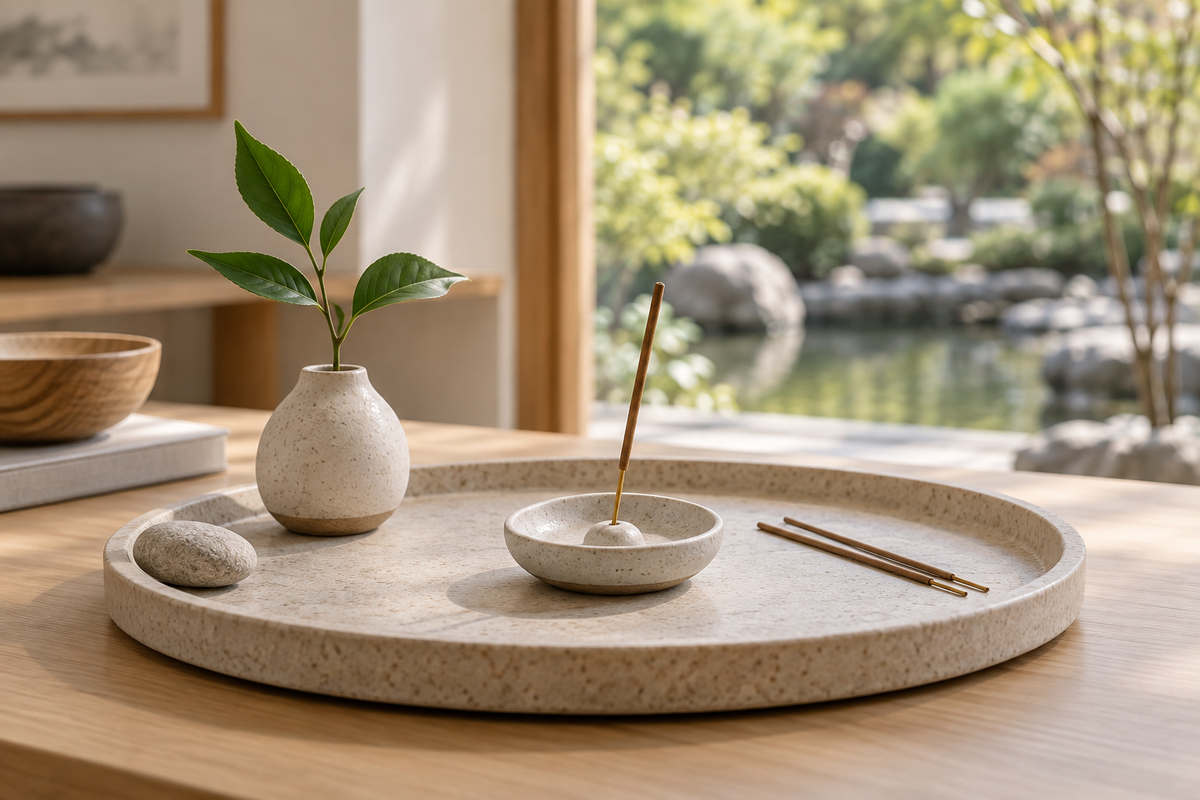
The incense holder must hold the product and collect the ash. Place it on a stable, heat-resistant surface, away from curtains, paper, and flammable objects. Follow the instructions for the holder and the incense.
Stay present during use and check for complete extinction before leaving or going to bed. A material advertised as fire-treated does not turn a piece of furniture into a universal burner. Do not move a hot holder and wait for it to cool down before cleaning.
Ventilate after use, ensuring you do not create a draft that disperses embers during combustion. Incense and completely cooled ashes should be stored or disposed of according to their instructions.
How to compare two references without overbuying?
Create a short note: advertised fragrance, format, number of pieces, indicative duration, required holder, and price of the packaging. Start with a small quantity when possible. A large set is only economical if the fragrance and format suit you.
Evaluate the scent separately during use and the odor that remains afterward. Do not burn several references together to compare them: you lose your benchmarks and increase emissions. Your preference may also change depending on the season and the home's ventilation.
A persistent odor in the house requires a different approach
If you are looking for incense to mask a sewer, damp, or burning smell, identify its source first. Scenting the room may delay finding the problem. A drain, a leak, or damp material requires an appropriate intervention.
To find out the contents of a set and check its availability, contact the Aquiflor team. The right choice remains one where the fragrance, accessories, and usage conditions truly match your home.