The sink smells bad: you clean the basin, rinse it, and then the smell returns. This scenario shows why you need to proceed in a specific order. An odor disappears permanently when its cause is corrected, whether it is an accessible deposit, a dry trap, or a connection defect.
The method below is designed to organize the initial checks in a home. It requires neither the removal of built-in fixtures nor the mixing of products. At each step, keep track of the result obtained: this will help you determine whether maintenance is sufficient or if a professional needs to take over the search.

Step 1: decide whether you can intervene
If the odor is sudden and very strong, or associated with discomfort or difficulty breathing, leave the premises and ask for help from outside. Call 112 if the situation is urgent. Do not search for a gas leak yourself and never enter a pit or manhole.
If there is a possible smell of distribution gas, avoid flames and electrical controls, then contact the network operator from a safe area. Cleaning a trap is not an answer to this uncertainty.
For a moderate and localized nuisance, next check what has already been poured into the drain. If a drain cleaner or unknown product may still be in it, do not disassemble the trap, do not use a plunger, and do not add any other product. Keep the packaging to inform the responder.
Step 2: identify the starting point
Go around the appliances without bringing your face close to the drains. Note the room where the odor is noticed, then the equipment in it: sink, shower, toilet, washing machine, floor drain. Also look at household waste and damp textiles, which can provide a false lead.
Write down three points on a sheet: first appearance, last use of the appliance, and drainage condition. A shower that has not been used for a month requires a different check than a sink that has been draining poorly for several weeks. If several rooms are affected simultaneously, prepare to check the common network instead.
Step 3: refill the traps of infrequently used appliances with water
A standard trap must retain water to form a barrier between the room and the pipe. When this reservoir evaporates, odors can pass through. Gently run water into the unused appliance if the drain works normally and no hazardous product is present.
Proceed appliance by appliance. In a laundry room, think of the floor trap; in a guest room, both the shower and the sink. Note which ones have been put back into service. You will then be able to link an improvement to the action actually taken.
If the odor returns quickly, do not simply keep adding water indefinitely. A missing part, a leak, or a pressure problem can prevent the device from working. This reappearance is information to pass on to the plumber.
Step 4: remove accessible waste
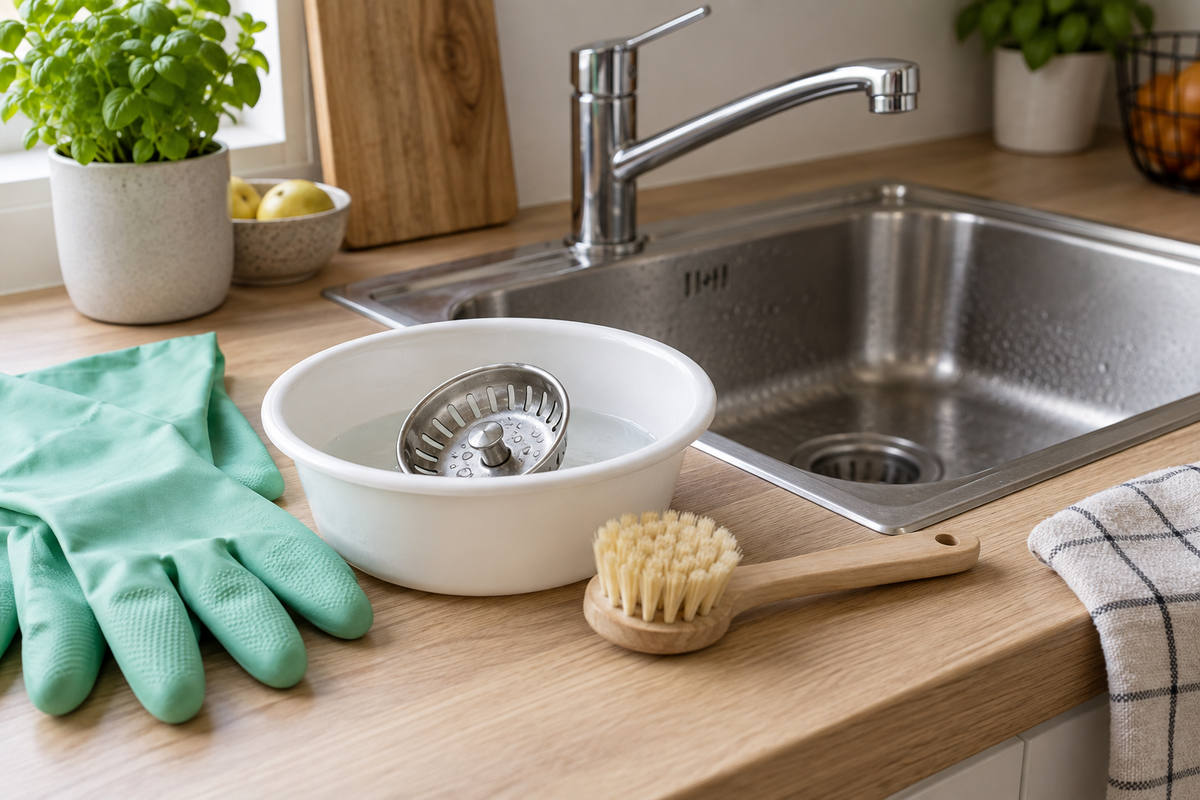
Prepare a basin, suitable gloves, a soft brush, and the sanitary fixture manual. Remove hair or residue caught in the basket or filter provided for this purpose. Dispose of the materials in the trash, according to local guidelines, instead of pushing them into the pipe.
Clean the removable parts using a method compatible with their materials. Do not systematically use boiling water: seals, coatings, and plastic elements are not all treated the same way. Rinsing according to the manufacturer's recommendations is better than a single recipe applied everywhere.
For a shower, distinguish the maintenance basket from the built-in assembly. Unscrewing the main fastener can compromise the seal under the shower tray. If you do not know which part is removable, stop at the manual or ask the manufacturer.
Step 5: check the reassembly and drainage
Replace each part in its original orientation, without forcing it. Some caps or inserts are part of the anti-odor barrier. A clean basket with a missing insert can therefore allow the problem to persist.
Next, perform a test limited to clear water, if the situation allows this test. Look at the visible connections and stop as soon as a leak or backflow appears. The goal is to check the result of the cleaning, not to fill a pipe that drains poorly.
If a part was removed from under a sink, also check for drips after putting it back into service. A photo before the intervention helps to restore the initial layout, but it does not replace an installation manual when the seals or connections are difficult to identify.
Step 6: choose a relevant complementary maintenance
When the pipes drain correctly and organic deposits explain the nuisance, biological maintenance can be considered after checking compatibility. Aquipond Bactodeur is offered with this logic by the manufacturer.

The manufacturer's presentation indicates 10 to 20 g in household kitchen pipes or toilets, once a week. Refer to the label on the packaging you received and to the manual of your installation. Do not increase the doses to try to solve a clog or a ventilation defect.
Bactodeur does not replace a seal, necessary desludging, or a repair. For a septic tank or treatment unit, first ask the opinion of the maintenance provider: adding bacteria is not essential in principle. Keep the products in their packaging and follow the indicated precautions, even when they are presented as biological.
Step 7: check the result without clouding the clues
After the intervention, continue to observe during normal use. Has the odor disappeared after refilling with water? Does it only return after a flush or a machine cycle? Does the drainage remain normal? These questions allow you to assess a real improvement.
Avoid changing three things at once. If you clean, scent, and add several products on the same day, you will no longer know what changed. A deodorizer can change the perception without correcting the source. Therefore, keep a simple record of the actions and the results.
When to call in a professional?
- Several drains slow down or back up.
- The trap regularly loses its water or reacts to other appliances.
- A leak, a damaged connection, or an odor after work is observed.
- The problem returns despite properly carried out accessible maintenance.
- The odor is located near a sanitation installation or a confined space.
Then prepare the photos, the timeline, and the list of products used. In a building, inform the manager so they can examine a possible collective cause. For advice on the use of Bactodeur, contact Aquiflor with these elements; for plumbing, contact a qualified professional.
The rule that avoids the most mistakes
Never mix cleaning products. The Poison Control Center notably recalls the danger of combinations involving bleach. A product already present in the trap also counts: pouring a second product a few minutes later always constitutes a mixture. In case of exposure, ask the Belgian Poison Control Center for advice at 070 245 245; in case of distress, call 112.
Gurgling and level variations count
An isolated noise is not enough to make a diagnosis. On the other hand, a trap that regularly reacts when another appliance drains deserves to be reported. The sizing of the pipes and their ventilation contribute to the stability of the water seals, as Buildwise explains.
Note a precise sequence: "the sink makes noise after the toilet flush", for example. This description helps more than "it sometimes smells". Do not go on the roof to inspect a ventilation outlet and do not block a vent to remove an outdoor odor: have the installation checked.
Observations to keep
Keep a record of the room, the time, the previous use, and the state of the drainage. Add the actions taken and their result. An improvement after refilling with water does not have the same meaning as a perfume that temporarily covers the odor. This little history avoids repeating the same tests and allows you to move toward a verifiable cause.
Baking soda and vinegar: what does the foam prove?
Baking soda and vinegar react together, notably producing carbon dioxide. The bubbles testify to a chemical reaction; they do not prove that a mass of hair has been removed or that a pipe is now clean.
This observation leads to a practical rule: assess the drainage and the state of the parts, not the spectacle in the drain. Effervescence does not allow you to confirm a disinfection any further. A deep clog or a ventilation problem is not diagnosed with this recipe.
Vinegar remains an acidic product. Never combine it with bleach or a product whose compatibility is unknown. Do not pour it after a drain cleaner assuming that its common origin makes it harmless. The Poison Control Center documents accidents related to these mixtures.
A short routine, with a verifiable result
Adapt the frequency of checks to the actual use of the appliances. A hair filter used daily is not monitored like a guest shower. Look at the accessible parts, remove the waste, correctly replace the elements, and note any change in drainage.
If the odors persist despite these actions, or if several appliances react together, call a plumber. Routine maintenance has a limit: it does not allow you to check a hidden pipe, the tightness of all connections, or the sizing of the ventilation.
Sources and references
- Geberit, maintenance of showers, traps, and sanitary equipment.
- Buildwise, trap water seals, Magazine July-August 2024.
- Poison Control Center, bleach and dangerous mixtures.
- Sibelga, instructions in case of a gas odor.
- Aquipond, instructions presented for Bactodeur.
- EPA, fact sheet on septic tank additives.
- American Chemical Society, chemical reactions and baking soda-vinegar effervescence.
- SPF Public Health, read labels before use.
- Southern Water, limit grease and waste in pipes.