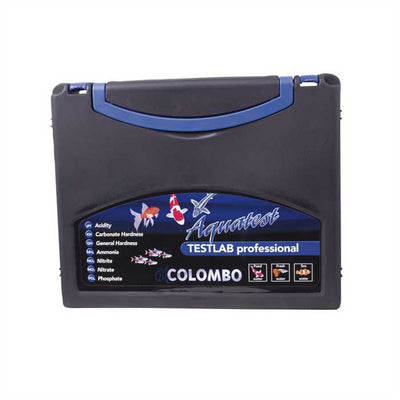


The short answer: to find out what is wrong in a pond, you need to measure. Seven values matter: pH, KH, GH, nitrites (NO2), nitrates (NO3), ammonia (NH3) and phosphates (PO4). You always correct them in the same order: first what is toxic (nitrites, ammonia), then the mineral foundation (KH of at least 7 °dKH, GH of at least 12 °dH), and finally what feeds the algae (nitrates, phosphates). A kit like the Colombo Test Lab measures all seven values using drop tests.
Key points
- Test in spring, in summer, after heavy rains and as soon as a problem appears.
- Nitrites and ammonia: toxic, to be treated as a priority.
- KH: at least 7 °dKH to stabilize the pH.
- GH: at least 12 °dH.
- High phosphates and nitrates: favorable conditions for algae.
Why test pond water?
Clear water is not necessarily healthy water. Nitrites or ammonia are invisible, and a sudden drop in pH cannot be seen before the fish suffer. Conversely, green water can have a very simple cause, such as excess phosphates. Without measuring, you treat at random: you add an algaecide when the problem comes from a collapsed KH, or you change the filter when it was enough to reduce the food.
It is also the first thing we ask at the store when a customer calls us about a pond that "is not right": the results of a test tell you where to look in a few minutes.
What values to aim for?
| Value | Pond benchmark | If it is out of range |
|---|---|---|
| pH | Between 7 and 8.5, especially stable | Check the KH first |
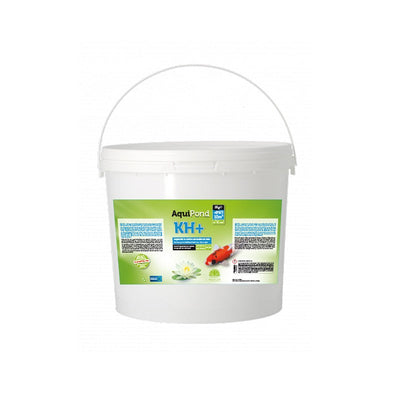
| KH (carbonate hardness) | At least 7 °dKH | Aquipond KH+ |
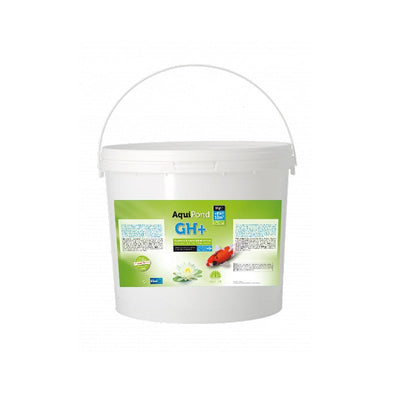
| GH (total hardness) | At least 12 °dH, above the KH | Aquipond GH+ |
| Nitrites (NO2) | Undetectable | Feed less, water change, bacteria |
| Ammonia (NH3) | Undetectable | Stop feeding, water change |
| Nitrates (NO3) | As low as possible | Plants, water changes, less food |
| Phosphates (PO4) | As low as possible | Minerals, plants, limit inputs |
What do pH and KH mean?
pH measures the acidity of the water. In a pond, it naturally varies between day and night: in full sun, plants and algae consume CO2 and the pH rises; at night, it goes down. What matters most is that it does not make large swings.
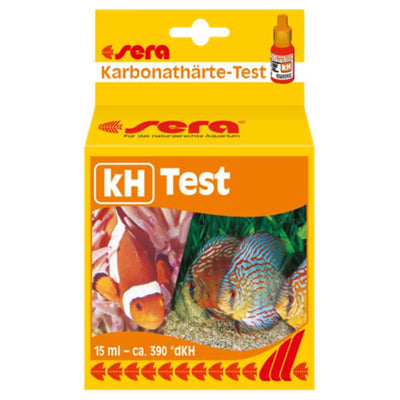
This is the role of KH, carbonate hardness: it acts as a buffer that prevents the pH from collapsing. Filter bacteria consume KH by transforming waste, and rainwater contains almost none. A KH that is too low means a pH that can drop suddenly, with stressed fish and a filter that works poorly. Aim for at least 7 °dKH. To raise it, Aquipond KH+ is dosed at two measures per m³ to gain about 2 units in 24 hours. The sera kH-Test test allows you to monitor KH alone, between two complete analyses.
And GH?
GH, or total hardness, mainly measures calcium and magnesium. These minerals are used by fish, plants, and biological filtration. Here too, rainwater dilutes the GH. We recommend at least 12 °dH, and a GH higher than the KH. To raise it, Aquipond GH+ is sprinkled at a rate of 25 g (one measure) per m³, to gain 1 to 2 °GH, respecting at least 24 hours between two additions. It also helps to precipitate part of the phosphates.


What to do if nitrites or ammonia are detected?
Ammonia comes from fish waste and decomposing food. Filter bacteria transform it into nitrites, then into much less toxic nitrates. If ammonia or nitrites appear, it means the filter is no longer keeping up: new pond, filter cleaned too thoroughly, overpopulation, excess food, or water too cold for the bacteria.
- Reduce or stop feeding for a few days.
- Do a partial water change with water treated against chlorine if it is tap water.
- Increase aeration: bacteria and fish need it.
- Seed the filter with starter bacteria.
- Check the KH: a KH that is too low slows down the filter bacteria.
- Retest after a few days, until both values are undetectable.
Warning: ammonia is all the more toxic when the pH and temperature are high. A pond with a high pH, in summer, with ammonia detected, requires a quick reaction.
Nitrates and phosphates: why algae love them?
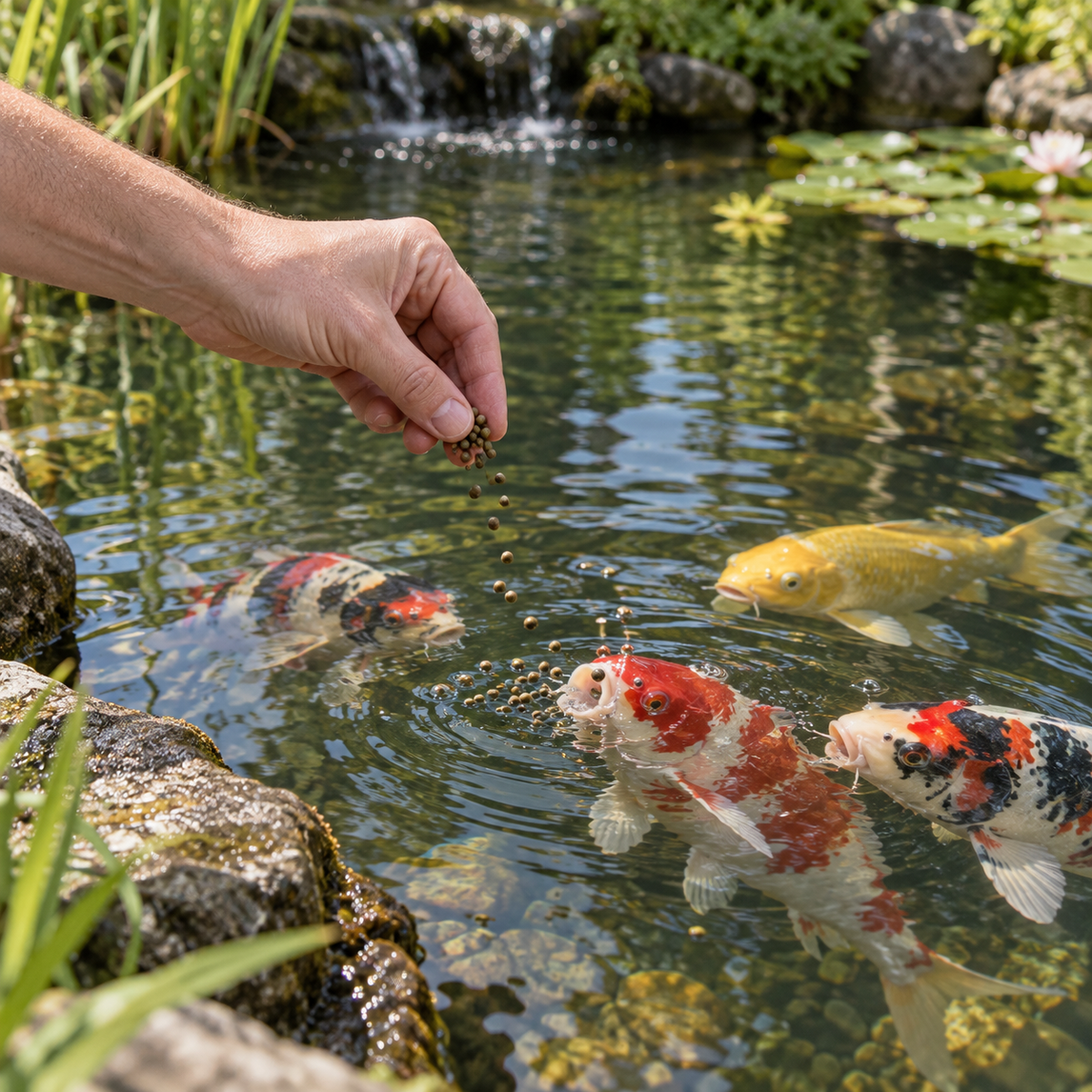
Nitrates and phosphates are fertilizers. They are not directly dangerous for fish at common pond levels, but they feed the algae. Phosphates come mainly from food, leaves, garden soil that washes in, and sometimes tap water. To lower them: feed just enough, remove leaves and sludge, add plants that consume nutrients, avoid fertilizers near the pond, and use minerals that fix part of the phosphates.
Rainwater or tap water to top up the pond?
Both have their drawbacks. Rainwater is almost devoid of minerals: after a stormy summer or a major top-up with cistern water, the KH and GH drop, and the pH becomes unstable. Tap water is mineralized but contains chlorine and sometimes phosphates. The good practice: top up in small quantities rather than all at once, treat the tap water against chlorine, and redo a KH and GH test after each major top-up to correct if necessary.
How to do a reliable test?
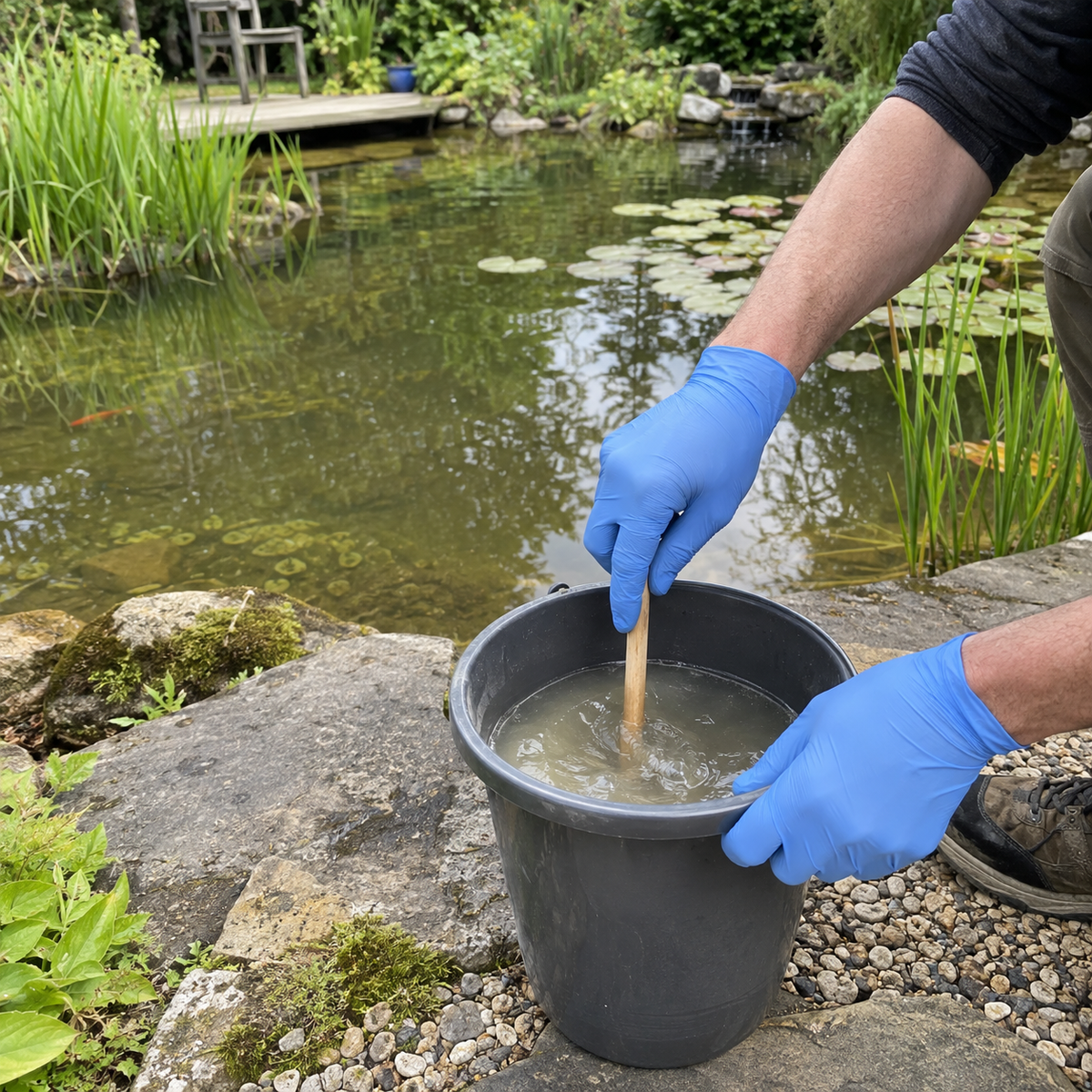
- Take the water 20-30 cm below the surface, away from the filter water inlet.
- Always test at the same time, preferably in the morning, because the pH varies during the day.
- Rinse the test tubes with pond water before and after.
- Respect the reaction times indicated for each test and read the color against a white background, in daylight.
- Record the results with the date: the evolution speaks the most.
- Keep the reagents cool and away from light, and check their date.
Drop tests give a finer reading than strips, parameter by parameter. The Colombo Test Lab brings together the seven Aquatest tests in a kit; the sera aqua-test set is limited to the four basic values (pH, KH, GH and nitrites).
The workshop's advice: send us your results with the pond volume and the number of fish. We will help you read them and decide what to correct first, without multiplying products.
When to test?
- In spring, when restarting the filter.
- After heavy rains, which dilute the KH and GH.
- In summer, when the water heats up and the fish eat a lot.
- After the arrival of new fish or a major filter cleaning.
- As soon as a problem appears: lethargic fish, cloudy water, foam, odor.
Frequently asked questions
What KH is needed in a pond?
At least 7 °dKH. Below that, the pH becomes unstable and can drop suddenly.
What GH is needed in a pond?
At least 12 °dH, and a GH higher than the KH.
What values does the Colombo Test Lab measure?
Seven values: pH, GH, KH, nitrites (NO2), nitrates (NO3), ammonia (NH3) and phosphates (PO4), using drop tests.
What to do if nitrites are detected?
Reduce food, do a partial water change, oxygenate, seed the filter with bacteria, and check the KH, then retest a few days later.
Written by the Aquiflor team, a store specializing in ponds and ponds in Nodebais (Belgium), official Oase repair workshop. Updated in November 2026. Mineral dosages: Aquipond manufacturer sheets.
Your results leave you perplexed? Send them to support@aquiflor.com or call 010 86 03 54: we will help you interpret them.