
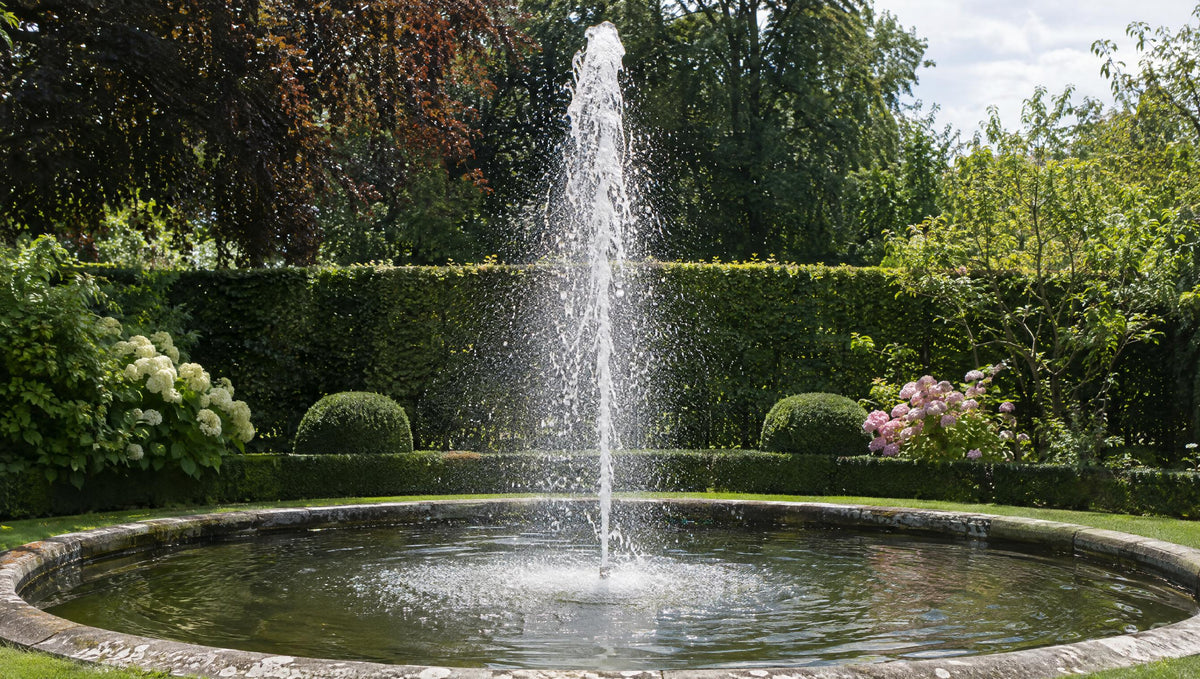
The short answer: for a fountain or water feature, choose a water feature pump, such as the Oase Aquarius, rather than a filtration pump. An Aquarius pump draws already-clean water through a fine screen and pushes it out under pressure to create a clear jet; a filtration pump, such as the AquaMax, draws in debris to send it to a filter. Choose the model based on the height to be achieved and the flow rate required by the nozzle: from 3,000 l/h and 3.20 m for a small fountain to 44,000 l/h and 10.50 m for large water features.
Key points
- Water feature = Aquarius pump (clean water, pressure); filtration = AquaMax pump (dirty water).
- The stated maximum height is achieved at almost zero flow rate: allow some margin.
- The nozzle determines the required flow rate: start with it.
- Recent Aquarius models are frost-resistant down to -20 °C according to Oase.
- Eco Premium models are controlled via the Oase Control app with a compatible control box.
Water feature pump or filtration pump: what's the difference?
Both circulate water, but they are not designed for the same job. A filtration pump must draw in water laden with leaves, waste, and sludge and send it to a filter. It accepts large particles: the AquaMax Eco Classic, for example, draws in impurities up to 8 mm. It delivers a high flow rate, but at low pressure.
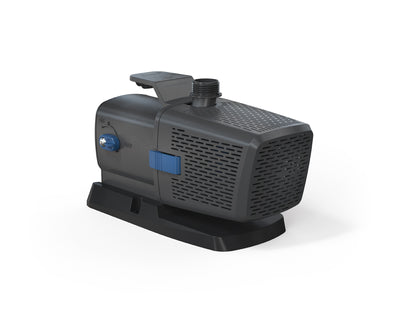
A water feature pump, on the other hand, must provide clean water and pressure so that the jet rises high and remains clear. A particle that passes through the nozzle clogs the small orifices and distorts the jet. The Aquarius models are therefore equipped with a finer screen: that of the Aquarius Universal Premium Eco 3000 retains particles as small as 4 mm. In a pond with fish, it is best to have both: a filtration pump for the water and an Aquarius pump dedicated to the water feature, placed in a clean area or on an elevated platform so as not to draw in sludge.
How to calculate the pump you need?
You always start with the desired effect, therefore the nozzle. Each nozzle requires a certain flow rate at a certain height to produce its effect: a geyser jet, a bell, a tulip, or a multi-jet does not require the same. The nozzle's data sheet indicates this requirement. Then, choose a pump whose flow curve provides this flow rate at the desired height.
Be careful when reading the figures. A pump's "maximum water column height" is the height it reaches when the flow rate becomes almost zero. The "maximum flow rate" is measured without height. In reality, you will always have a little of both, plus losses in the pipe. A pump rated at 3.20 m will not produce a 3 m high jet with a beautiful effect: it will be more suitable for a small fountain or a low decorative jet. Allow some margin and, if in doubt, choose the model above, even if you have to reduce the flow rate with the dial or electronics.
| Pump | Max. flow | Max. height | Power consumption | Control |
|---|---|---|---|---|
| Aquarius Universal Classic 3000 | 3,000 l/h | 3.20 m | 40 W | Mechanical adjustment |
| Aquarius Universal Premium Eco 3000 | 3,000 l/h | 3.20 m | 40 W | Dial |
| Aquarius Eco Premium 4500 | 4,500 l/h | 3.50 m | 12 to 35 W | Oase Control |
| Aquarius Eco Premium 13500 | 13,500 l/h | 7 m | 30 to 145 W | Oase Control |
| Aquarius Eco Expert 44000 | 44,000 l/h | 10.50 m | 700 W | EGC |
Specifications: Oase data from the product sheets.

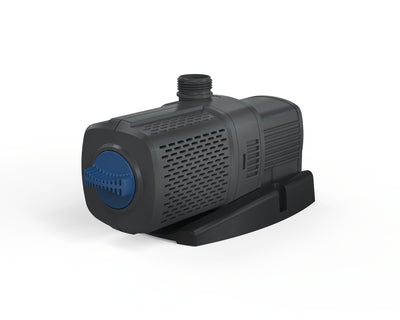
Aquarius Eco Premium
4500 and 13500

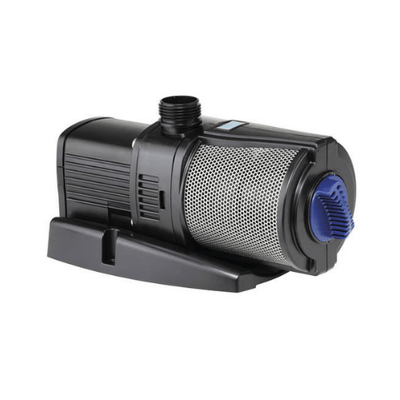
Universal Classic 3000
Small fountains

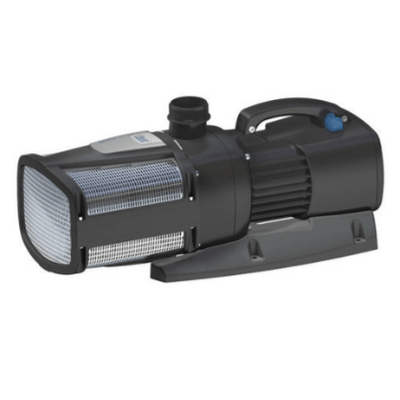
Aquarius Eco Expert 44000
Large water features
Which model for which project?
Small fountain, patio basin, water wall
The Aquarius Universal Classic 3000 and Universal Premium Eco 3000 deliver up to 3,000 l/h and reach 3.20 m for 40 W. They can be installed in the water or dry, work even with little water, and remain very quiet: you hear the murmur of the water, not the pump. The Classic suction pipe pivots 360° and its frost resistance goes up to -20 °C according to Oase. They are perfect pumps for a patio fountain, an above-ground pond, or a small decorative jet.
Pond jet, animated fountain
The Aquarius Eco Premium range (new 2025 generation) uses Oase's Core 6 motor technology, which is more energy-efficient than the previous model: the 4500 consumes 12 to 35 W for 4,500 l/h and 3.50 m, the 13500 30 to 145 W for 13,500 l/h and 7 m. Built-in animations vary the jet, a 2-way distributor allows powering a second adjustable outlet, and the EFC protection cuts the pump in case of overheating or blockage. They are controlled from the Oase Control app, provided you have a Garden Controller Home/Cloud or an InScenio FM-Master Home/Cloud.
Large water features, exceptional bodies of water
The Aquarius Eco Expert 44000 is the professional pump for large water features: 44,000 l/h, a 10.50 m water column, a stainless steel housing, and German manufacturing. Its dynamic function adjusts the height of the jets, and it is controlled in EGC with a compatible InScenio control box. According to Oase, it consumes 50% less energy than the previous model and is frost-resistant down to -20 °C.
The workshop's advice: place the pump on a brick or a small base, about ten centimeters from the bottom. It draws in less sludge, the screen clogs less quickly, and the jet remains regular all season. Also provide a cable length that allows you to take the pump out without emptying the pond.
How to install a fountain pump?
- Choose the nozzle and note the flow rate and height it requires.
- Choose the pump with margin on the height and flow rate.
- Place it in a clean area, on a base, away from leaf deposits.
- Connect the nozzle directly or with a tube extension, limiting bends.
- Connect to an outdoor socket protected by a 30 mA RCD.
- Adjust the flow rate to get the desired effect and avoid splashing out of the pond in strong wind.
Attention to evaporation: a high and fine jet throws out a lot of droplets, which the wind carries out of the pond. In dry and windy weather, the level can drop quickly. Monitor it so that the pump never runs dry, even if recent models have protection.
And in winter?
Recent Aquarius models are protected against frost down to -20 °C according to Oase, which prevents damaging the pump if it remains in the pond. This does not mean that you have to run the jet in the middle of winter: it cools the surface water and can bother the resting fish. Many owners stop the water feature in autumn, clean the screen and the nozzle, and restart it in spring. Follow the instructions of your model.
Errors to avoid
- Using a filtration pump for a fine jet: the jet is weak and the nozzle clogs.
- Choosing based on maximum height without looking at the flow rate required by the nozzle.
- Placing the pump in the sludge.
- Forgetting to clean the screen: a jet that drops often comes from there.
- Running the jet in winter over a fish pond.
Frequently asked questions
Can you use a filtration pump for a fountain?
It is not ideal: it delivers a lot but at low pressure, and lets particles through that clog the nozzle. A water feature pump like the Aquarius gives a higher and clearer jet.
Which pump for a small patio fountain?
An Aquarius Universal 3000 (3,000 l/h, 3.20 m, 40 W) is suitable for most small fountains and decorative jets.
Does the maximum height correspond to the height of the jet?
No: it is the height reached at almost zero flow. The actual jet depends on the nozzle and the flow rate; allow some margin.
Can you leave an Aquarius pump in the pond in winter?
Recent models are frost-resistant down to -20 °C according to Oase. It is nevertheless advisable to stop the water feature in winter and follow the instructions.
Written by the Aquiflor team, a store specializing in ponds and ponds in Nodebais (Belgium), official Oase repair workshop. Updated in November 2026. Technical specifications: Oase manufacturer data sheets.
Do you have a fountain or water feature project? Send us a photo, the dimensions of the pond, and the desired effect to support@aquiflor.com or call 010 86 03 54. And if your Oase pump is weakening, our official workshop will overhaul it in Nodebais.