
In short: the sturgeon is a bottom-dwelling fish, an tireless swimmer that needs plenty of space, highly oxygenated water, and sinking food that reaches it. In a koi pond, it often misses its meals: floating pellets are eaten before they reach the bottom. This guide explains how to prepare your pond, how to feed it, who it can live with, and what mistakes to avoid to keep it healthy for many years.
A fish apart
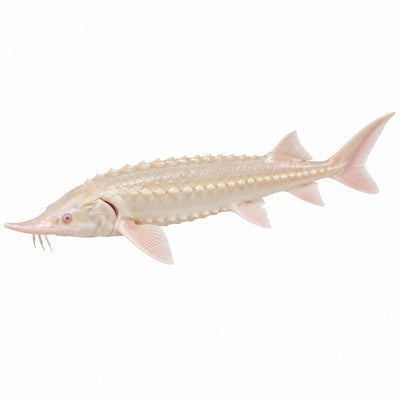
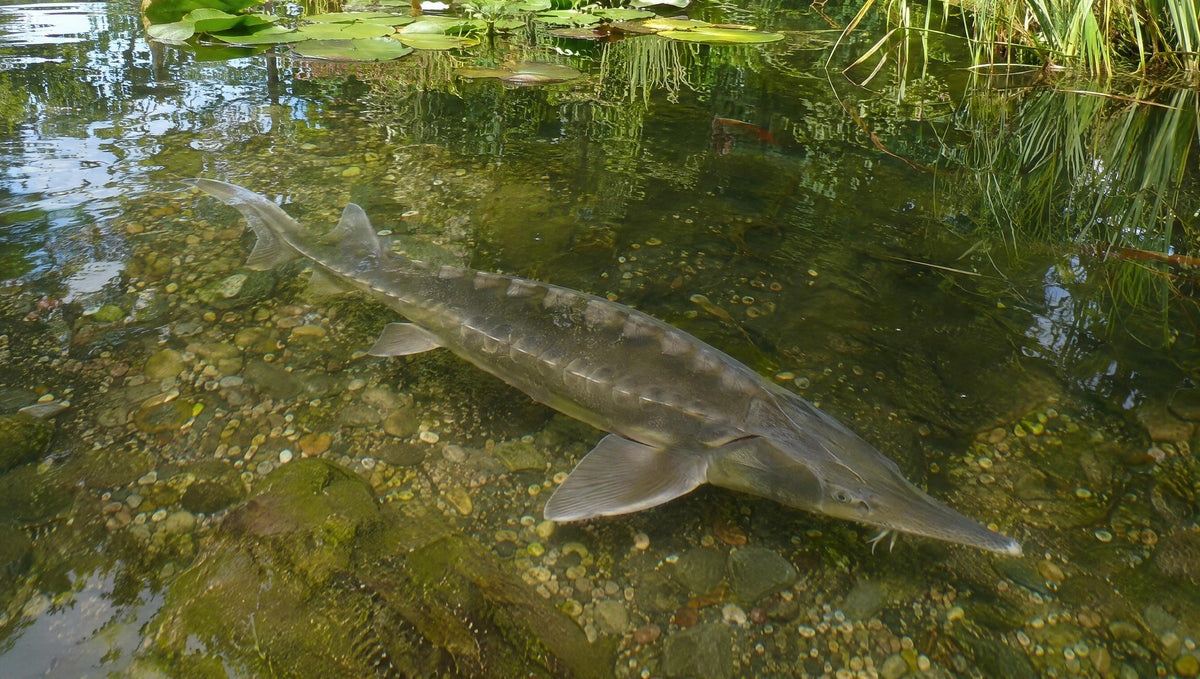
The sturgeon belongs to a very ancient family of fish. It does not have scales like a carp, but rows of bony plates along its body. Its mouth is located under its head, surrounded by sensitive barbels with which it roots around the bottom in search of food. It swims almost constantly, along the walls and the bottom of the pond. These characteristics have three direct consequences for its owner: it needs space to swim, oxygen-rich water, and food it can find where it eats, that is, at the bottom.
The sterlet is the most common species in garden ponds, often offered in an albino version, with a very graphic rosy white color. Like all sturgeons, it grows well beyond its sale size: a 20 cm fish is only at the beginning of its growth.
The ideal pond for a sturgeon
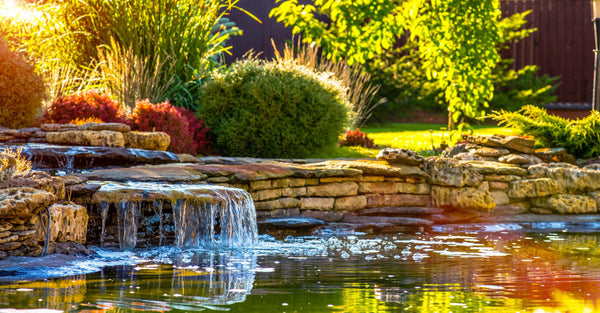
- A large volume: the sturgeon needs a long swimming circuit. A well-sized koi pond, rather than round, suits it well. Small preformed ponds are not suitable.
- An open bottom: avoid basket plants in the middle, large rocks, and corners where it could get stuck. A sturgeon does not know how to swim backward.
- Cool and highly oxygenated water: it does not tolerate warm, oxygen-poor water well. Summer is the period of risk.
- Efficient filtration and stable water, with a GH of at least 12 °dH and a correct KH.
- Smooth walls and a surface skimmer rather than an open bottom drain, in which a young fish could be sucked in: always protect the drains with a screen.
Oxygen, the absolute priority
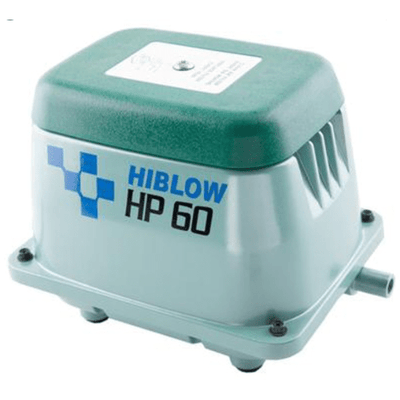
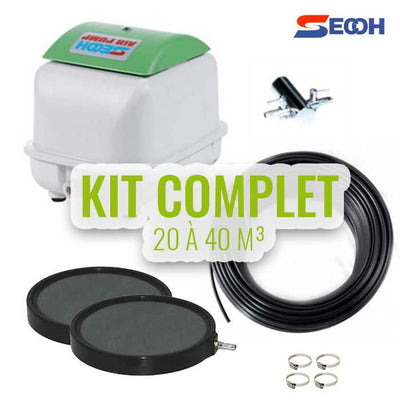
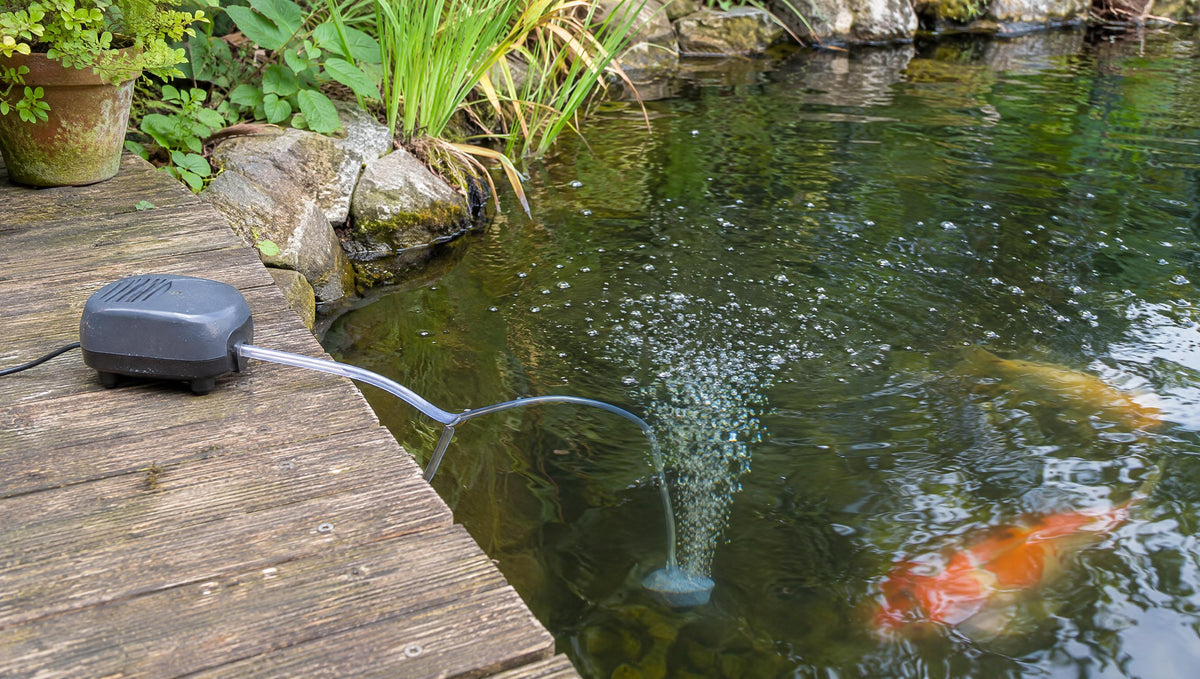
This is the point on which the sturgeon is the least forgiving. It naturally lives in cool, flowing rivers, rich in oxygen. In a pond, a summer thunderstorm, a hot night, or a pump failure can be enough to put it in difficulty, often before the other fish. Permanent aeration with a diffuser at the bottom is therefore essential. A compressor like the HiBlow HP-60, 60 liters of air per minute for 51 W, powers several diffusers and ensures a comfortable safety margin. For a medium pond, a Secoh kit no. 3 is a good base.
Warning sign: a sturgeon swimming on the surface, head out of the water, or remaining motionless on its back, lacks oxygen. Immediately increase aeration, perform a partial water change with treated water, and measure the parameters.
Feeding a sturgeon: the bottom rule
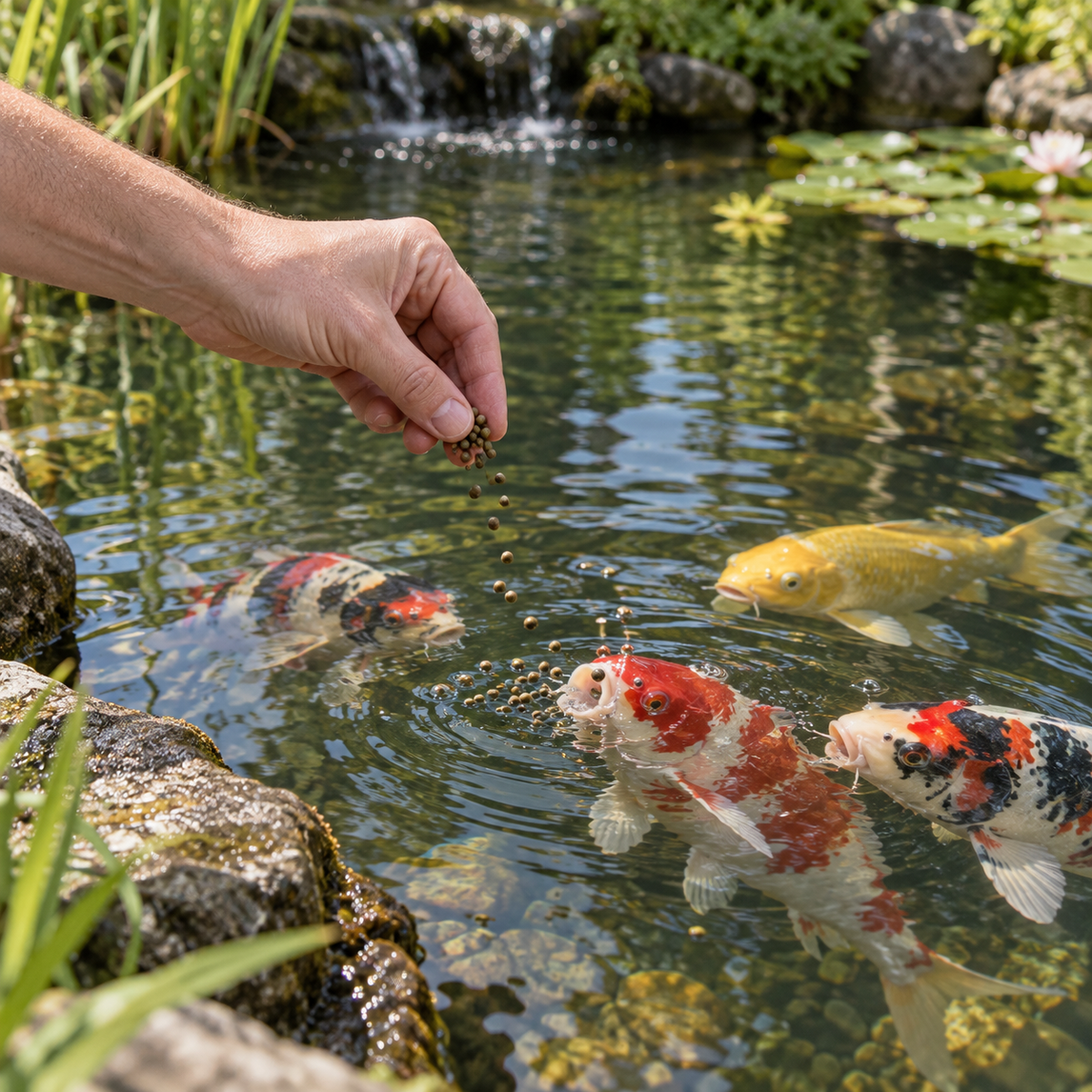
Sturgeons root around the bottom and let floating pellets pass by. In a pond with koi, these latter, faster, eat everything on the surface. Result: the sturgeon loses weight without us noticing. The solution is a specific sinking food.
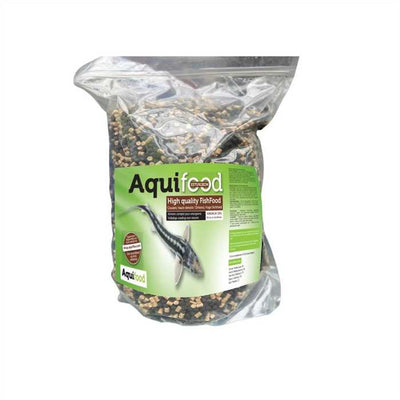
Aquifood Sturgeon 6 mm is a mixture of sinking pellets, rich in protein (38%) and fats (12%) while remaining highly digestible. The 6 mm size is suitable for sturgeons over 25 cm. It is given all year round, including in winter, by adapting the quantities to the temperature. It is available in a 5 kg bag and 10 kg.


How to feed
- Choose a feeding corner at the bottom, always the same, where the sturgeon regularly passes.
- Prefer to feed at the end of the day, at dusk, when the sturgeon is most active.
- Feed the koi first, at the other end of the pond, with their floating food, then throw the sinking pellets near the sturgeon.
- Observe: a well-fed sturgeon has a slightly rounded belly. A hollow belly or a head that appears large compared to the body are signs of underfeeding.
What quantity and at what temperature?
As with all pond fish, the quantity depends on the water temperature. The sturgeon remains active in cooler water than the koi: that is why Aquifood Sturgeon is given all year round. In full season, distribute small regular rations; when the water cools down, space out and reduce, but do not cut off completely as long as the fish is looking for its food. Always remove the unconsumed surplus after a few hours, it must not rot at the bottom.
Cohabitation: with whom?
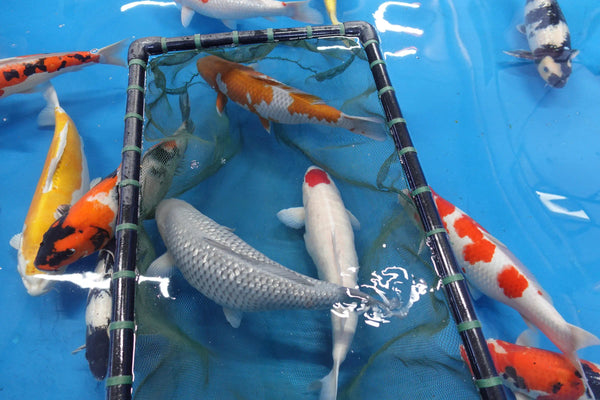
- With koi: it is possible in a large well-filtered and aerated pond, provided you manage the food as described above.
- With goldfish: no problem, the sturgeon is peaceful.
- Several sturgeons: they live well together if there is enough space.
- To avoid: very planted small ponds, ponds with a cluttered bottom, and installations without aeration.
The workshop's advice: before buying a sturgeon, imagine it as an adult in your pond. Its sale size must not hide its future growth. If the pond seems just today, it will be too small in a few years.
Health and treatments: caution
The sturgeon is more sensitive than cyprinids to certain pond treatment products. Before any antiparasitic, anti-algae, or medicinal treatment, read the instructions carefully: some expressly indicate not to use them in the presence of sturgeons. In case of doubt, ask us for advice or isolate the fish during treatment. Prefer preventive approaches: clean and stable water, good oxygenation, maintenance bacteria, and suitable food avoid most problems.
The sturgeon in winter
The sturgeon tolerates the cold well, but slows down. Keep an opening in the ice thanks to aeration, with the diffuser raised to 20 or 30 cm below the surface so as not to cool the bottom. Continue to offer a little sinking food if it shows itself active, in small quantities, and remove what is not eaten.
Delivery of live fish
We deliver our live fish during a weekly tour, within a radius of 160 km around Aquiflor, by an Aquiflor delivery person. Before ordering, check that your address is in this zone and prepare the receiving pond: stabilized water, aeration running, and sinking food ready. You can also come and choose your fish at the Nodebais store.
The most frequent mistakes
- Feeding it with floating pellets: it does not find them and slowly loses weight.
- Placing it in a small pond: it bumps around, exhausts itself, and grows poorly.
- Turning off the aeration at night for the noise: it is precisely at this moment that oxygen drops the most.
- Treating the pond without reading the instructions: some products are not suitable for sturgeons.
- Leaving unprotected drains: a young sturgeon can get stuck in it.
Frequently asked questions
Does a sturgeon eat goldfish?
No, it is a peaceful fish that feeds at the bottom. It does not hunt the other fish in the pond.
Why is my sturgeon swimming on the surface?
It is often a sign of lack of oxygen or poor water quality. Increase aeration and measure the parameters without waiting.
Can you put a sturgeon in a natural pond?
Yes, if it is large, deep, and well oxygenated. Just make sure it finds its food, because a natural pond is generally not enough to feed it.
Are you hesitating about the size of your pond or cohabitation with your koi? Send us the volume, depth, and a photo to support@aquiflor.com: we will advise you before purchase.