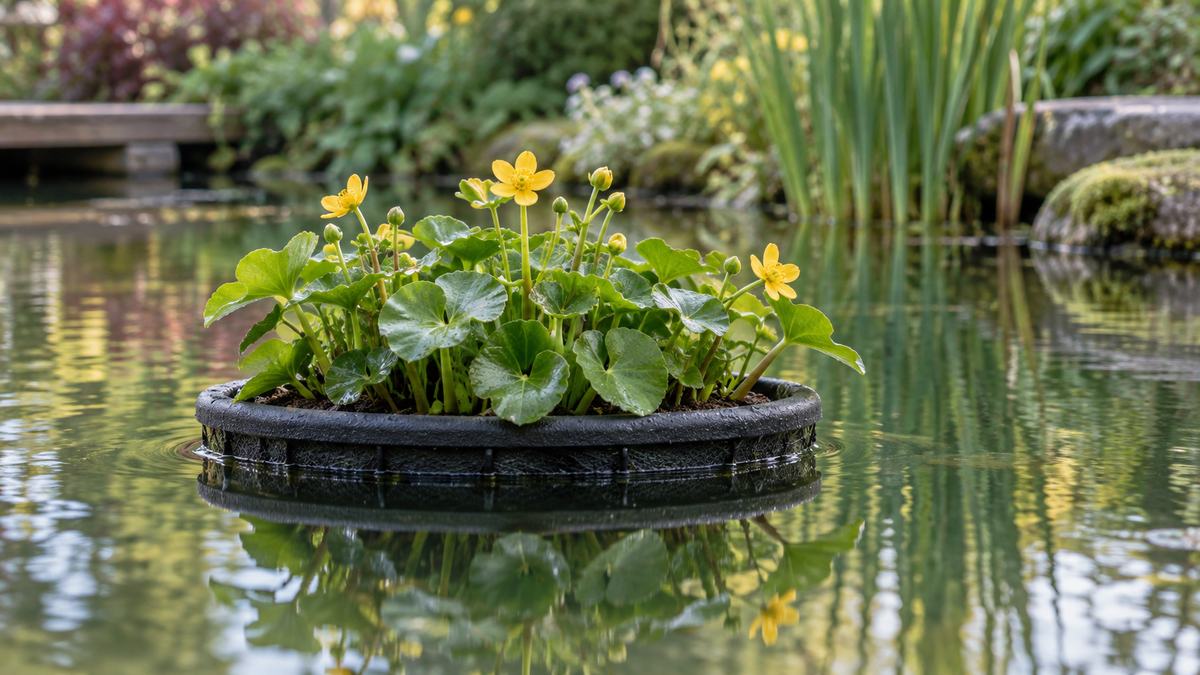
In a floating basket, first choose a marsh plant whose roots can tolerate permanent moisture, then check that its growth remains compatible with the support. A small plant at the time of purchase can become a heavy clump a few months later. Success therefore depends as much on the basket as on the species.
This solution is interesting when the pond does not have a shallow shelf, or when you want to bring a planting closer to the viewing point. However, it requires a little method. Here is how to choose a plant, prepare its installation, and keep the whole stable throughout the seasons.
Floating plant or plant in a floating basket?
The two terms do not mean the same thing. A truly floating plant lives freely on the surface, without needing a basket to stay there. In a floating basket, it is the support that ensures buoyancy. The plant can be a palustrine species, usually planted on a damp bank or in shallow water.
The right approach is therefore to read the botanical sheet, not just the "aquatic plant" label. This term brings together plants with very different needs. A water lily, a submerged plant, and a bank plant are not automatically placed in the same device. If you want to grow a particular species, start with its needs to choose its container.
The five criteria to check before purchase
| Criterion | Question to ask | Practical consequence |
|---|---|---|
| Moisture and depth | Where should the crown be located relative to the water? | The root ball must be correctly positioned once the basket is loaded. |
| Adult growth | What height and volume will the plant reach? | A small floater requires a proportionate planting. |
| Root vigor | Will the clump need to be divided often? | Plan for easy access and a suitable container. |
| Exposure | How many hours of sunlight does this location receive? | Choose for the actual conditions of the pond. |
| Wintering | Can the plant and the support stay outside? | Check the plant's needs and the manufacturer's instructions separately. |
For a first trial, a single well-chosen plant is easier to monitor than a dense mixture. You will see how the basket behaves and have room for growth. A slightly understated result at the start is better than a composition that tips over as soon as the leaves develop.
Two plants to consider depending on your installation
Marsh marigold, for its spring flowers
Caltha palustris bears yellow flowers in spring and rounded foliage. The Royal Horticultural Society describes it as a wetland perennial, suited to watersides. It can reach about 50 cm in height: it is therefore not a miniature to be installed without thinking in the smallest available basket.
Its appeal is mainly seasonal. If you are looking for flowers throughout the summer, do not base your choice solely on a photo of a marsh marigold in full bloom. Check the space available for the clump and ask what size container is suitable for the plant offered. The basket must remain stable when it is fully developed.
Brookspeedwell, to watch for its vigor
Veronica beccabunga appreciates constantly damp environments and shallow waters. Its small blue flowers provide a more discreet presence. The RHS highlights its vigor and the usefulness of containing its roots. This characteristic is useful to know before associating it with a less vigorous plant.
Reserve it an accessible location to monitor its growth. Do not choose it to fill a promise of filtration on its own: choose it because its needs match your installation and you are ready to maintain it. In a shared composition, regularly check that it does not take up all the space.
Other marsh plants may be suitable, but their exact name matters. Before ordering a variety, compare its adult height, planting depth, and hardiness with your project. The selection of Aquishop aquatic plants allows you to start this choice; a photo alone is not enough to confirm compatibility.
Marsh speedwell, an option for a lower composition
Natagora classifies Myosotis scorpioides among the low plants of damp soil, with blue flowers. This sheet concerns the natural pond; it does not guarantee compatibility with every floating basket. Before choosing it, check that the assembly holds its root ball at the right height and that neighboring plants do not dominate it. This is an option to examine if you are looking for a more discreet effect than a large vertical clump.
Choose the support before multiplying the plants
There are individual baskets equipped with a floating ring and supports featuring several pot holders. They are not necessarily filled in the same way. Compare their design and instructions before buying the potting soil or plants.

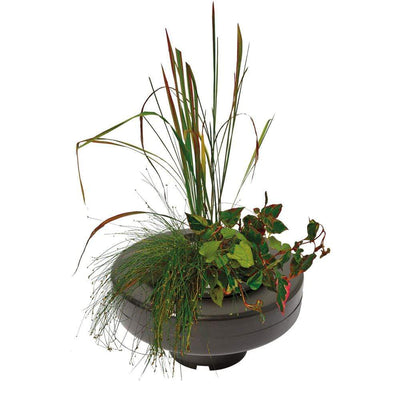
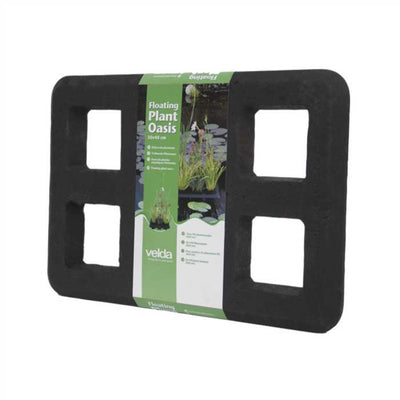
A round Superfish floating basket can serve as a starting point for an isolated planting. A multi-location support meets another desire: to create a small group and be able to work on the pots. The choice is made according to the project, not solely according to the visible surface of the floater.

The Floating Plant Oasis illustrates this second approach. To compare the formats, consult the floating baskets for aquatic plants. If the load capacity is not indicated on a sheet, ask for confirmation instead of deducing a capacity from the diameter alone.
Install the plant without unnecessarily disturbing the water
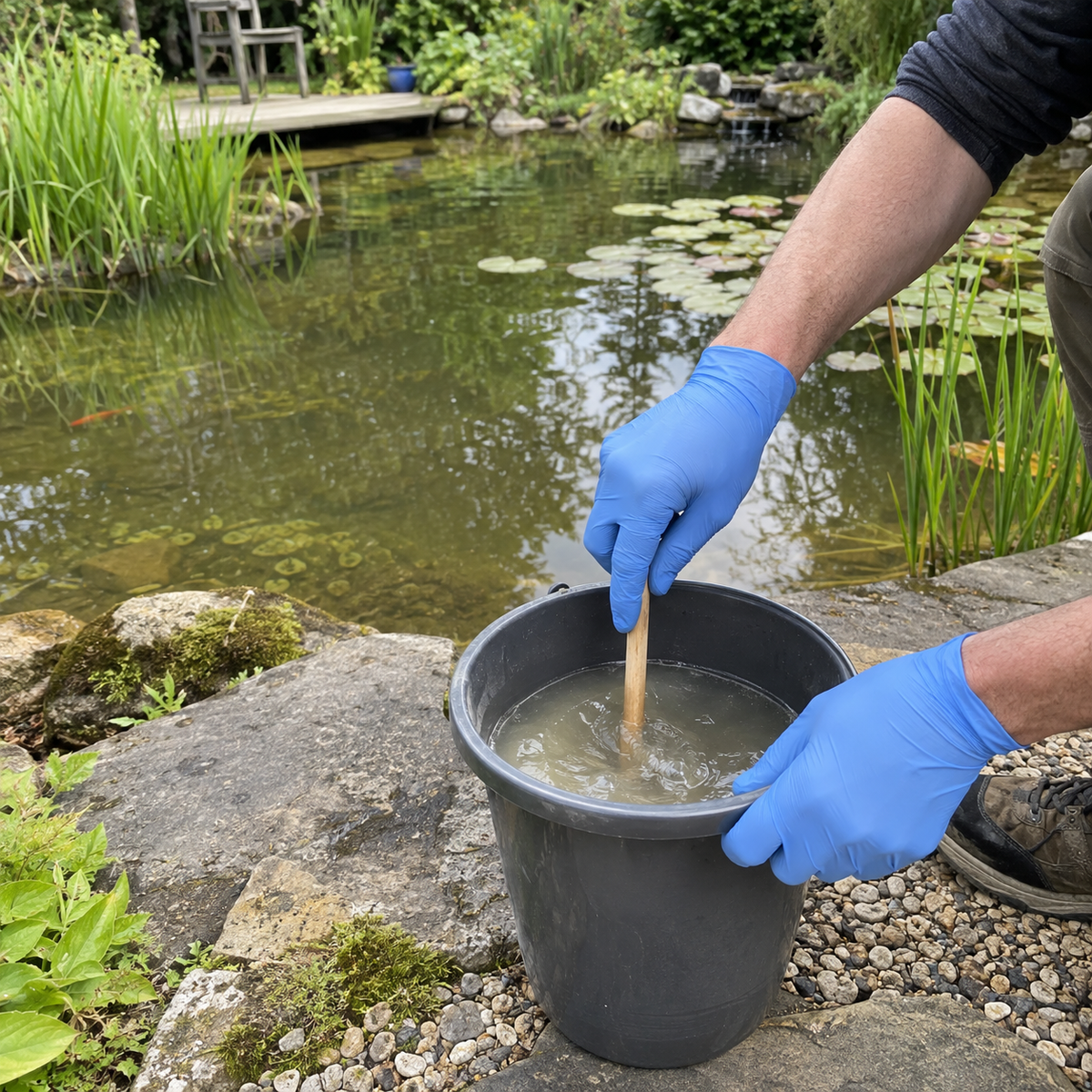
Prepare the assembly at the edge of the pond, on a clean surface. Identify the instructions for the exact model. Velda recommends, for its Floating Plant Island, planting with pond soil, a moistened root ball, and a covering of gravel or substrate. This method concerns this product; it should not be automatically transposed to all floating supports.
Use materials intended for aquatic use and respect the recommended quantities. Adding a lot of gravel "so that it holds better" also weighs down the whole. The goal is to obtain a properly supported planting, with the water level adapted to the plant once the support is in place.
Put the basket in the water within reach and observe it before letting it drift away. It must remain horizontal, without the crown being drowned by an excessive load. In case of imbalance, redo the assembly according to the instructions. Do not compensate randomly by tying a large stone under the device.
Where to place the basket in the pond?
Choose an area that allows you to enjoy the planting and access it easily. Take into account the current created by the waterfall, the skimmer suction, and the variations in water level. Observe the path of the support during the normal operation of the equipment: a calm place with the pump off can become less favorable later.
If positioning is necessary, use a solution compatible with the support and the pond. Preserve access to the equipment and avoid any assembly that could get caught in a suction. The device must also be able to be retrieved without entering the water or leaning dangerously.
Maintain the planting and prepare for the next season
During the first weeks, look especially at the stability, the condition of the leaves, and the position of the root ball. A plant struggling to recover requires a diagnosis: unsuitable depth, exposure, root damage, or another problem. Adding fertilizer without understanding the cause is not a systematic answer.
As it grows, remove accessible dead parts and check for overcrowding. Plan for a division or a change of container when the clump becomes disproportionate. For winter, consult the indications regarding the species and the floater. The hardiness of a plant grown in the ground is not enough to describe all the constraints of an exposed small container.
Does a floating basket replace a filter?
A decorative planting does not allow, on its own, to size the purification of a fish pond. Keep the questions separate: what plant to grow, what load the support accepts, and how the pond water is maintained. If your main goal is to solve green water or a water quality problem, start by measuring and understanding this problem.
Frequently asked questions
What plant to put in a floating basket?
A marsh plant that can tolerate having its roots in the water permanently, such as marsh marigold, brookspeedwell, or marsh speedwell, chosen according to the size of the basket and the exposure.
Can a floating basket sink?
It can tip or sink if the planting becomes too heavy. Respect the instructions of the support, limit the gravel, and divide the clump when it grows.
Should the floating basket be brought in for winter?
It depends on the hardiness of the plant and the instructions of the floater manufacturer. Check both separately before frosts.
Is a floating basket enough to purify the pond?
No. It provides vegetation, but does not replace a filtration system sized for a fish pond.
Sources and references
- Natagora — Les plantes de la mare (2021): presentation of marsh speedwell among the low plants of damp soils.
- Velda — Floating Plant Island: principle of the support and planting method specific to this model.
- Royal Horticultural Society — Caltha palustris: growth habit, flowering, and growing environment of marsh marigold.
- Royal Horticultural Society — Aquatic veronicas: needs and vigor of brookspeedwell.