
To properly size your aeration, start with the airflow available at installation depth, the number of diffusers, and the pond's needs. Water volume helps describe the project, but is not enough to choose a pump. The volume ranges presented below are general guidelines that should be validated; they do not constitute a sizing applicable to every pond.
Aeration can support oxygenation and certain biological processes. However, it does not guarantee the disappearance of algae, the elimination of all undesirable substances, or always clear water. A correctly chosen pump must work with the filtration, maintenance, and the pond's population.
The four pieces of information to gather first
- The pond volume and the planned depth for each diffuser.
- The fish present, their size, and the planned evolution of the population.
- The length of the air network, its diameter, and the number of outlets.
- The objective: pond aeration, feeding a biological filter, or another specific use.
This information allows you to compare complete sets. Two pumps advertising the same flow can give different results when they are connected to pipes and diffusers placed at different depths. Ask for the performance in your configuration, and not just the maximum value.
Aeration is a crucial component for maintaining the health and ecological balance of your garden pond. A quality air pump not only ensures good oxygenation of the water, but it also helps prevent the accumulation of toxins, promotes the decomposition of organic matter, and supports aquatic life.
In this article, we will explore in depth how to choose the air pump suited to your pond, by providing you with expert advice and highlighting the benefits of pumps.
Why is an air pump essential for your pond?
Water oxygenation
Dissolved oxygen is vital for the fish, plants, and microorganisms in your pond. An air pump ensures a constant supply of oxygen, thus promoting a healthy and balanced environment.
Prevention of water problems
A good level of oxygen helps prevent common problems such as bad odors, filamentous algae, and the accumulation of toxins. By promoting water circulation, an air pump prevents stagnation and the formation of anaerobic zones (without oxygen).
Support for waste decomposition
Beneficial bacteria that decompose organic matter in your pond need oxygen to work effectively. Good aeration stimulates their activity, helping to maintain clear and healthy water.
How to choose the air pump suited to your pond?
Assess the size of your pond
The size of your pond is the first criterion to consider. The larger the pond, the more you will need a powerful pump to ensure good water circulation and adequate oxygenation.
Calculation of the required power- For small ponds (<500 liters): a pump of 10-20 liters per minute (LPM) is generally sufficient.
- For medium ponds (500-5000 liters): a pump of 20-50 LPM is recommended.
- For large ponds (>5000 liters): a pump of 50-100 LPM or more may be necessary.
Consider the depth of the pond
The depth of the pond also influences the choice of the pump. Pumps must be able to push the air through the water column to the bottom of the pond for maximum efficiency. Make sure to choose a pump that can handle the depth of your pond without losing power.
Assess the specific needs of your ecosystem
Oxygen needs vary depending on the species of fish, plants, and microorganisms present in your pond. Ponds with a large fish population or sensitive species may require more intensive aeration.
Take the noise level into account
Some air pumps can be noisy, which can be disturbing if your pond is located near relaxation areas or the house. SECOH air pumps, for example, are renowned for their quiet operation, which makes them ideal for residential environments.
Check the energy consumption
Energy consumption is another important factor to consider, especially if you use the pump continuously. Opt for energy-efficient models that offer a good balance between performance and operating cost.
Why choose a SECOH air pump?
Reliability and durability
SECOH air pumps are recognized for their exceptional reliability and durability. Designed with high-quality materials, they resist outdoor conditions and environmental fluctuations.
Quiet operation
SECOH pumps are among the quietest on the market, thanks to advanced technology that minimizes vibrations and noise. This makes them an ideal choice for ponds located near living areas.
Energy efficiency
SECOH pumps are designed to be energy-efficient, thus reducing your electricity consumption while ensuring optimal aeration of your pond.
Ease of maintenance
SECOH pumps are easy to install and maintain. They require little maintenance, allowing you to spend more time enjoying your pond rather than managing the equipment.
To complete this advice, do not hesitate to watch our explanatory video on YouTube where we detail each step to choose the ideal air pump for your pond. Click below to watch the video:
Choosing the right air pump for your pond is crucial to maintain a healthy and balanced aquatic ecosystem. By assessing the size and depth of your pond, the specific needs of your ecosystem, you can make an informed choice. SECOH air pumps stand out for their reliability, quiet operation, energy efficiency, and ease of maintenance, making them an excellent choice for any type of pond.
Don't forget to share this article and subscribe to our YouTube channel so you don't miss any of our expert advice!
Read the flow at the actual depth
A technical sheet may express the flow in liters per hour or liters per minute. To compare, put the values in the same unit: 1,200 l/h correspond to 20 l/min. This conversion does not yet provide information about the pressure at which the flow is provided.
OASE gives, for the AquaOxy 5000, distinct values depending on the depth: 90 l/min at 0.5 m, 80 l/min at 1 m, and 70 l/min at 1.5 m. This example illustrates the benefit of a detailed sheet. You should not apply these figures to another model, even if its maximum flow seems close.
When you ask for advice, indicate the installation depth of the diffuser rather than just the maximum depth of the pond. If several diffusers are installed at different levels, describe each one. The network must be designed for this distribution.
Match the pump, the hose, and the diffusers
The diffuser is part of the choice. Check the flow it accepts, its connections, and the maintenance conditions. Adding outlets does not create additional flow: you must distribute the available flow while respecting the operation intended by the manufacturer.
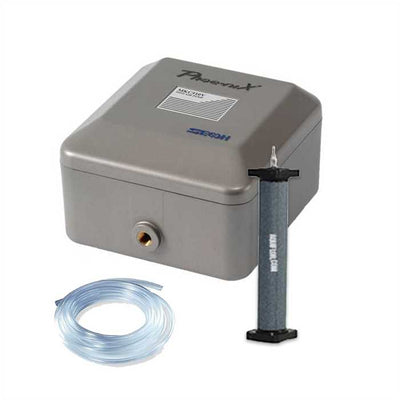
Also compare the length of the hose provided with the distance actually required. A kit can be convenient, but its contents must match your pond. Think about the complete path from the pump location to the diffuser, while keeping an accessible installation.

The Secoh aeration kit offered on Aquishop exists with several configurations of diffusers and hose. Compare the selected variant with the desired setup. The volume range announced on a commercial sheet does not exempt you from checking the actual conditions.
Install the pump in a suitable place
Weather resistance does not mean that the device can be submerged or placed in a flood zone. BIBUS describes, for example, the JDK-S 150 to 250 models for outdoor use in a protected location. The instructions of your model remain the reference for installation.
Provide a stable support and the necessary space for the controls. Do not try to reduce the noise by enclosing the pump in an improvised box that would prevent its ventilation. Also see if the vibrations are transmitted to a wall or a light support: the quality of the installation influences the perceived comfort.
Check in the manual the position to respect relative to the water and the protections against water return. The electrical connections must suit the outdoor environment. Keep the documentation with the precise reference of the pump.
What bubbles allow you to see, and what they do not measure
Bubbles show that an airflow is reaching the diffuser. They do not directly give the concentration of dissolved oxygen. To assess this concentration, you need a suitable measurement, performed correctly and put back into its context.
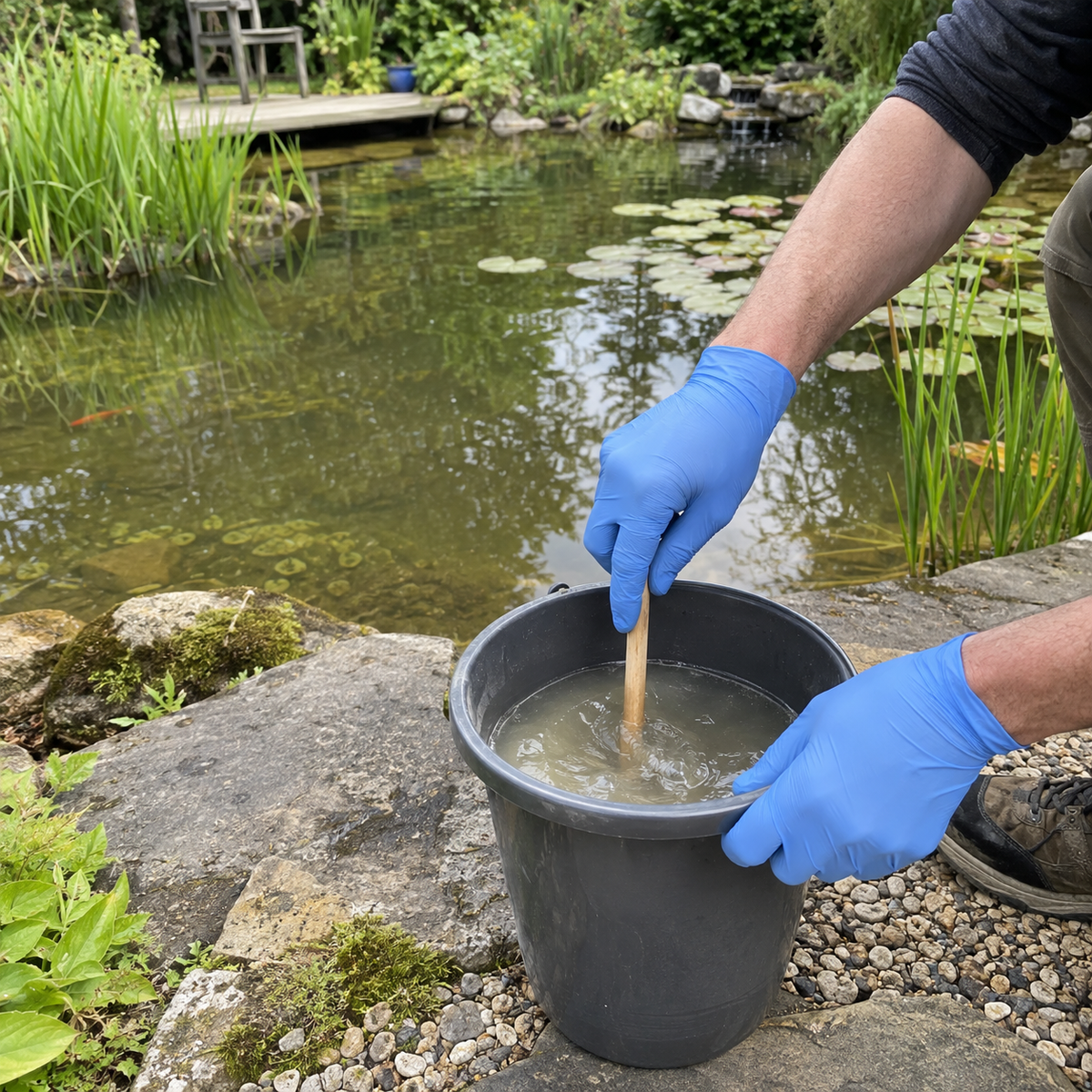
UF/IFAS explains that oxygen varies with exchanges, photosynthesis, and the respiration of organisms. The variations between day and night count, especially in waters rich in algae. An isolated reading in the middle of the afternoon therefore does not describe all the conditions encountered by the fish.
The same organization reminds that stirring can put sediments back into suspension and that starting aeration in a deep and stratified body of water requires precautions. For such a pond, have the installation and commissioning prepared by a specialist rather than immediately lowering all the diffusers to the bottom.
Prepare a simple maintenance to follow
Keep a photo of the installation and note the usual behavior of each outlet. If a diffuser produces significantly fewer bubbles, examine the circuit according to the manual: pinched hose, connection, diffuser, or need for pump maintenance are paths to distinguish.
The membranes and some other components are wear parts. BIBUS offers maintenance kits specific to the Secoh series. The choice must be made from the exact model and its version; a similar part is not proof of compatibility.

To compare solutions, consult the Aquishop aeration equipment with the measurements of your pond. A photo of the existing network, the pump model, and the depth of the diffusers will allow to guide the advice more precisely than a simple number of liters.
Calculate the cost over one year
The electricity consumption deserves a simple calculation. A 15 W device used continuously for 365 days theoretically consumes about 131.4 kWh. Multiply this energy by your kilowatt-hour price.
This calculation assumes a constant power and continuous operation. It does not pre-judge the times suited to your pond. The risk periods, especially at night and in hot weather, must guide the operation.
Add to the price of the pump the hoses, diffusers, manifolds, and necessary maintenance parts. A cheaper model at purchase can become less interesting if the installation requires many additional accessories.
Finally, compare the availability of membranes, the air filter, and replacement diffusers. The possibility of maintaining the equipment counts for a device intended to work for a long time.
Alarm, backup, and monitoring: according to the pond's needs
An alarm can signal a particular technical fault, but it does not necessarily measure the oxygen of the pond. Check what it detects: pressure, temperature, or other condition.
In a very populated pond or containing demanding fish, prepare the course of action in case of failure or power outage. The backup equipment must be suited to the autonomy and the flow required.
After installation, check the water during representative periods and observe the fish. A change in population or feeding justifies re-examining the equipment.
The presence of bubbles confirms an air circulation at that location. It is not enough to conclude that all areas of the pond have satisfactory oxygen.
The fish and their feeding
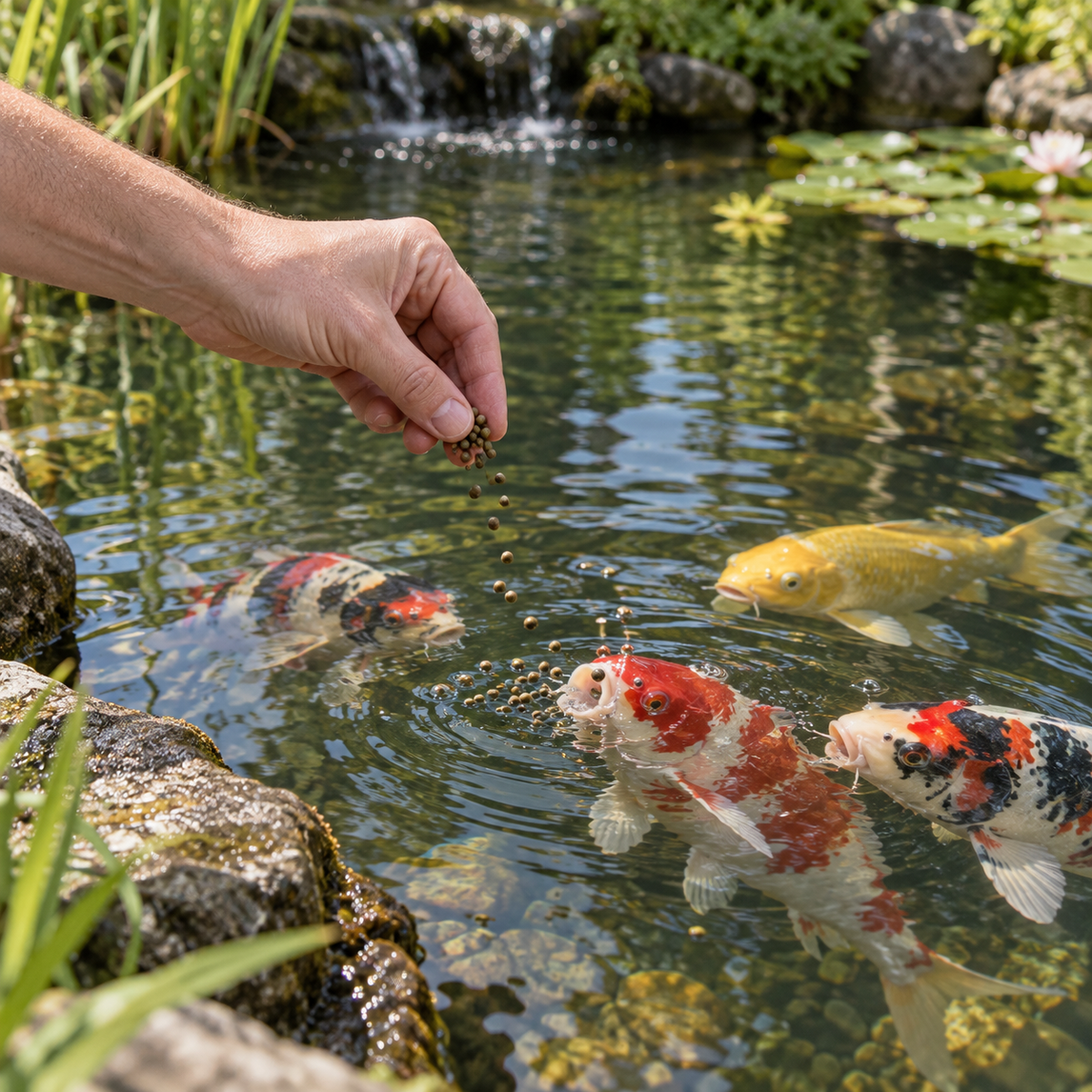
List the species, their number, and their approximate size. A group of large koi does not represent the same load as a handful of small goldfish.
Sturgeons require special attention to oxygenation. OATA highlights that they do not thrive in slow, poorly oxygenated, and nutrient-loaded water. However, the choice of an aerator does not compensate for a pond unsuitable for their adult size.
Also note the quantity of food distributed in season. It helps to describe the activity of the pond and the waste that the filtration must treat. An increase in feeding or the arrival of new fish can justify a new evaluation of the installation.
The situations where aeration becomes a priority
Fish that breathe quickly or gather at a water inlet require immediately checking the existing aeration and circulation. Lack of oxygen is an important hypothesis, but other problems, including nitrites, can produce similar signs.
Maintain or reinforce a safe aeration, temporarily stop feeding in a distress situation, and check the water. If the signs persist or if several fish are affected, quickly ask for the help of a specialist or a veterinarian competent in fish.
A kit ordered for later does not constitute an answer to a present emergency. First check the available devices, the disconnected hoses, and the clogged diffusers.
Sources and references
- OASE — AquaOxy 5000: example of flows announced at different depths.
- BIBUS — Secoh JDK-S 150 to 250: protected installation conditions and maintenance possibilities specific to this series.
- University of Florida, IFAS — What you need to know about aeration: effects and limits of aeration, oxygen variations, and precautions for stratified bodies of water.
- OASE — AquaOxy 1000: flow, consumption, and kit contents.
- OASE — AquaOxy 2500: maximum flow and box.
- USGS — Dissolved oxygen and water: oxygen availability.
- University of Maryland — Basics of Pond Aeration: configuration and needs.
- BIBUS — SECOH JDK-AL: installation, back pressure, and maintenance.
- Penn State Extension — Dissolved oxygen in ponds: temperature, daily cycle, and measurements.
- University of Georgia — Oxygen Depletion in Ponds: deficiency situations and aeration.
- OATA — Pond fish care: species needs and maintenance.