
The short answer: a large pond lacks oxygen above all else at the bottom, where sludge decomposes and the water no longer mixes in summer. Three solutions exist: aeration by diffusers placed on the bottom and powered by a compressor, discreet and economical; the hydro-ejector such as the Aquasub, which injects micro-bubbles into a powerful water current and stirs large masses of water; and the floating fountain, which oxygenates the surface with a decorative effect. For a deep lake or pond, stirring and bottom aeration are often combined.
Key points
- In summer, the water in a deep pond stratifies: the bottom becomes depleted of oxygen.
- Bottom diffusers bring deep water up without visible noise.
- The Aquasub hydro-ejector oxygenates and stirs at the same time; the data sheet indicates 0.35 kg of O₂ per hour.
- The floating fountain oxygenates the surface and beautifies the body of water.
- Hot and stormy nights are the times of risk.
Why does a large pond lack oxygen?
In a calm and deep body of water, summer creates two layers that no longer mix: a warm, lit, and oxygenated surface layer, and a colder deep layer, sheltered from light and wind. This is stratification. At the bottom, the sludge decomposes and consumes the available oxygen, without the surface being able to replenish it. Deprived of oxygen, the sludge releases phosphates and foul-smelling gases. These nutrients then rise and feed suspended algae.
The danger appears when stratification is abruptly broken, for example during a thunderstorm or a cold gust of wind: the oxygen-poor water from the bottom suddenly mixes with the entire mass of water. At night, when plants and algae also consume oxygen, the level can drop to the point of causing fish mortality. Aerating a large pond therefore prevents this stratification and maintains oxygen throughout the entire water column.
Solution 1: bottom diffusers
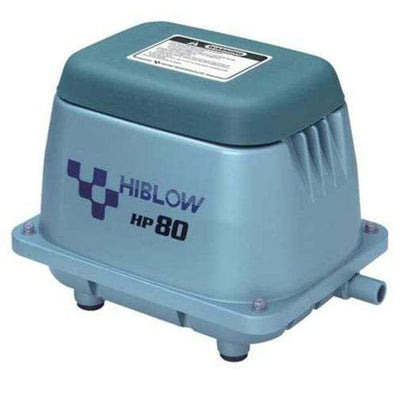
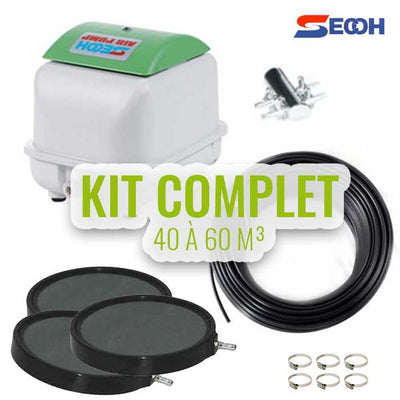
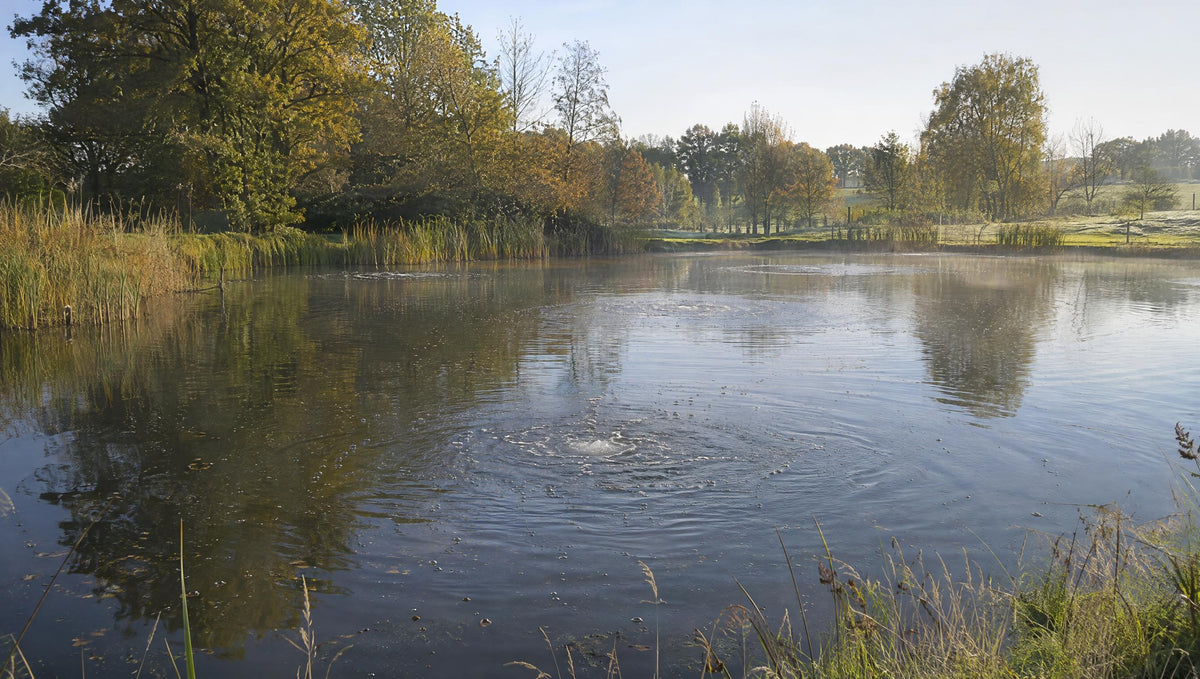
A compressor installed on the bank sends air through weighted pipes down to diffusers placed on the bottom. The bubbles rise, pulling deep water toward the surface, where it recharges with oxygen: the entire water column slowly gets into motion. This is the most discreet and often the most economical solution for deep ponds. For large bodies of water, a compressor like the HiBlow HP-80 powers several diffusers distributed in the deepest areas. For a 40 to 60 m³ pond, the Secoh aeration kit no. 4 combines a pump, diffusers, and hose.
Solution 2: the Aquasub hydro-ejector
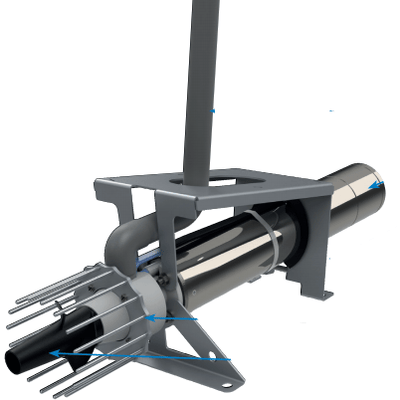
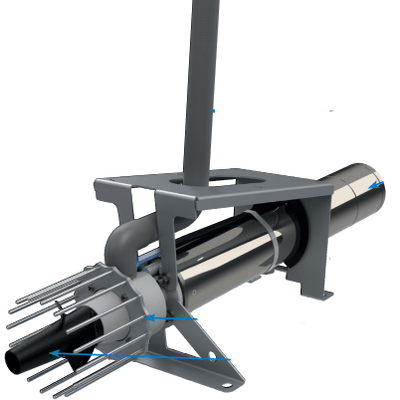
The Aquasub from Aquitechnics combines aeration and stirring in a single device. A turbine spins at 3,000 revolutions per minute at the end of the drive shaft; the air arrives through a guide tube and is sucked into the center of the propeller by the Venturi effect. Mixed with water, it is diffused as micro-bubbles in a current directed toward the bottom. These micro-bubbles remain for a long time in the pushed volume of water, hence a significant oxygen transfer: the data sheet indicates 0.35 kg of oxygen per hour.
The Aquasub stirs and mixes water masses, de-stratifies lakes and ponds, and can be converted into a simple stirrer. It requires no special maintenance (no lubrication, self-cleaning screen), is relatively quiet with an optional silencer, and is fixed on a 120 kg concrete block offered as an option. It is available in 3 HP, single-phase or three-phase, and in 5 HP for larger bodies of water. According to the manufacturer, the oxygenated current also limits the development of phytoplankton and promotes the degradation of organic matter by aerobic bacteria. In winter, it can keep part of the body of water open.


Solution 3: the floating fountain
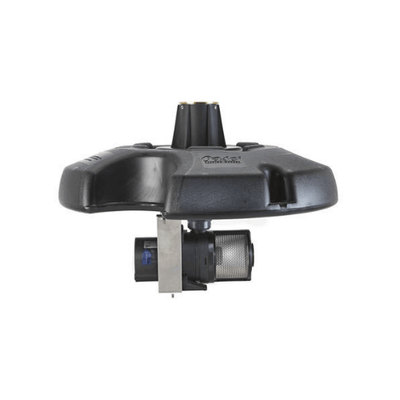
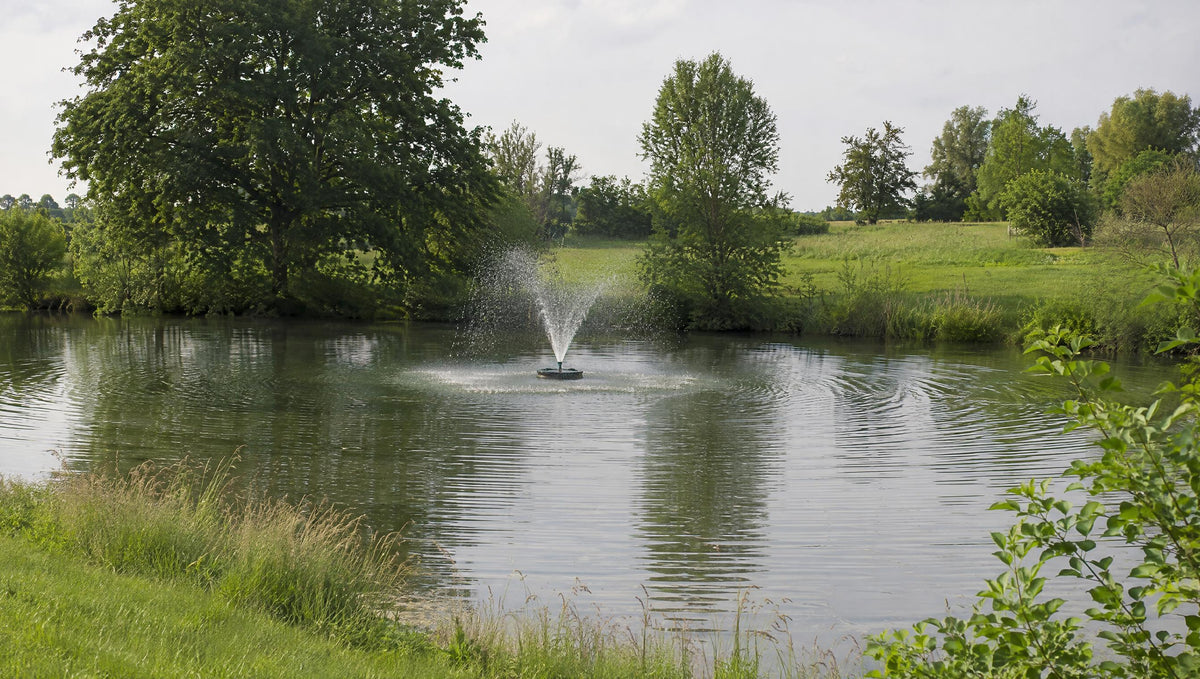
A floating fountain like the Oase PondJet Eco draws water from under the surface and shoots it into the air: falling back as droplets, it becomes charged with oxygen. Its jet rises up to 3 m, and it is installed in a pond at least 1 m deep in clear water (1.5 m on a sludge bottom). It is the most visible and decorative solution. It acts mainly on the top layer: in a deep pond, it is ideally combined with bottom aeration.
Which solution for which body of water?
| Body of water | Main solution | As a complement |
|---|---|---|
| Deep garden pond | Bottom diffusers | Floating fountain for enjoyment |
| Fishing pond, high fish density | Aquasub hydro-ejector | Diffusers in the pits |
| Private lake, large body of water | Aquasub 3 or 5 HP | Bacteria and minerals (Clean-Lac) |
| Shallow ornamental pond | Floating fountain | Bank plants |
The workshop's advice: on a large body of water, aeration and biological treatment complement each other. Oxygen allows bacteria to break down sludge; bacteria like Bactovase or a mineral and bacterial treatment like Clean-Lac work much better in aerated water. Think of both together.
How to install a hydro-ejector?
- Choose the location: a sufficiently deep area, from where the current can sweep the largest part of the body of water.
- Plan for the fixation: the stand-mounted version is placed on the bottom, ideally on a concrete block, so that the device remains stable and well oriented.
- Run the underwater cable provided to an electrical box on the bank, connected by an electrician with the appropriate protections.
- Orient the current toward the area to be stirred, avoiding directly stirring up thick sludge at startup.
- Start up gradually at the beginning of the season, before the strong heat, rather than in an emergency in the middle of summer.
Do not abruptly start a highly stratified pond in the middle of summer: mixing a large mass of deep water devoid of oxygen at once can cause the oxygen of the entire pond to drop. Start with short periods, preferably during the day, and increase gradually. The ideal remains to start aeration in spring, before stratification sets in.
An example: a 3,000 m² fishing pond
Let's take a 3,000 m² fishing pond, 2.5 m deep in the center, well populated with carp and tench. Every summer, after a few days of heat, the fish come to breathe at the surface in the early morning. The chosen plan: a 3 HP Aquasub hydro-ejector fixed on a concrete block in the deepest part, oriented to circulate the water over the entire length of the pond, and two additional diffusers powered by a compressor in a distant pit. Aeration starts in spring, when the water warms up, and runs continuously during the warm months. We complete with a supply of bacteria against sludge and monitor the behavior of the fish after each thunderstorm.
Signs of an oxygen deficiency
- Fish coming to breathe at the surface, especially early in the morning.
- Rotten egg smell when stirring the bottom.
- Water that suddenly changes color after a thunderstorm.
- Apathetic fish or grouping near water inlets and waterfalls.
At the slightest of these signs, immediately reinforce aeration and reduce or stop feeding.
Frequently asked questions
What is pond stratification?
In summer, the water of a deep pond separates into a warm and oxygenated surface layer and a cold deep layer that becomes depleted of oxygen, without mixing.
How does an Aquasub hydro-ejector work?
A 3,000 rpm turbine draws air by the Venturi effect and diffuses it as micro-bubbles in a water current directed toward the bottom. The data sheet indicates a transfer of 0.35 kg of oxygen per hour.
Is a fountain enough to aerate a large pond?
It oxygenates mainly the surface. In a deep pond, it is combined with bottom aeration by diffusers or with a hydro-ejector.
When should you aerate the most?
During warm periods, stormy nights and at the end of the night, when the oxygen in the water is at its lowest.
Written by the Aquiflor team, a store specializing in ponds and lakes in Nodebais (Belgium), an official Oase repair workshop. Updated in November 2026. Features: Aquitechnics, Oase, HiBlow and Secoh product data sheets.
Do you manage a large pond, a fishing pond or a private lake? Send us its surface, its depth and a few photos to support@aquiflor.com or call 010 86 03 54: we will offer you a suitable aeration solution.