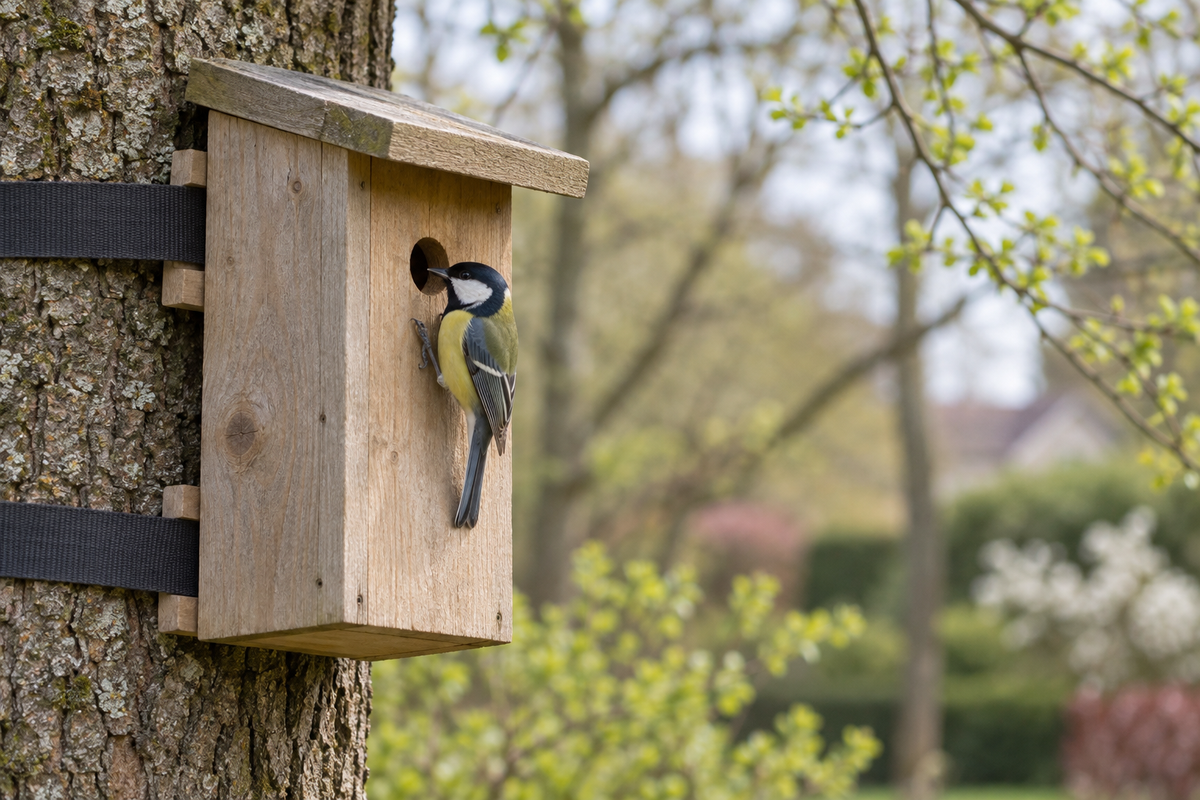
You have spotted the tits in the hedge and found a place to install a nest box for them. One very practical question remains: which way should the entrance face? In Belgium, an opening facing east, north-east, or south-east generally provides a good starting point, which can then be adapted to your terrain.
Proper orientation primarily provides protection from prevailing rain and intense sun. It must go hand in hand with stable mounting, unobstructed access, and a nest box suited to the species. A compass direction alone is not enough.

East, north-east, or south-east: how to choose?
The Natagora fact sheet recommends these orientations to avoid, in particular, exposure to wind and rain that frequently comes from the south-west. However, look at the conditions around your house: a wall, a landform, or a line of trees can change the local exposure.
Walk around the garden after a rainy, windy day. The wettest sides will give you a useful indication. Also observe the shadows at different times: a wall that is clear in winter can become scorching during spring and summer days.
When choosing between two locations, prioritize the one that combines shelter and tranquility. A side exposed to runoff from a roof will be less attractive than a slightly different nearby location that remains dry. Water should not reach the entrance directly.
Morning sun and afternoon heat
Moderate morning light can be suitable, whereas prolonged exposure to intense sun poses a problem of overheating. Evaluate the nest box as it will be during the nesting period, when the days are longer.
The material of the support also counts in your observation: a light-colored facade, a dark wall, and a trunk surrounded by foliage do not create the same environment. Do not choose a spot just because it looks pretty from the terrace.
Are you hesitating between a tree and a garden shed? Take a photo of both locations in the morning and then in the afternoon. This quick survey allows you to compare sunlight and obstacles without buying multiple nest boxes to experiment.
At what height should a tit nest box be fixed?
For a small nest box with a flight hole, an installation height of around two to three meters is often a practical reference, to be adjusted according to the model and the site. The BTO indicates a range of one to three meters for this type of nest box on a trunk.
Above all, the height must make access difficult for predators while still allowing for safe maintenance. A nest box placed too high, and inaccessible without dangerous intervention, risks never being monitored.
Spot neighboring supports: a horizontal branch, a low wall, or the roof of an outbuilding can facilitate a cat's approach. Conversely, do not block the birds' flight path with dense foliage right in front of the entrance.
Prepare the installation from a stable support and with the appropriate equipment. If the location requires working in an insecure position, choose another area or have the installation done by someone else.
What entrance diameter for which tit?
Not all tits use the exact same type of entrance. The diameter helps select possible occupants, without guaranteeing that a pair will move in.
| Target species | Indicative diameter according to Natagora | Keep in mind |
|---|---|---|
| Blue tit | 28 mm | A small entrance limits access to larger birds. |
| Great tit | 32 mm | The internal volume must also be adapted. |
Measure the actual hole or ask the seller for this information. The external dimensions of the nest box do not provide information about its opening, its internal volume, or the thickness of the walls.
Avoid enlarging an entrance yourself at random. You could change the purpose of the nest box, weaken its facade, or create sharp edges. If you are building a model, start from a naturalistic plan corresponding to the targeted species.
A functional nest box, down to the details
Choose an insulating material and a construction that withstands bad weather. The BTO recommends, among other things, wood walls at least fifteen millimeters thick; Natagora plans favor thicker, unfinished wood. A very thin wall does not offer the same qualities.
The roof must protect the box, and the cleaning opening must be able to close properly. A perch placed under the hole is not necessary for tits and can facilitate access for a predator.
On Aquishop, the Iris 1 birdhouse is presented as a wooden model measuring 19 × 22 × 26.5 cm. Before choosing it for tits, have the entrance diameter, wood thickness, and cleaning access confirmed: these characteristics are not detailed in its current product sheet.

Fixing the nest box without letting it sway
The support must remain stable in the wind. On a tree, use an appropriate fixture that preserves the bark and can be checked as the tree grows. Spacers allow you to prevent the box from pressing directly against the trunk.
Check the fasteners regularly, without intervening while the box is occupied. A fixture forgotten for several years can loosen or compress the trunk. Note its inspection in your autumn maintenance routine.
Place the facade vertically or with a slight forward tilt to limit rain from entering. Avoid tilting the nest box backward. On a wall, adapt the fasteners to the support and ensure that no water runoff falls onto the box.
When to install the nest box?
Autumn and early winter allow you to prepare the installation before the breeding season. The nest box can be spotted in advance and serve as a shelter depending on the circumstances.
If you install it later, observe the surroundings and the birds already present first. Once materials are brought into a cavity, leave the occupants alone: it is no longer the time to change the orientation to improve the view from the house.
A nest box that remains vacant for the first season is not necessarily poorly installed. Garden resources, nearby cavities, and bird territories also play a role. Keep notes before concluding that everything needs to be moved.
Keep a distance from the feeder
The feeding area attracts visitors and activity. The BTO advises keeping it away from nest boxes to preserve the tranquility of the pairs. Therefore, avoid bringing the feeder, birdbath, and nest box together on the same small support.
In a compact garden, draw three possible locations on a simple plan. You can reserve the quietest corner for the nest box and keep accessories that need cleaning near a convenient access point.
Several identical boxes packed close to one another do not guarantee more tits. Allow space between nest boxes intended for the same species and ask for advice if you wish to equip a large piece of land.
Cleaning in autumn, after inspection
Natagora recommends removing the old nest and cleaning with hot water in autumn. Before any intervention, ensure that the nest box is no longer occupied: birds or small mammals may still be sheltering there.
Let it dry, check the roof and the fasteners, then close it properly. Do not apply toxic or repellent products inside. If you discover an occupant, postpone maintenance and seek advice if in doubt.
To choose your equipment, check the Iris 1 product sheet and have the specifications confirmed to match the tits you are observing. A good nest box starts with a few measurements and a well-thought-out location.
Sources and references
- Natagora — Practical fact sheet: bird nest boxes.
- BTO — Putting up a nest box.
- BTO — Choosing a nest box.
- Natagora — When to clean nest boxes?.
- Iris 1 Aquishop product sheet linked in the article.