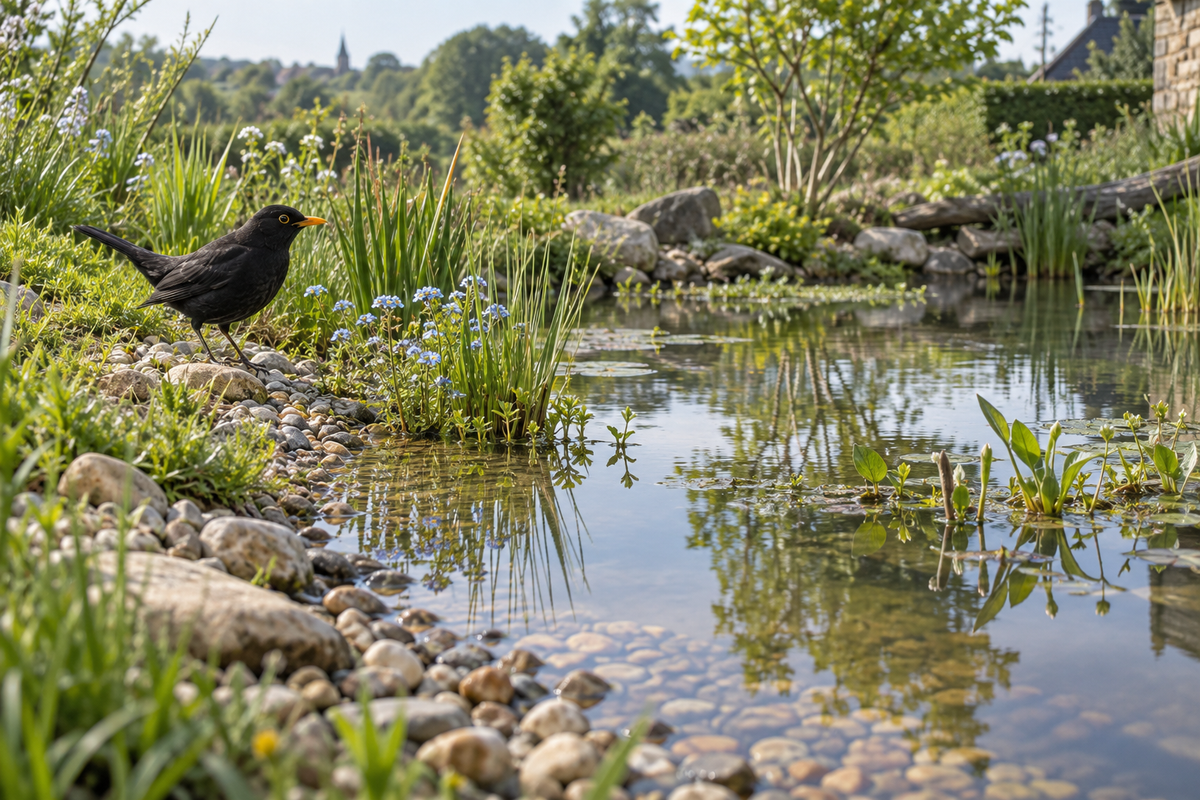
The pond has just been filled. The plants are still small and the edges look a bit bare. Then a blackbird comes down to drink, an insect glides across the surface, or a dragonfly swoops by. These first visitors change the way you look at the garden: you stop for a few minutes to see what’s happening.
After creating a water feature, life can arrive spontaneously, but it does not follow a fixed schedule. The season, surrounding habitats, and the layout matter more than a number of weeks. Here is what you can observe and how to support this setup without trying to rush everything.

Every water feature offers something different
A birdbath, a planted basin, and a pond of several square meters do not serve exactly the same functions. The first provides access to water for drinking and bathing. The second adds a small aquatic habitat. The pond allows for more variety in depth, plants, and refuges.
Start by clarifying your goals: observing birds from the window, growing a few aquatic plants, welcoming local wildlife, or keeping fish. These projects can coexist in a garden, but their equipment and maintenance differ.
Small size does not make a feature any less interesting. However, it requires choosing proportional plants, monitoring the water level more closely, and providing suitable access. A tall container with smooth sides does not become welcoming simply because it contains water.
The first days: observe and check access points
At first, your main task is to check the installation. Are the stones stable? Is there still a ramp leading to the water? Has a plant fallen over after filling? Is the level dropping unusually? Make these checks before adding decor or moving the baskets again.
Insects may visit the site quickly. The RHS cites water striders and aquatic beetles among the animals likely to arrive in the first few days or weeks. An isolated garden or an installation completed in the cold season will have a different evolution: the absence of immediately visible visitors is not a failure.
On a small, shallow area, a few protruding stones offer perches. Check their stability by hand without creating a stack that could tip over. Also, keep a part clear to see the water level and intervene easily if necessary.
The first weeks: visits becoming familiar
Birds come to drink and preen their feathers
A blackbird, a sparrow, or a tit may spot the water feature and use it regularly. Bathing helps with feather maintenance. For these visitors, a very shallow and accessible area is more interesting than a great depth bordered by vertical walls.
If you install a separate birdbath, place it in a spot where the birds can see danger approaching. The RSPB recommends a shallow, stable container with gradual edges. Avoid tucking it against a spot that provides immediate cover for a cat.
Maintenance is specific: the RSPB recommends refreshing the water daily, then cleaning and disinfecting the container weekly according to their guidelines. This routine applies to a removable birdbath. It does not involve emptying or disinfecting a living pond every week.
Dragonflies may explore the pond
A dragonfly may fly over the water, hunt, or land on a stem. Observe its behavior rather than immediately concluding that it has settled in. For some species, reproduction implies a long aquatic larval phase and conditions that must last beyond the visit of an adult.
Erect stems and aquatic vegetation offer support and refuge. Later, an empty larval skin attached to a plant, called an exuvia, can testify to an emergence on-site. Leave the insect and its support alone if the transformation is in progress.
Throughout the seasons: a pond can become a breeding ground
Frogs, toads, or newts may discover a pond if populations live nearby and movement is possible. Their arrival depends notably on the season and the garden environment. Therefore, one cannot predict "frogs by the fourth week" for every installation.
Natagora advises letting animals arrive on their own. Do not transport eggs, tadpoles, or animals from another pond. Do not add water or mud collected elsewhere with the idea of starting faster: you could introduce unwanted organisms or diseases.
The life of a pond is not limited to its surface. Animals remain discreet in the plants or on the bottom. Sit in the same spot for a few minutes, observe the movements between the stems, and compare your notes from one season to the next. You will notice more things than by systematically stirring the water with a net.
Nocturnal visitors: making exits truly usable
A hedgehog may come to drink in the garden without being spotted. A track at the water's edge, however, is not enough to identify the animal: it is better to have a clear observation or image than certainty based on a noise heard at night.
The British Hedgehog Preservation Society reminds us that hedgehogs can swim but may drown if they cannot climb out of a pond. Provide a gentle slope or a stable ramp with a surface that offers grip. For a raised container, also consider access from the outside.
Check the exit when the water level drops: a ramp that stops above the water no longer serves its purpose. A shallow, maintained, and accessible dish on the ground can complement the setup for animals visiting the garden.
Child safety should also be planned from the design stage. Low depth and a planted bank do not replace proper protection and supervision.
Plants gradually give the pond its structure
In the first few weeks, it is tempting to fill all empty spaces. Instead, take the time to read the mature dimensions. A young pot can form a large clump; a vigorous plant can take up much more space than expected.
In a pond intended for local biodiversity, choose native species adapted to your region. Vary the forms: some vertical stems, low bank vegetation, and submerged plants according to the possibilities. Natagora recommends different depths to accommodate several types of plants.
Water forget-me-not for a moist edge
The water forget-me-not offered on Aquishop can accompany a bank with its small blue flowers. The description indicates a height of about 20 cm, sun or partial shade exposure, and a flowering period generally between May and September. These benchmarks depend on growing conditions and the season.

Measure the height between the substrate surface and the water level before positioning the basket. A bank plant is not intended to be placed at the deepest point. Keep its name and description: this will facilitate adjustments and divisions when it grows.
Maintain without trying to freeze the pond in time
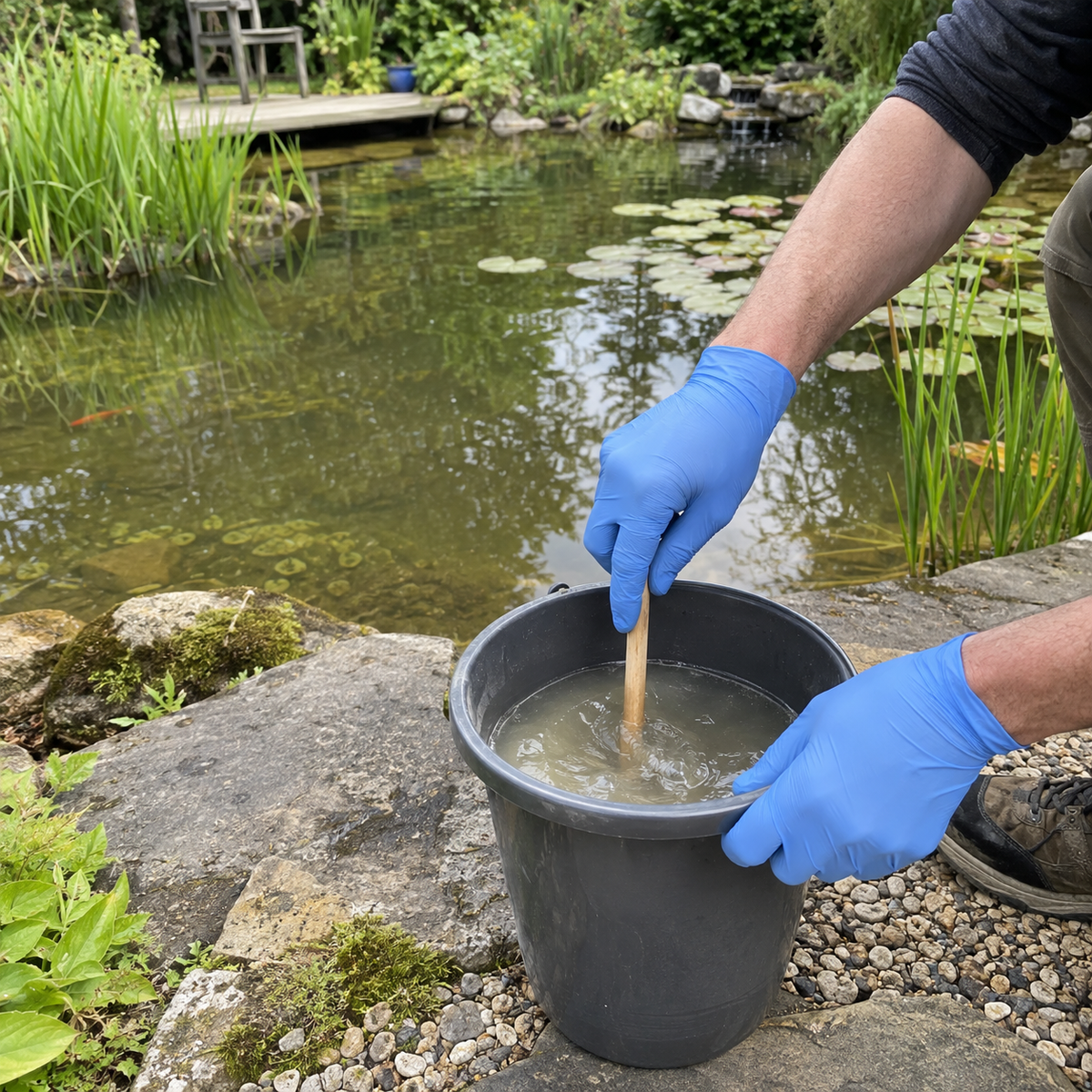
The water and plants change in appearance over time. A bit of algae or a few leaves does not automatically mean the pond is malfunctioning. Observe the evolution, the extent of the phenomenon, and any potential runoff of soil or fertilizer from the surroundings before acting.
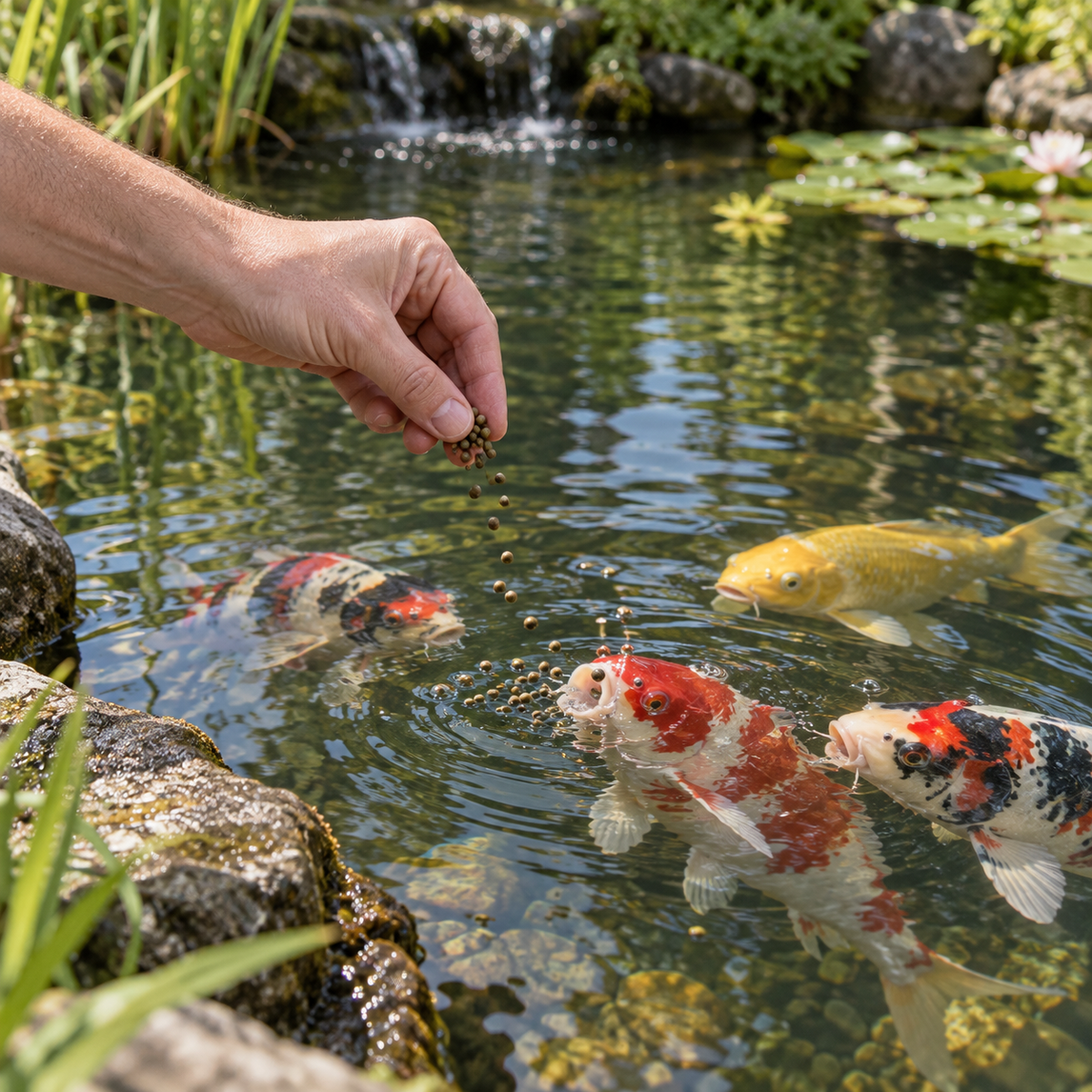
A natural pond without fish can function without a filter or pump. A fish pond requires different management, especially for waste and oxygen. If you have chosen to keep fish, their arrival must take into account the system's preparation and water results, not just the number of days since filling.
To preserve refuges, stagger your interventions. Avoid cutting all the plants or removing all the bottom sludge at once. Keep a practical access point for maintenance and leave another portion of the bank quieter.
An observation notebook rather than a calendar of promises
The draft of your garden becomes clearer with each visit. A photo taken from the same spot each month will show plant growth, water level variations, and spots used by animals. To photograph wildlife, stay at a distance and wait for them to come on their own.
You can share these images without moving an animal to place it in the frame. Ordinary scenes are already very interesting: a bird hesitating before bathing, the circles left by an insect, a stem bearing an exuvia.
- Note: date, weather, water level, and observed animals.
- Check: stability of access points, condition of plants, and absence of polluting runoff.
- Adjust: an exit, a planting, or an observation area, depending on what you notice.
The pleasure of a water feature also lies in this bit of the unexpected. Prepare an accessible environment, let it evolve, and keep time to watch it.
Start with a well-planted bank
Identify the available depths and choose plants adapted to each location. For a moist and flowered edge, check the characteristics of the water forget-me-not before composing your planting.
Sources and useful reading
- RHS — Wildlife ponds: colonization, access, and pond maintenance.
- Natagora — The natural pond: layout and spontaneous arrival of wildlife.
- RSPB — Make the perfect bird bath: bird needs and container shape.
- RSPB — Make a splash with water: bird bath hygiene.
- British Hedgehog Preservation Society — Gardening with hedgehogs: pond access and exits.
- British Dragonfly Society — Frequently asked questions: dragonfly life cycle.
- Aquishop — Water forget-me-not: characteristics of the featured plant.