Two ponds can appear equally clear while offering very different conditions for fish. In one, the parameters remain stable. In the other, the buffering capacity is depleted or nitrites appear following a filtration failure.
Understanding water chemistry means learning to read the relationships between a few measurements. You do not need to turn your garden into a laboratory. You need to know what each test describes, what it does not show, and what action can actually correct the situation.

The pond is constantly transforming what enters it
Food, leaves, top-up water, and maintenance products bring in different materials. Fish and microorganisms transform them. Plants use a portion of them, while cleaning and water changes can remove them.
Mechanical filtration traps particles that must then be removed. Biological filtration transforms certain dissolved compounds. These two functions complement each other, but they do not measure the same things and do not solve every problem.
Before searching for a perfect value, ask a simple question: what has changed? A doubled ration, a filter cleaned too vigorously, several days of heat, or a large top-up can explain a change.
pH: describing acidity, then observing its stability
pH indicates whether water is acidic, neutral, or basic. Its scale is not linear: a difference of one unit represents a significant change in hydrogen ion activity.
In a planted pond, photosynthesis and respiration can cause the pH to fluctuate throughout the day by modifying the dissolved carbon dioxide. To compare your usual results, measure under similar conditions and note the time.
If you suspect strong fluctuations, readings at different times, notably in the morning and late in the day, can help in understanding the processes. A single value does not describe this entire evolution.
Avoid correcting pH in isolation without looking at KH and ammonia compounds. Rapidly raising the pH can increase the proportion of toxic ammonia when ammoniacal nitrogen is present.
KH: understanding the buffering capacity
KH tests used in ponds give an indication of the buffering capacity associated mainly with carbonates and bicarbonates. They help monitor the water's ability to resist certain acidic variations.
This buffering capacity is not inexhaustible. Nitrification consumes alkalinity. Depending on the composition of the inputs and the operation of the pond, the KH can therefore evolve. Low-mineral rainwater can also alter the balance through dilution.
Aquipond KH+ is intended to raise this parameter when a measurement and the needs of the pond justify it. Calculate based on the actual volume and apply according to the current instructions, with successive checks.
The goal is to obtain an adapted reserve and a stable environment. Adding KH+ at fixed intervals without measuring can cause you to miss the cause of a problem or lead to an unnecessary correction.
GH: minerals, mainly calcium and magnesium
General hardness, or GH, mainly describes the presence of dissolved calcium and magnesium. It provides information on an aspect of mineralization useful to aquatic organisms.
GH and KH are linked to the water's composition but remain two distinct measurements. Water can have a relatively high buffering capacity without exhibiting an equivalent general hardness. Therefore, there is no universal rule requiring GH to always be higher than KH.
Aquipond GH+ targets the increase of general hardness. It meets a different need than KH+. Check both parameters before choosing and proceed gradually according to the product instructions.
Also measure the water used for top-ups. This helps to understand why a pond changes after repeated water replacements.
Ammonium and ammonia: read the result with pH and temperature
Nitrogenous waste from fish and the degradation of organic matter fuel ammoniacal nitrogen. In water, the balance is split between ammonium, NH4+, and unionized ammonia, NH3.
The second form is particularly concerning for fish. Its proportion increases notably with pH and temperature. The same overall measurement therefore does not represent the same risk under all conditions.
Read precisely what your test measures and the units used. Some methods indicate a concentration expressed in nitrogen, others in the compound itself. Use the manufacturer's table or competent interpretation rather than comparing figures from different methods.
In an established fish pond, the goal is to avoid detectable accumulation. If a value appears, check the feeding rate, the state of the filter, and the history before adding multiple correctors.
Nitrites and nitrates: two different stages
Nitrifying bacteria transform ammonia/ammonium into nitrites, then nitrites into nitrates. This process requires oxygen and conditions compatible with their activity.
Nitrites are undesirable in a fish pond. They can disrupt the transport of oxygen in the blood; respiratory difficulty therefore does not automatically mean that the water lacks oxygen.
Nitrates are generally less toxic than nitrites at comparable concentrations, but their accumulation should still be monitored depending on the species and the system. Nitrification does not make them disappear: it produces them.
Aquipond NitriBoost is offered for seeding with nitrifying bacteria. It does not replace either the filter's setup time or the analysis. Follow its usage conditions; it does not constitute a guarantee of immediate suppression of a nitrite spike.
Oxygen: the measurement that cannot be seen in transparency
Water contains dissolved oxygen, used by fish, bacteria, and other organisms. Plants and algae produce it in the light via photosynthesis, but respiration also continues at night.
Temperature influences the amount of oxygen that water can hold at saturation. Warm water holds less than cold water, all else being equal. Consumption related to waste and the population also counts.
A waterfall or an aerator contributes to gas exchange, without proving that the concentration is sufficient everywhere. The flow rate of an air pump, expressed in liters of air per hour, is not a measurement in milligrams of dissolved oxygen per liter of water.
In case of gasping fish, check the system quickly and ask for advice based on the severity. An on-site oxygen measurement provides information that pH or nitrite tests cannot replace.
Phosphates and organic matter: understanding the inputs
Phosphates are among the nutrients used by organisms, particularly algae and plants. A high reading suggests examining food, debris, runoff, and the quality of top-up water.
A low result does not prove the absence of all phosphorus in the pond: a portion may already be present in the biomass or deposits. Therefore, interpret the test in light of the pond's condition and maintenance.
For accessible deposits, a PondoVac 4 physically removes material. Aquipond Bactovase targets the organic component of sludge according to its instructions. Biological action does not mean that all mineral elements have left the pond.
Building a simple and reliable monitoring routine
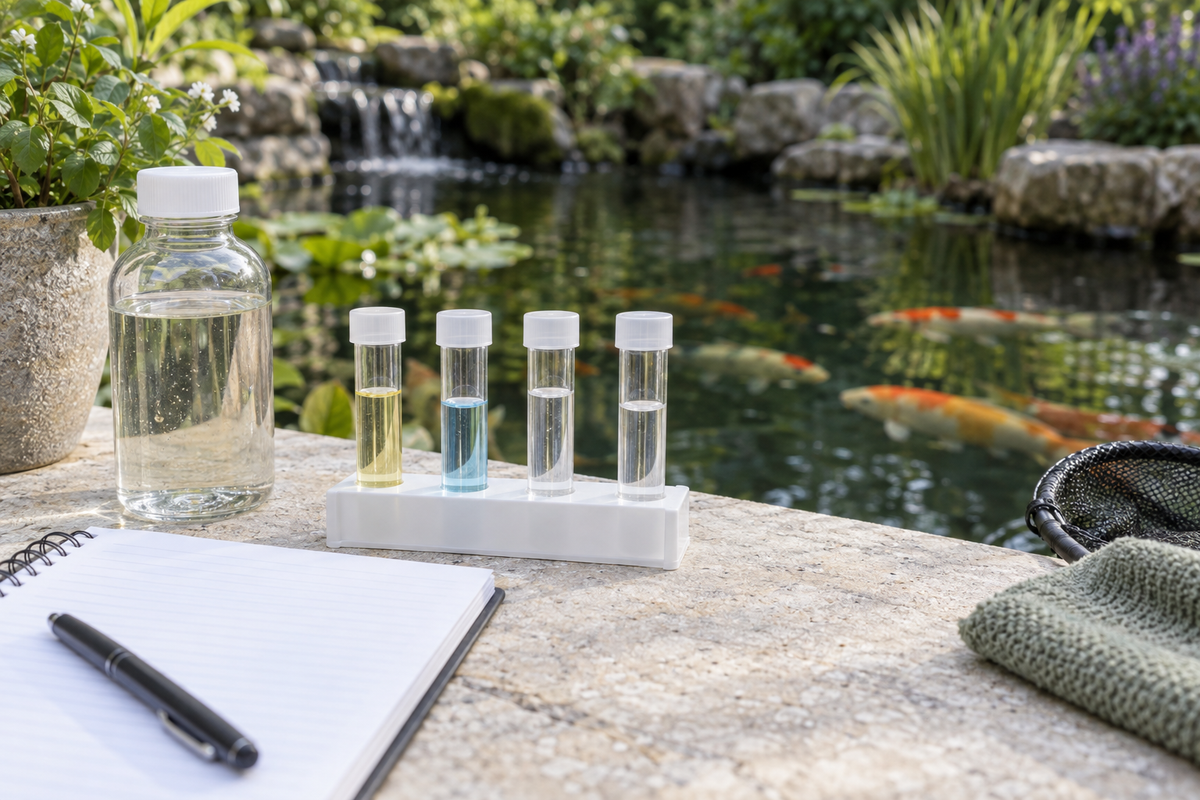
The JBL ProAquaTest CombiSet Pond kit includes pH, KH, GH, ammonium, nitrites, and phosphates. It covers several complementary parameters. Plan separately for temperature, dissolved oxygen, and nitrate measurements if they are necessary.

Note the results along with the time, temperature, units, and interventions. The OATA recommends regular checks; a new pond, a breakdown, unusual signs, or a change in population justify closer monitoring.
Respect reaction times and use properly stored reagents. If a value is surprising, check the procedure and confirm the measurement before a major correction, without delaying an urgent intervention when fish are in distress.
An example for connecting the figures
Imagine a pond where nitrites appear after an increase in feeding. The first task is to check the filter operation, aeration, and load. Modifying only the GH does not address the observed problem.
Another situation: a falling KH with pH fluctuations. You must examine the buffering capacity and water inputs. Before raising the pH, also check the ammoniacal nitrogen. The order of checks prevents a correction from improving one figure while worsening another risk.
Measure, understand, then correct
Start with a complete reading and the pond volume. Then, choose the Aquipond product corresponding to the identified need and check the effect after application.
See the analysis kit →
Consult Aquipond KH+ →
Consult Aquipond GH+ →
Sources
- UF/IFAS — Ammonia in Aquatic Systems: ammoniacal forms and nitrification.
- Mississippi State University Extension — pH and Alkalinity: pH and buffering capacity.
- Mississippi State University Extension — Total Alkalinity: distinction between alkalinity and hardness.
- USGS — Hardness of Water: calcium and magnesium.
- USGS — Dissolved Oxygen and Water: oxygen and temperature.
- Merck Veterinary Manual — Environmental Diseases of Aquatic Animals: interpretation and risks of parameters.
- RHS — Pond Algae and Blanket Weed: nutrients and maintenance.
- OATA — How to Look After Pond Fish: water monitoring.
- Aquishop product sheets for the cited tests and Aquipond products.