To buy aquatic plants in Belgium, you can visit a specialized nursery or prepare your selection online. The right advisor should, above all, be able to link each plant to your pond: depth, exposure, available space, and the potential presence of fish.
Aquiflor welcomes you to Nodebais, Rue de la Liberté 22, and the Aquishop selection allows you to prepare your purchases remotely. Some plants are better suited for store pickup; others can be delivered depending on the item and destination. Here is how to organize your purchase so you leave with a coherent planting scheme, not just a few pretty flowers.

Buying on-site: the benefit of an aquatic nursery
A visit allows you to compare foliage, volume, and the condition of the available plants. It is also an opportunity to ask how a small root ball will evolve once installed. The size of the pot does not tell you much about the space an adult clump will occupy.
At Aquiflor, the team can guide you based on your project's characteristics. Bring a few photos and the planting depths: this information makes the advice more precise than a simple request for "filtering plants."
Before coming, check Aquiflor's updated opening hours, which vary by season. If you are looking for a specific species or cultivar, confirm its availability. A listing in the catalog does not guarantee that a batch will be waiting for you on the day of your visit.
Ordering online: points to check
The Aquishop aquatic plant collection allows you to compare product sheets before making your selection. Read the botanical name, packaging, adult dimensions, and indicated depth.
Also check the quantities sold: a reference might correspond to one pot, several root balls, or an assortment. For a water lily sold by color, the chosen color does not guarantee a specific cultivar or growth identical to that of another variety.
The delivery method for plants must be confirmed for your address and the chosen references. The aquatic plant ordering page specifies that some fragile plants are preferably picked up on-site, with the possibility of considering a delivery offer depending on the project. Therefore, avoid planning your work based on a presumed delivery time.
Information to prepare before your purchase
| Information | Why it is useful |
|---|---|
| Pond dimensions and depth | To evaluate available space and possible locations |
| Depth of shelves | To choose suitable species and containers |
| Sunlight hours | To avoid putting a light-demanding plant in an area that is too shaded |
| Fish present | To take into account digging, plant consumption, and filtration |
| Plants already installed | To complete the composition without adding a redundant or overly vigorous species |
| Project objective | To distinguish between a pond for wildlife, an ornamental pond, and a planted technical zone |
A simple drawing is sufficient: indicate water levels and place existing plants. Add a photo taken from the spot where you usually view the pond. This also helps to distribute heights without blocking the entire view.
Which plant families should you look for?
Marginal plants
They occupy damp soil and shallow depths, depending on the species. The Caltha palustris (marsh marigold) offers a yellow bloom in spring and is suitable for a position close to the water level. It should not be placed indiscriminately at the bottom of a deep pond.
The water mint is another option for a damp or slightly submerged edge. Its ability to spread must be taken into account from the moment of selection.
Water lilies

The white water lily in a 3-liter pot provides floating leaves and a summer bloom. For a small pond, ask for a plant whose spread and depth requirements truly match the container. A large water lily does not become dwarf just because you limit its basket.
Submerged plants
The Ceratophyllum demersum (hornwort) allows you to vegetate the water column without conventional rooting in the bottom. This group contributes to habitat diversity but does not, on its own, replace the need to monitor oxygen levels in a fish pond.
Choosing the timing and preparing for installation
The RHS generally places a good period for installing aquatic plants between mid-spring and early summer, when the water warms up. The possibilities, however, depend on the species, packaging, and local conditions.
In summer, prepare the site before collecting the plants to limit their waiting time in the sun. In autumn, discuss the recovery and overwintering of the items being considered. A plant purchased late does not require the same care as a clump that has been established for several seasons.
When ordering, provide the appropriate planting baskets and materials. Verify that they fit on the shelves and remain accessible. Plants should not wait for several days for lack of a container or a ready spot.
Transporting plants to the pond
Ask for the specific transport conditions for each group. A submerged plant, a marginal root ball, and a water lily are not handled in exactly the same way. Keep the root balls under recommended moisture conditions and protect the foliage from crushing.
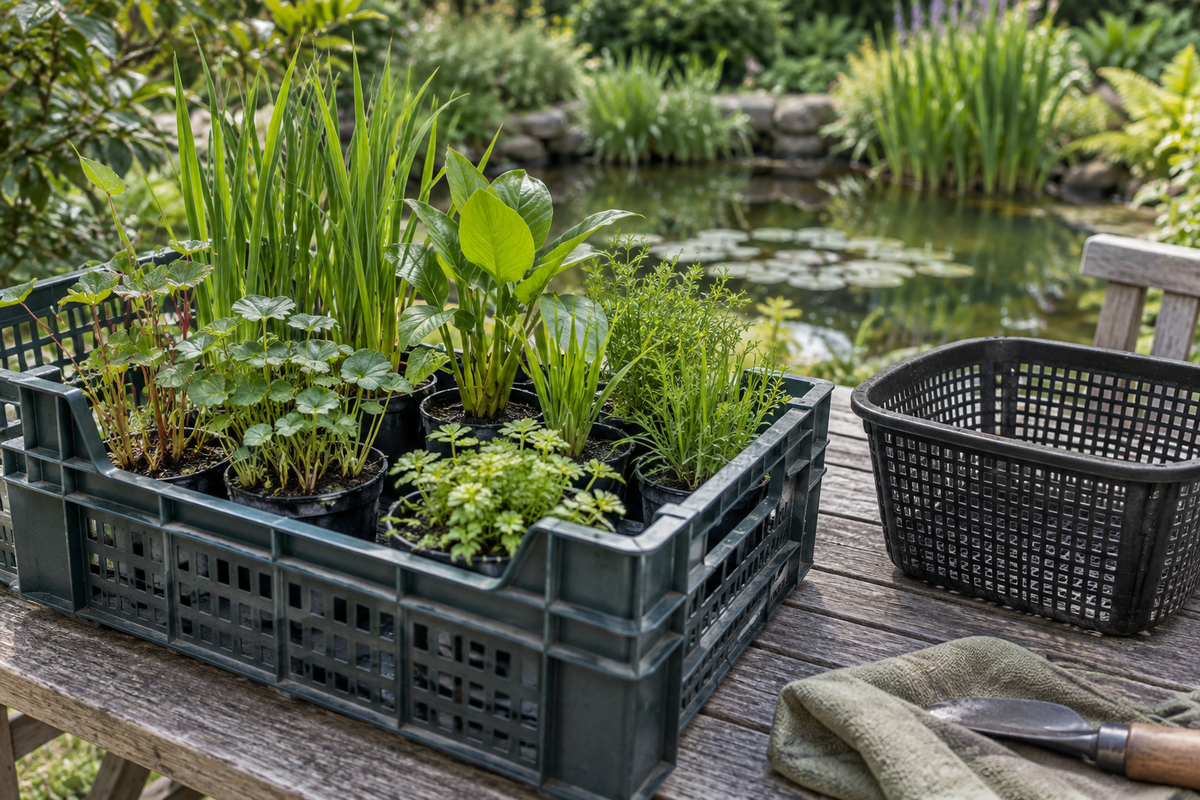
For pickup, a stable crate helps keep the pots upright. Avoid a long wait in a hot car and install the plants as soon as conditions allow. Upon receipt, check the items, the condition of the plants, and the provided advice before throwing away the packaging.
If a plant seems damaged or different from what was ordered, take photos and contact the seller. This allows the problem to be examined before planting, which would complicate the diagnosis.
Focus on a clear identity and controlled origin
Buy plants that are identified and adapted to your region. If your goal is a pond composed of native species, state it explicitly: "aquatic plant" does not mean "local plant."
European and Walloon lists regulate certain invasive exotic species. Verify the full name if in doubt, especially for plants offered on foreign platforms or during exchanges between individuals.
Do not use a natural pond as a nursery. Harvesting can disrupt the environment and transport unwanted organisms. During future maintenance, do not discard excess plants into a ditch, river, or other body of water.
Preparing a useful order with Aquiflor
A good selection can remain simple: a few adapted plants, the necessary containers, and a defined location for each. It is often easier to supplement after observation than to quickly remove a planting that has become too dense.
To prepare your visit or a delivery request, send your photos and pond characteristics to support@aquiflor.com, or call 010 86 03 54. Indicate your municipality, desired species, and planned installation period to verify the practical possibilities.
Sources and practical information
- Aquiflor — contact details and seasonal hours.
- Aquiflor — aquatic plant ordering procedures.
- RHS — choosing pond plants and planting timing and methods.
- SPW — lists of regulated invasive exotic species and prevention of their dispersal.
- Aquishop product sheets for the plants and accessories cited in this guide.