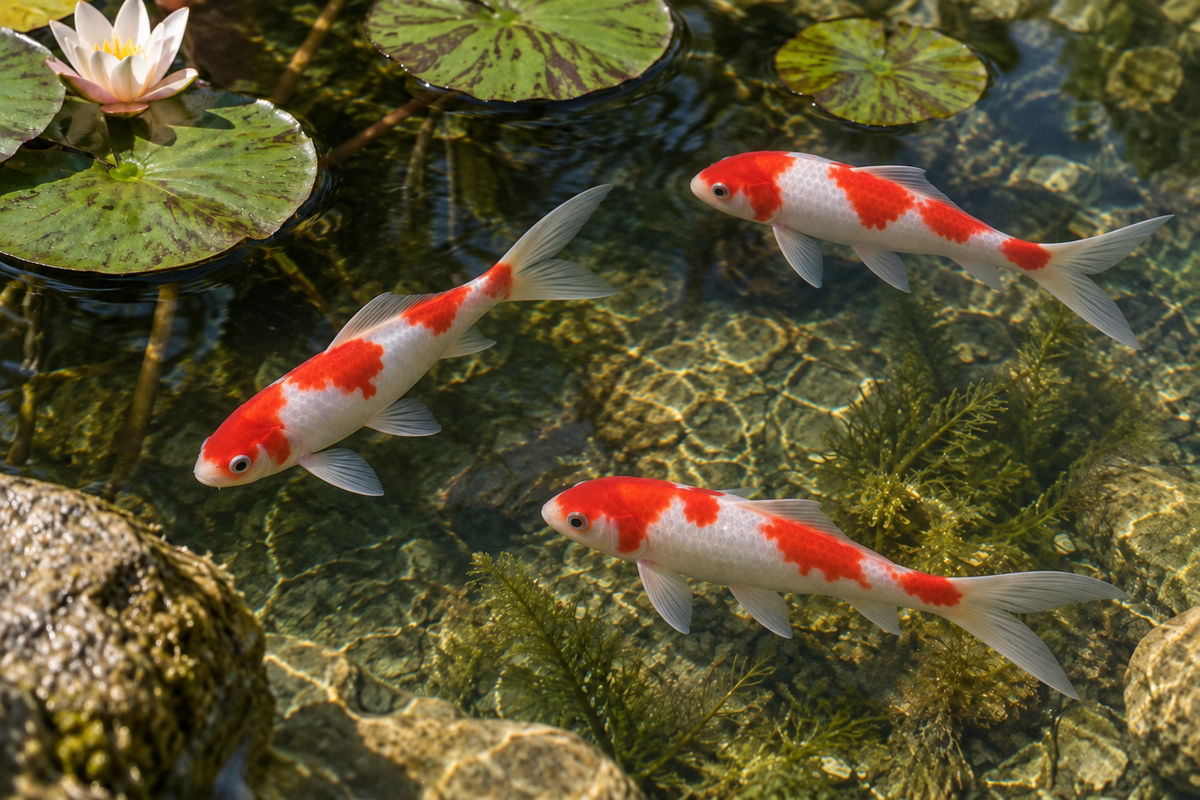
With its red patches on a white background, the Sarasa provides contrasts that are easy to follow in a pond. It is among the goldfish offered at Aquiflor and appeals to those who love bicolored patterns. The Sarasa remains a goldfish, with the needs of an animal that grows, swims actively, and requires monitored water quality. Its small size at the time of purchase should not define its housing for its entire life.
Before choosing a few individuals, take the time to distinguish its coloration, its shape, and the conditions of your pond. This preparation allows you to enjoy its colors without discovering a space or filtration problem too late.

What is a Sarasa?
The name Sarasa refers to a red and white coloration in the goldfish, Carassius auratus. It is not a distinct species. In ponds, one often encounters forms similar to the common goldfish and comets, with a slender body and a more or less developed single tail.
This detail helps in understanding commercial names. A red pattern on the head, a particularly long tail, or a stockier silhouette can lead to additional names. Always ask to see the fish in question: two offers bearing the word Sarasa do not necessarily describe the same shape or the same size.
The red and white areas create patterns that vary greatly from one individual to another. You can choose a contrast that you like without looking for perfect symmetry. Selection for a family pond relies above all on fish in good condition and a suitable installation.
Sarasa or koi carp: how to distinguish them?
The red and white coloration may resemble that of some koi, but the two fish belong to different species. Koi are carp and have barbels around their mouths; goldfish do not possess them. Their silhouette, development, and the requirements of the installation must also be taken into account.
Do not buy a Sarasa thinking it is simply a miniature koi. Conversely, a very small koi does not become a fish suitable for a small container just because it initially resembles a young goldfish. For a beginner, having the identification confirmed at the store is a simple precaution.
How much space should you provide in the pond?
Goldfish can reach several tens of centimeters depending on their form and maintenance conditions. The Aquiflor datasheet mentions an adult size that can reach up to 40 cm for the Sarasa; this figure should be understood as a potential, not the guaranteed size of each individual. The installation must anticipate fish significantly larger than those in the sales tank.
To decide on stocking, combine the actual volume, depth, swimming surface, filtration, and the fish already present. An isolated rule like "one fish per so many liters" does not describe all of this. A pond heavily cluttered with plant baskets also leaves less useful space than a simple external measurement suggests.
In a mini-terrace pond, volume and temperature can vary rapidly. A planted setup without fish is often easier to keep consistent. If you wish to have Sarasas, have the project verified before buying them, while also planning for their care during cold and hot spells.
Prepare suitable water and functional filtration
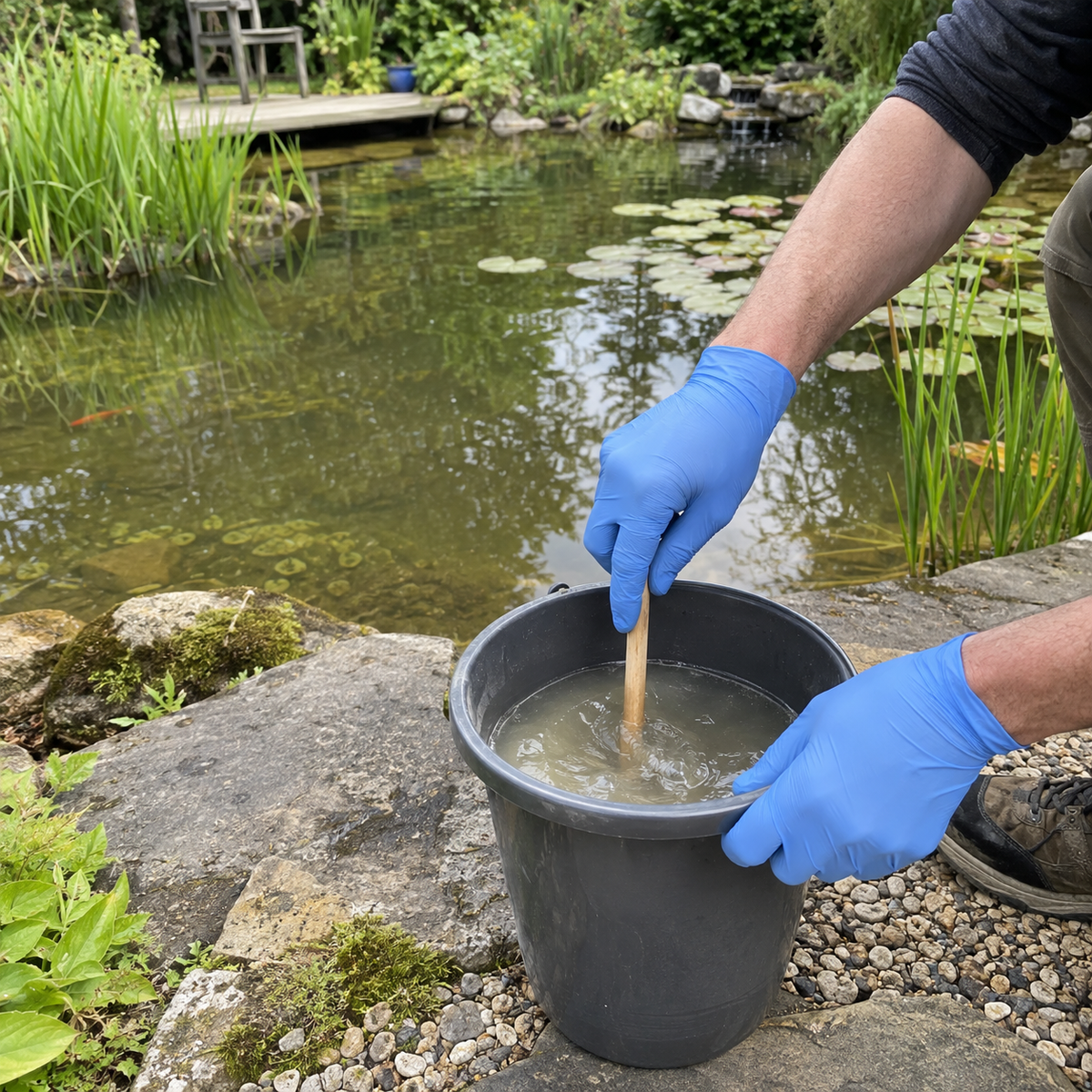
Transparent water is not necessarily suitable water. Ammonium/ammonia and nitrite checks are particularly useful at start-up and after an increase in stocking. The biological filter must be able to process the waste produced by the fish and their food.
The JBL ProAquaTest CombiSet pond is particularly useful for checking these compounds, pH, and hardness levels. Record the results with their date. You will thus have a useful history if the fish change their behavior.
When the context warrants it, Aquipond NitriBoost for ponds can support biological filtration according to its instructions. Its use does not exempt you from monitoring the water or allowing the installation time to adapt to a new load.
Where to buy Sarasas and what to check?
The Sarasa datasheet on Aquishop presents several fish sizes. Check availability and accommodation or delivery terms before finalizing your project. A size indicated in the catalog does not guarantee the immediate presence of the desired batch.

Observe swimming, breathing, fins, and skin condition. Ask about the origin of the batch and the food currently being distributed. A visible anomaly on several fish from the same source deserves an explanation before purchase. Also, plan for appropriate quarantine if a population is already present at your home.
Organize the journey and acclimation with the seller. Transport time, temperature, and packaging determine the instructions to follow. Preparing for their arrival before you leave helps avoid rushed handling once the fish are at home.
How to feed a Sarasa?
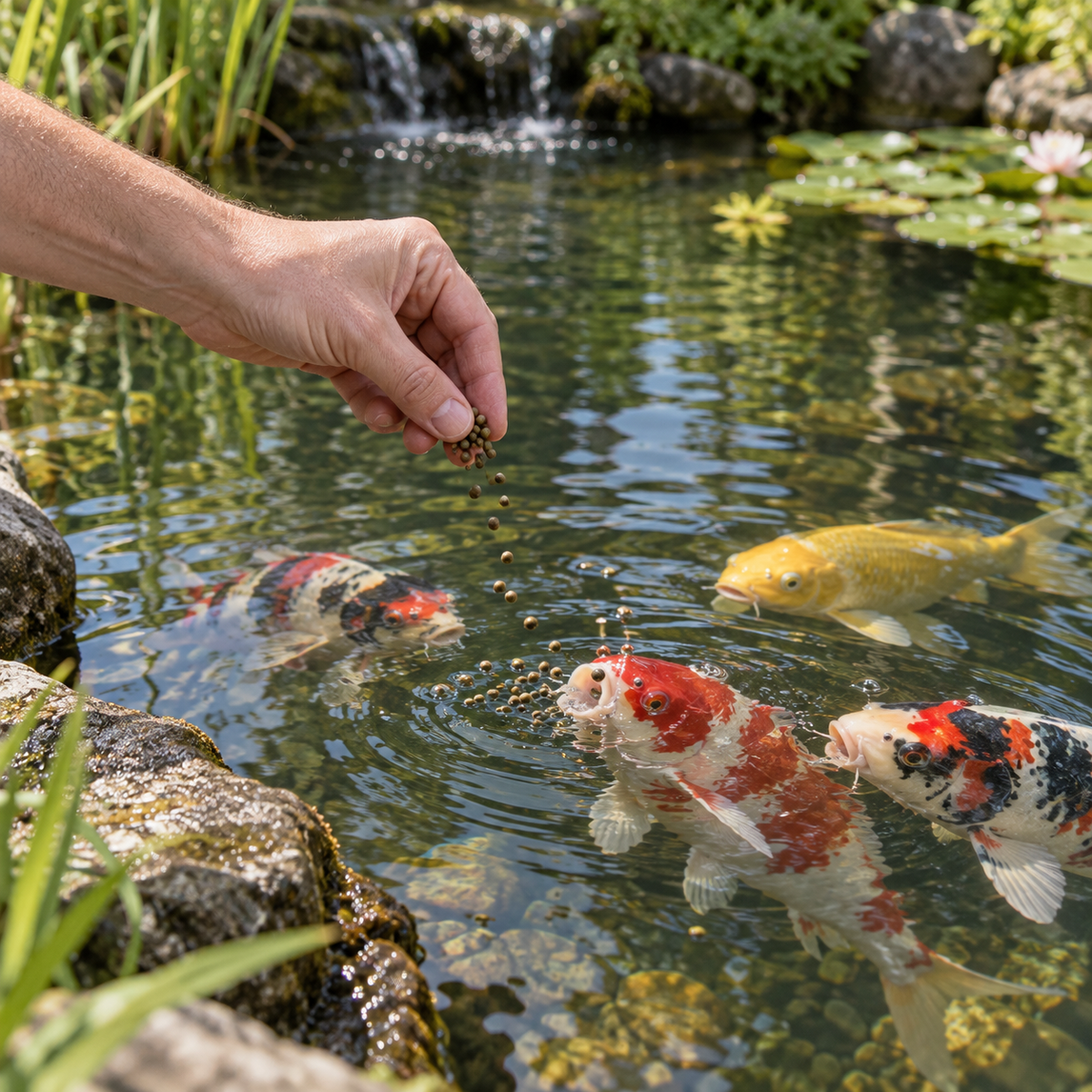
Use food intended for goldfish and a size that the individuals can swallow. Aquifood Pond Fish Food Mix Goldfish Floating 3 mm is an option for fish capable of consuming this diameter. Its floating presentation makes it easier to observe feeding.
Distribute a controlled amount and watch to see if everyone is eating. Adjust the ration based on water temperature, activity levels, and the food's instructions. Do not add more to compensate for a fish that stays behind: first check if the size, competition, or its general condition explain the situation.
A small measuring container and one person in charge of feeding prevent double distributions. Keep the food dry, seal the package, and choose a size compatible with your consumption. Freshness and storage deserve as much attention as the brand name.
What fish can it live with?
Compatibility does not depend only on the peaceful nature of a species. You must compare swimming speed, access to food, adult size, and environmental needs. Very slow goldfish forms may be disadvantaged compared to active comets. With koi, it is also the overall capacity of the pond that must be reassessed.
Avoid adding several species to visually fill all areas of the water. A well-monitored group and open space often offer more pleasant observation than a population that is difficult to feed equitably. Have your planned combinations validated before purchasing.
Maintenance and reproduction: thinking throughout the seasons
Monitor the filter flow, remove accumulated leaves, and observe the fish regularly. In autumn, adapt the food to the cooling water. In summer, be attentive to hot periods and oxygenation. Changes should be decided based on the actual pond, not just by the calendar date.
Spawning may occur when conditions are favorable. Not all eggs and fry survive, but a population can nevertheless increase. Anticipate the possibilities for housing young fish and never release ornamental fish into the wild.
Prepare for the arrival of Sarasas with Aquiflor: send a photo of the pond, its volume, the equipment, and the current population. This information will allow us to discuss the number of fish and the equipment that is truly useful.
Sources and references
- Aquiflor: Sarasa presentation.
- OATA: Goldfish identification and development.
- OATA: Pond fish maintenance and arrival.
- FAO: Carp characteristics, notably barbels, along with the Aquishop datasheets for the mentioned products.