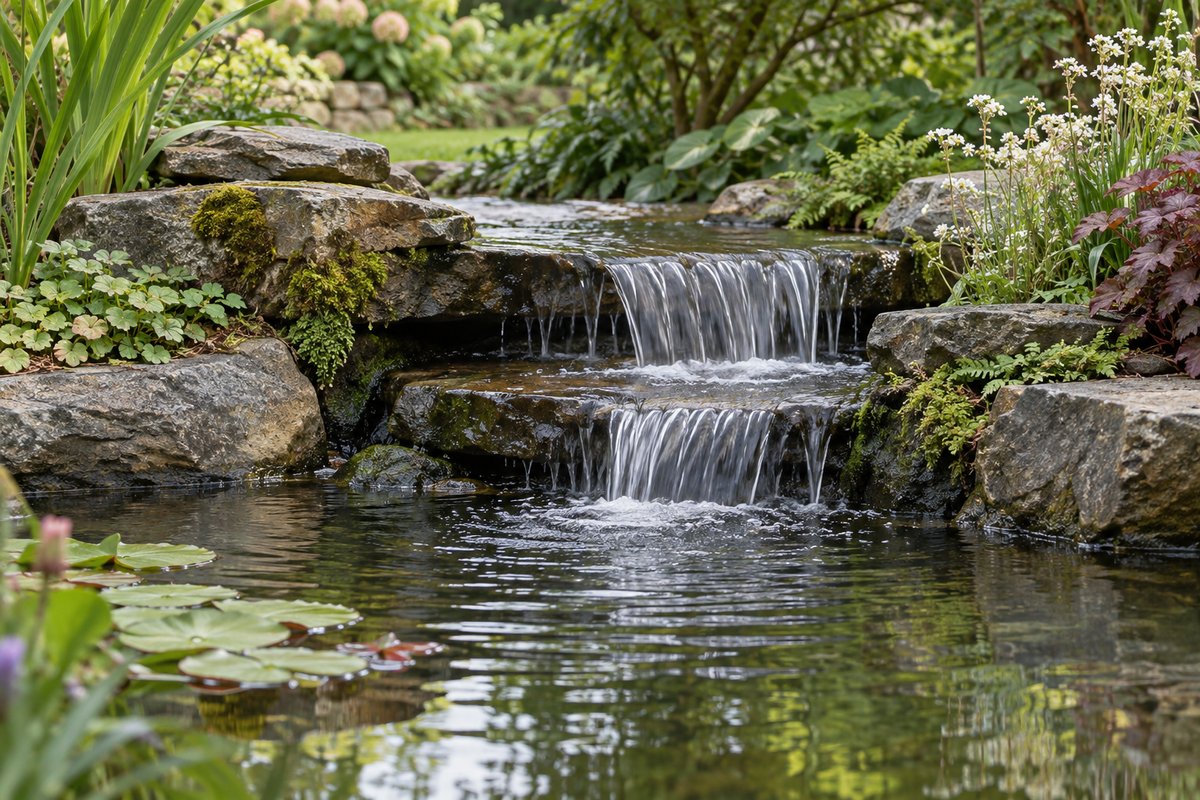
Is the waterfall splashing the surrounding area, making too much noise, or looking more like a torrent than the intended trickle? Start by looking at how the pump can be adjusted and what it is feeding. The solution may be an adjustment of its controller, a distribution of the flow towards two outlets, or a suitable modification of the circuit.
The question "how to reduce the pressure in the waterfall?" often concerns the volume of water arriving every minute. This flow must be reduced without depriving the pump of water or disrupting the pond's filtration.

Flow and pressure: understanding what you want to correct
Flow is a quantity of water per unit of time, generally expressed in liters per hour. Pressure is involved in circulation through pipes and accessories. These concepts are related but do not describe the same thing.
With an open waterfall, you mainly observe the exit velocity, the thickness of the sheet of water, and the splashing. A very narrow passage can concentrate the flow. An inclined stone can send the water too far even if the total flow remains reasonable.
Therefore, identify the specific defect: too much water over the entire waterfall, a jet concentrated in one spot, overflowing on one side, or excessive noise at the point of impact. The correction will not necessarily be the same.
Before making any adjustments, map out the circuit
Locate the pump, the filter, any UV clarifier, and the return to the pond. Also indicate the secondary branches, such as a water jet or a stream.
If the pump is only used for a decorative waterfall, its flow can be adjusted within the limits set by the manufacturer. If it also ensures filtration, the amount of water passing through the filter must remain compatible with the system's requirements.
An open filter that returns to the pond by gravity must maintain free flow. Closing its outlet to calm the waterfall may cause an overflow. A pressure filter also has an admissible pressure and connection guidelines to respect.
Note the full reference of the pump. Two models with similar names may offer very different adjustment options.
Solution 1: use the controller provided for the pump
When the pump has an electronic adjustment designed by its manufacturer, this is generally the first setting to examine. Gradually decrease the setpoint, then observe the entire circuit.
The recently released AquaMax Eco Premium 9000 features an OASE Control interface. The manufacturer provides for control via a compatible Eco Control device. Check the necessary controller and its inclusion before purchasing.
The displayed percentage should not be automatically interpreted as the percentage of maximum flow or power consumption. The result depends on the operation of the pump and the actual circuit.
A generic electrical dimmer is not a universal solution. Pumps such as the AquaMax Eco Classic 8500 must not be connected to this type of dimmer. Consult the manual for the exact reference.
Solution 2: distribute the water between the waterfall and another return
A bypass can send part of the flow to the waterfall and another part to a return suitable for the pond. This principle allows you to adjust the decorative effect without trying to choke the pump's suction.
The OASE 1 ½-inch Y-distributor, reference 56668, includes one inlet and two individually adjustable outlets. Its connections must match the pipes and the setup planned.

Be careful with placement: this OASE distributor is not designed for dry installation. Therefore, do not select it as an external valve in a technical room without considering this restriction. For installation outside the water, look for fittings and valves suitable for that use.
The bypass must be designed in conjunction with the filtration system. If you divert a significant portion of the water before the filter, that portion no longer passes through it. Depending on the circuit, another layout or a dedicated pump for the waterfall may be required.
The new return must remain within the waterproof zone, be securely fastened, and avoid stirring up silt or creating a current that bothers the fish. A bypass does not negate the need for total flow control.
Solution 3: authorized hydraulic adjustment at the discharge
On pumps and circuits that allow it, a valve or a suitable regulator on the discharge line may allow for adjustment. The choice depends on the type of pump, operating limits, and the devices located after it.
Have this solution verified if the manual does not describe it. Do not close a line completely while the pump is running and do not leave the system operating without sufficient circulation.
Avoid improvised adjustments: a kinked hose, foam placed in front of the intake, or a partially blocked inlet. These modifications can cause water shortage, unstable operation, and protective shutdowns.
A hydraulic adjustment does not equate to electrical savings proportional to the flow removed. If the pump is highly oversized, a model that is better adapted or adjustable is worth comparing over the long term.
Choosing between the solutions
| Situation | Option to consider | Point of vigilance |
|---|---|---|
| Pump with compatible controller | Gradually reduce its setpoint. | Maintain the intended operation of the filter and UV. |
| Need for a second return to the pond | Distribute the flow with a bypass designed for the setup. | Check where the filtered water goes and the wet/dry usage of the fittings. |
| Pump without electronic adjustment | Study an authorized hydraulic regulator. | Respect the limits of the pump and the devices in the circuit. |
| Pump significantly oversized | Compare a better-suited pump. | Use the actual flow at the height of the waterfall. |
The problem may come from the shape of the waterfall
Observe the last stone, the outlet width, and the point where the water falls back. A small correction to the threshold can distribute the water more evenly or bring the point of impact closer to the pond.
Check for debris and leaves stuck in the passage. They can shift the flow to one side. Removing them is preferable to a permanent reduction in flow intended to compensate for a temporary obstacle.
Before moving a stone, stop and unplug the relevant equipment. Preserve the integrity and stability of the decor. A heavy, poorly supported stone should not be manipulated from an unstable position at the edge of the pond.
For a manufactured water blade, compare the installation height and the flow recommendation of the model. The specifications of a 30 cm wide waterfall do not automatically apply to a much wider natural waterfall.
Adjust gradually and monitor the result
- Start with a maintained circuit, with the correct water level and clear passages.
- Modify only one setting at a time.
- Allow the flow to stabilize and observe all tiers.
- Check the operation of the filter and the flow limits of any UV clarifier.
- Check the connections, pump noise, and any error messages.
- Monitor the pond level and the wet areas around the waterfall.
An adjustment that is too low can make the sheet of water irregular or cause water to pass behind a threshold. The right result is one that suits the decor while ensuring a reliable return to the pond.
If a modification causes an alarm, unusual noise, or unstable circulation, stop the test and re-verify the setup. Do not disable a safety feature just to keep the desired look.
What if the goal is primarily to reduce noise?
The sound depends on the flow rate, the height of the drop, and the landing zone. A fall concentrated into a small cavity can be noisy even with moderate flow.
Evaluate the result from where you usually sit. The sound perceived at the immediate edge of the waterfall is not the same as that heard on the terrace. A gentler landing zone or an additional tier may be useful if the decor allows for it.
If the same pump feeds the filter, avoid solving the noise problem with improvised daily shutdowns. An independent waterfall offers more freedom in scheduling, after verifying its design and equipment.
Prepare an adjustment tailored to your installation
Gather the pump reference, a sketch of the circuit, and a photo of the waterfall in operation. This information helps in choosing between a compatible controller, a bypass, and changing the pump.
See the OASE Y-distributor and its installation requirements →
Discover a pump with an OASE Control adjustment interface →
Sources
- OASE — 1 ½-inch Y-distributor, 56668: adjustable outlets and dry installation restriction.
- OASE — AquaMax Eco Premium 9000: interface and compatible control.
- OASE — AquaMax Eco Classic Manual, hosted by Fishkeeper: operating conditions and dimmer.
- OASE — Waterfall 30: selection based on model and height.
- Aquascape — Waterfall flow and circuit restrictions: influence of pipes, maintenance, and height.
- Aquishop product sheets for the equipment linked in the article.