A first mild week is sometimes enough to wake up the fish and make you want to get the pond back into full operation. However, the filter does not necessarily regain its summer capacity at the same pace. It is this gap that must be managed in the spring.
To limit the risk of green water, prepare the system before increasing food intake. The order of operations matters: observe, analyze, restore equipment to working order, and then monitor the recovery. The calendar provides a benchmark; water temperature and test results guide decisions.

Before you start: how did the pond spend the winter?
Two setups may require different interventions. In the first, filtration continued to run. In the second, the circuit was shut down and some of the equipment was dismantled. Reconstruct your winterization process before choosing your program.
Note which equipment remained in the water, which filter media were preserved, and any potential breakdowns. A shut-down filter containing stagnant matter must not be reconnected without inspection and maintenance according to its manual.
Observe the animals as well. Unusual breathing, an isolated fish, or a loss of appetite requires checking the water and, if necessary, seeking expert advice. These signs should not be automatically attributed to the end of winter.
Perform an initial analysis before adding anything
Measure the temperature, pH, KH, GH, and nitrites. Supplement with ammonium depending on the situation, especially if the filter has been disrupted or if the fish have been present all winter. Save these results as a starting point.
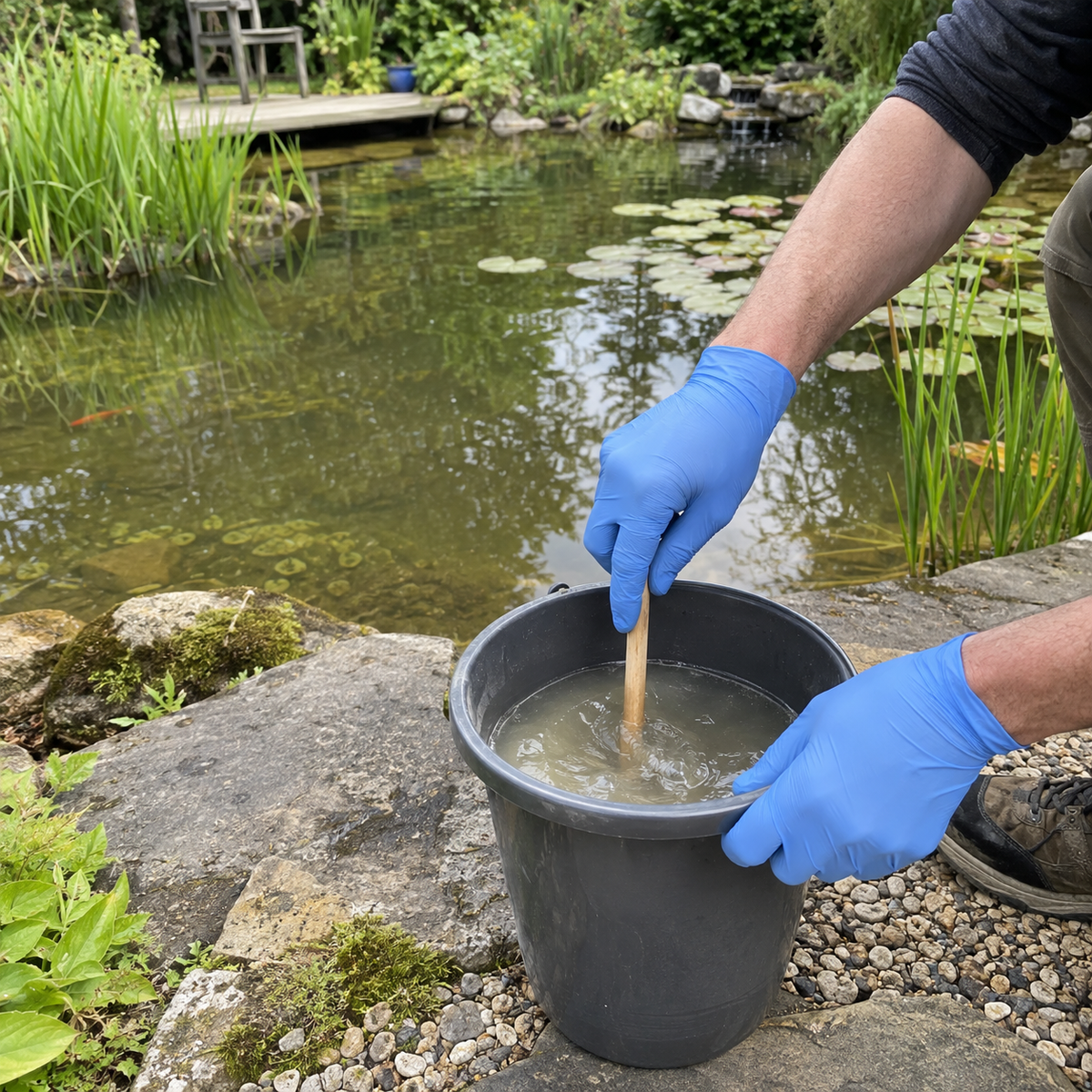
The JBL ProAquaTest CombiSet Pond allows you to check pH, KH, GH, ammonium, nitrites, and phosphates. Follow the reaction times and volumes specified by the kit. A sample taken in haste can lead to unnecessary correction.
If the KH is insufficient, examine the pH stability before choosing a correction. If nitrites are detected, look for what is limiting their transformation and adjust the feeding load. The two problems cannot be corrected with the same product.
Aquipond KH+ can meet a measured need for carbonate hardness. An addition should not be systematic every spring: the pond water and replenishment water may already have a sufficient reserve.
Restore the hydraulic circuit to working order
Inspect pipes, fittings, and valves before restarting. Look for cracks, displaced seals, and points where frost may have damaged the installation. Clean the parts specified by the manual, with devices unplugged.
After starting, track the water from the beginning to the end of the circuit. Check the return to the pond, any potential overflows, and the level during the first few hours. A slow-leaking fitting can go unnoticed during a check that is too quick.
Compare the flow rate to that of a clean installation in normal operation. If the water is barely circulating, look for the obstruction before relying on the filter to clear the pond. A pump receiving electricity is not proof of sufficient flow.
Clean the mechanical components and preserve the biological supports
Remove waste accumulated in the chambers and mechanical elements according to their maintenance method. Biological supports require more restraint: aggressive washing of all media can reduce the community already established.
Avoid systematically scrubbing these supports with chlorinated water. Proceed with the method recommended for the filter and limit the duration of interruption. Biological function depends notably on adequate circulation and oxygen supply.
Aquaculture literature from the University of Florida IFAS reminds us that nitrification consumes oxygen and alkalinity. It is therefore not limited to the presence of a bag of bacteria. The operation of the circuit and the parameters remain decisive.
Prepare the UV before heavy proliferation
Check the lamp reference, its service life, and the condition of the quartz. Replace parts that have reached their expiration date according to the manual. A device that turns on may still require maintenance to perform its role correctly.
The clarifier acts on algae in suspension that pass through its circuit. It does not directly remove filaments fixed to stones and does not replace mechanical filtration. Confirm that the flow rate and assembly match the device's requirements.
Carry out disassembly operations with the power off and do not bypass the housing's safety features. If you are planning a biological supplement, check the product's instructions regarding UV; there is no universal shutdown time for all treatments.
Support recovery with Aquipond NitriBoost
Aquipond NitriBoost is offered to seed the filtration system, especially at the start of the season or after major cleaning. It can be used once the circuit has been restored and water conditions have been verified.

The manufacturer's sheet indicates a pH between 6.5 and 8 and a water temperature above 10°C for optimal operation. Measure these parameters in the pond before application. A mild day does not guarantee that all the water has reached this temperature.
Follow the packaging instructions and continue testing. The filter does not automatically become capable of accepting a large increase in food after the addition. The evolution of ammonium and nitrites allows you to verify the actual recovery.
Remove deposits that accumulated during winter
Start with accessible leaves and debris. If an accumulation of sludge is hindering the operation of the ornamental pond, localized vacuuming with a PondoVac 4 allows you to work in sections.
Prepare for disposal and avoid stirring up the entire bottom. Spring can be an active period for amphibians: locate spawn and refuges before maintenance. The RHS notably recommends not moving spawn from one pond to another.
Aquipond Bactovase concerns the organic fraction of sediments and can supplement the program according to its conditions of use. Bacteria intended for sludge and those used to support the filter serve different purposes.
Resume feeding gradually
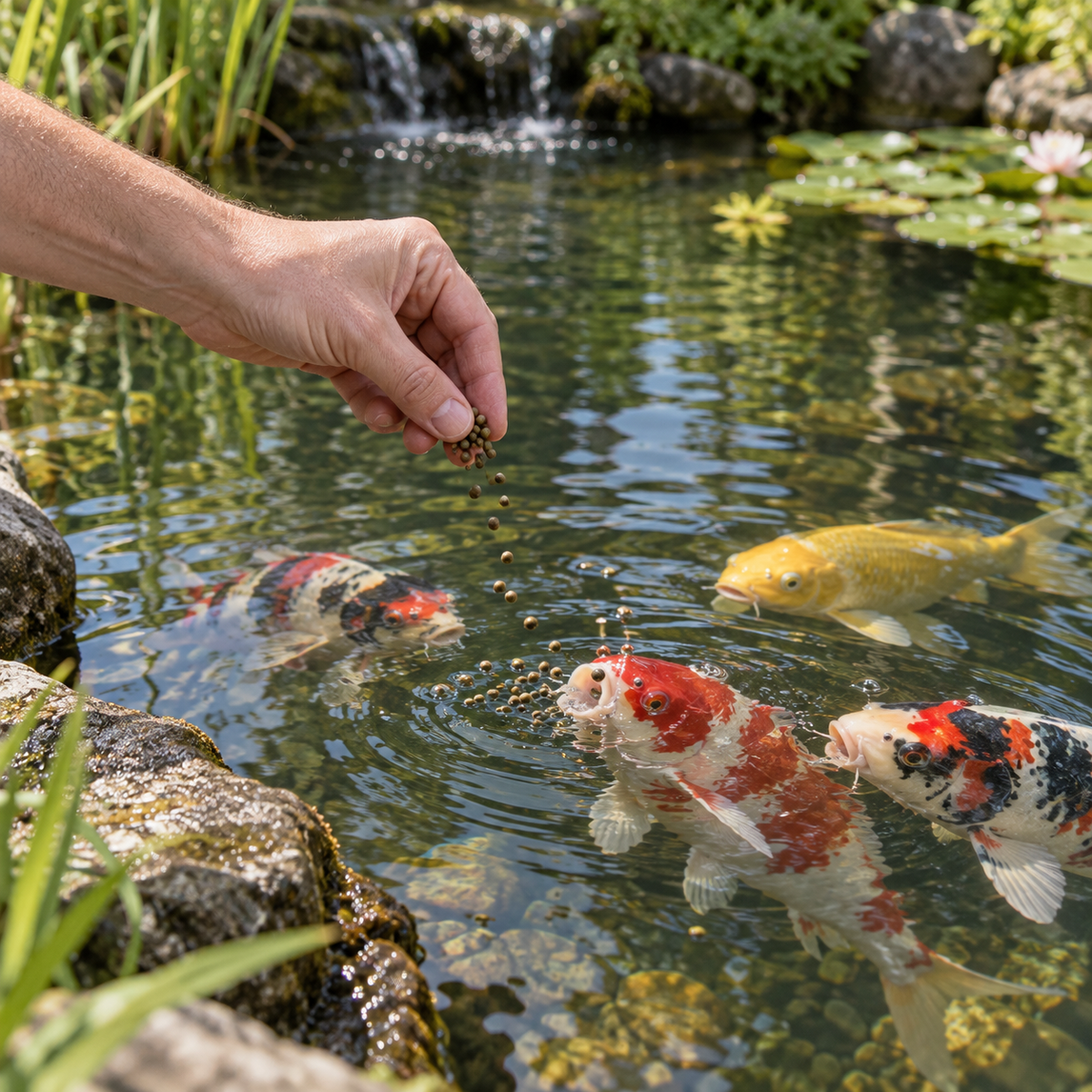
Fish appearing at the surface do not, by themselves, measure the capacity of the filter. Resume with quantities adapted to their activity and the chosen food, then observe consumption and water results.
Aquifood Wheat-Germ floating 3 mm is offered for off-season feeding. Follow the conditions of this formula and the needs of the species present. The name Wheat-Germ does not define a universal minimum temperature for all brands.
After increasing rations, monitor the parameters before moving to the next stage. A return to cold weather may justify a new adjustment. It is better to follow an irregular recovery than to maintain a quantity decided solely because the calendar says April.
If the water starts turning green anyway
Review the list of checks: flow rate, lamp, quartz, filter, inputs, and measurements. Green water does not automatically prove a failed restart, but it deserves to be compared to the observed operation.
Avoid combining a complete drain, total cleaning, and multiple treatments. You would lose the ability to understand what has changed. Correct the identified point, then monitor visibility and fish behavior.
A few algae on a stone or a slight biofilm do not necessarily require intervention. A balanced pond remains alive. The priority is water suited to its inhabitants and an installation capable of handling the season's load.
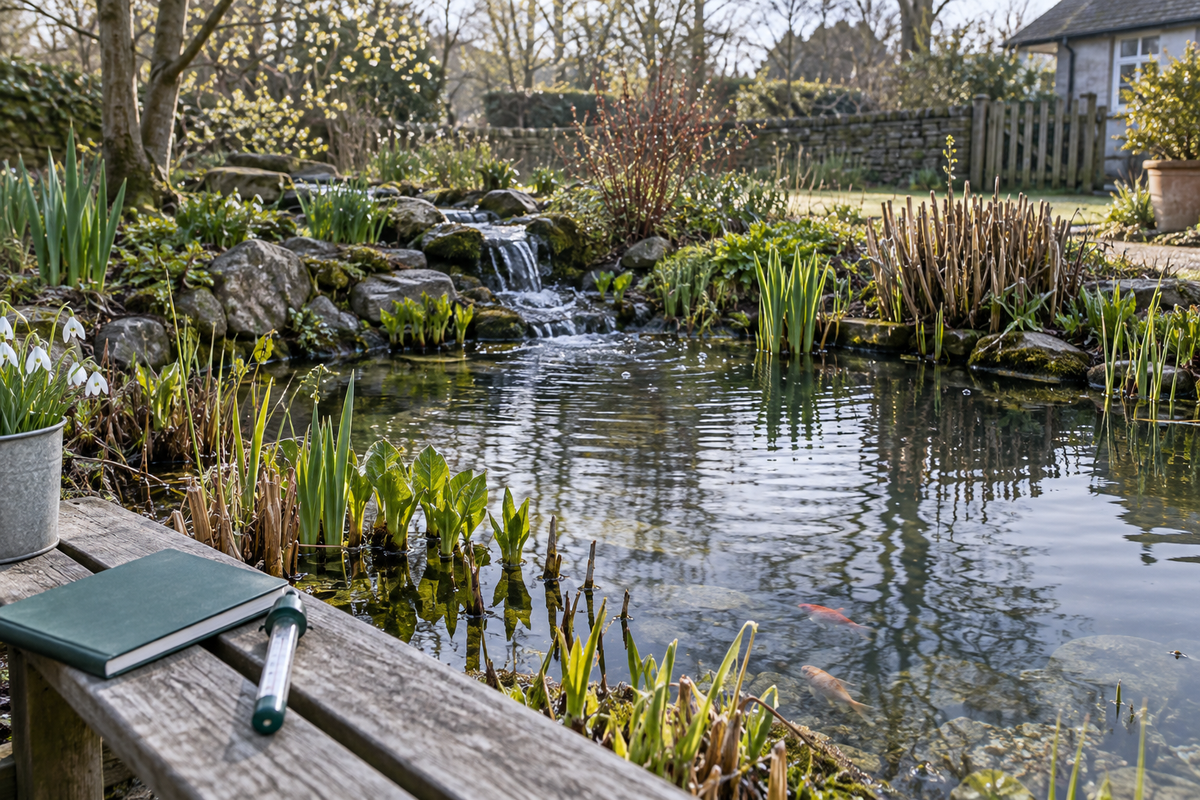
The tracking sheet to keep near the equipment
- Date, water temperature, and test results.
- Flow rate status and intervention on mechanical parts.
- Reference and replacement date of the UV lamp.
- Added product, quantity, and conditions at the time of application.
- Evolution of meals, visibility, and fish behavior.
This information makes any advice much more precise. It will also be useful the following year to anticipate steps, without automatically repeating a treatment that was only necessary for one season.
Prepare for a measured recovery
Start with analysis, then support filtration when conditions are suitable for the product.
Sources
- RHS — Pond maintenance in March: equipment inspection, feeding, and wildlife protection.
- University of Florida IFAS — Ammonia in Aquatic Systems: conditions of biological operation.
- RHS — Choosing a Pond Filter: mechanical and biological filtration.
- Aquipond — NitriBoost: uses and conditions indicated by the manufacturer.
- Aquishop product sheets for JBL, Aquipond KH+, Bactovase, PondoVac, and Aquifood linked in the article: characteristics and conditions specific to the products.