Does your pond have no soil at the bottom, are its sides steep, or would you like to be able to move your plants? There are several ways to add greenery to your water without planting directly into the bottom of the pond. However, "no rooting in the bottom" does not always mean "no roots."
You can choose a free-floating submerged plant like Ceratophyllum demersum, use removable baskets, or install marginal plants on a floating island. These solutions require different amounts of space and maintenance. Here is how to distinguish between them and where to find them for a project tailored to your pond.

Three solutions, three ways of living in water
| Solution | Where is the plant located? | Key takeaway |
|---|---|---|
| Free-floating submerged plant | In the water column | Does not necessarily require soil planting; monitor growth and suction points |
| Basket-grown plant | Rooted in a removable container | The basket rests on a suitable shelf; depth remains essential |
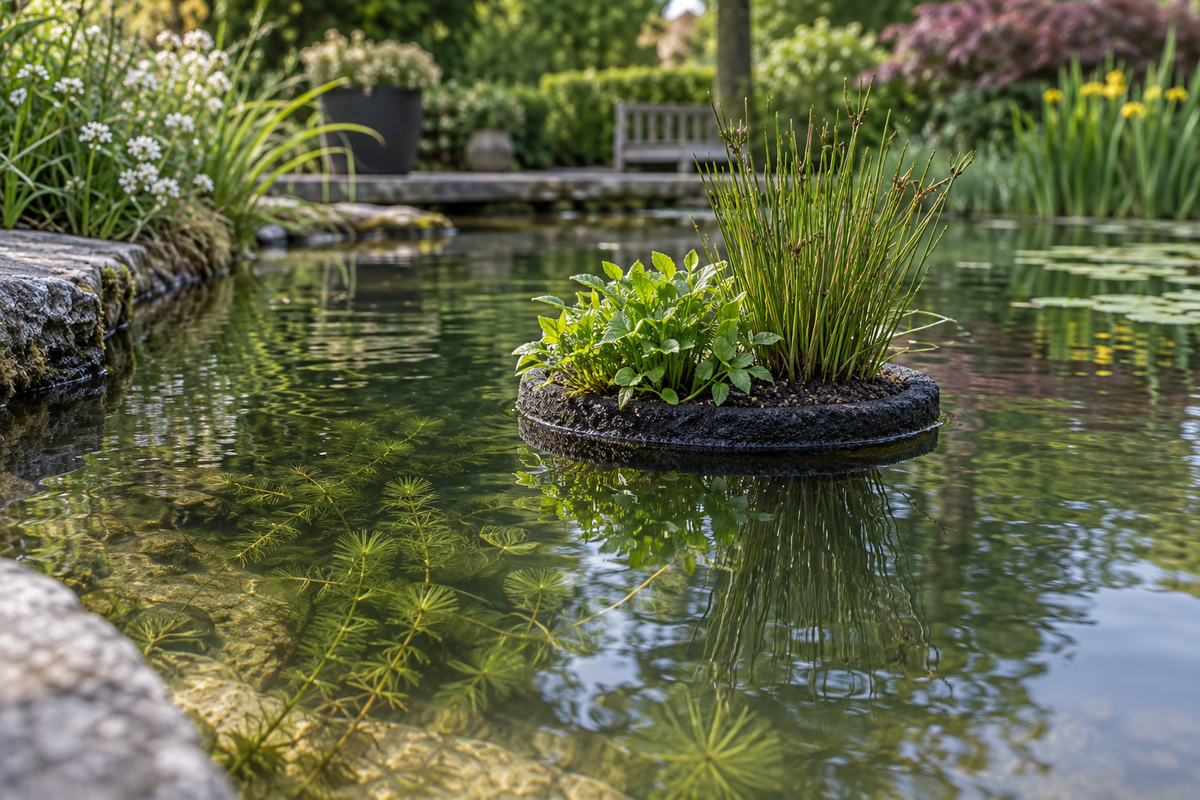
| Planted floating island | In a surface-level support | Roots develop in contact with the water; ensure stability and maintenance |
Free-floating surface plants form yet another group. Their leaves remain above the water while their roots dangle in it. Before looking for a species of this type, check its identity and regulatory status: some outdated advice is still circulating even though it no longer aligns with currently permitted plants.
Hornwort: a submerged plant that doesn't need the bottom

Ceratophyllum demersum, or hornwort, is one option for greening your water without traditional rooting. The RHS describes it as a free-floating submerged plant capable of forming dense vegetation.
It can provide support and refuge for small organisms. In light, its photosynthetic activity contributes to oxygen production. This does not exempt you from monitoring aeration in a fish pond: at night, plants also breathe and consume oxygen.
The Aquishop product sheet indicates a maximum depth of 120 cm for the plant on offer. This benchmark does not mean it should be dropped immediately to the deepest point: available light and pond conditions remain important. Place it in a calm area, away from any suction points that might pull in the stems.
Hornwort can change appearance throughout the seasons. The RHS describes a dieback of the vegetation in winter and regrowth from specialized buds. Do not judge its condition solely on the amount of foliage visible in summer.
Baskets: keeping roots without planting in the liner
If your main goal is to keep the bottom accessible, a basket may suffice. The plant roots into its own container, which remains independent of the garden soil and the pond’s seal. You can remove it to divide the clump or change the arrangement.
The square aquatic plant basket is available in several sizes. Choose a size that sits flat on a shelf and allows space for the mature plant. A large basket should not be balanced on a ledge that is too narrow.
This solution is suitable for many marginal plants and water lilies, provided their needs are met. It does not allow you to put just any species at any depth. The key measurement remains the water depth above the crown, after accounting for the basket.
If the pond has no shelves, have a stable support or an alternative solution designed. Avoid unstable stacks and sharp elements in contact with the liner.
A floating island to create a mobile planted zone
A floating island can be useful when the bottom is too deep for marginal plants or when you wish to create a vegetated area on the surface. The plants are set in the support; their roots can then develop in the water.
The 61 cm round floating island offered on Aquishop is designed for this use. Its product sheet highlights plants such as marsh marigold, water mint, and certain rushes. The final choice must account for mature size, wind resistance, and the stability of the support.
Do not turn a small island into an overloaded bed. The plants grow, the roots lengthen, and the weight changes. Check the installation and weight capacity instructions for the model before adding substrate, stones, or large plants.
Also consider its position: it must remain accessible and not block a water intake, skimmer, or overflow. Proper securing may be necessary depending on the wind and current. Vegetation provides shade, but the island alone does not constitute complete filtration for a koi pond.
Where to buy these plants and their supports?
You can browse the Aquishop selection of aquatic plants and the product sheets for the accessories mentioned in this guide. For an in-person selection, Aquiflor is located at Rue de la Liberté 22, 1320 Nodebais, Belgium.
Before visiting or ordering, specify that you are looking for a solution without planting in the bottom. This wording is clearer than "floating plant" if you are also considering baskets or a vegetated island.
The availability of live plants and their transport method depend on the items and the season. Aquiflor indicates that some plants are best picked up in-store and that delivery options can be reviewed based on the project. Confirm these details for your selection.
Check the species before any exchange or purchase
A trade name like "water salad" or "oxygenating plant" is not enough to identify a plant. Ask for the full botanical name, especially when purchasing from an individual or on a foreign platform.
Water lettuce, Pistia stratiotes, is on the European list of invasive alien species of concern. Its sale and cultivation are subject to the prohibitions provided by this regulation. Do not look for it as an ordinary alternative for your pond in Belgium.
Consult the official European and Walloon lists, which change. An old garden photo or an archived advice sheet does not guarantee that a species is still authorized. Also, do not introduce plants taken from a natural pond.
Installing and monitoring vegetation without complicating maintenance
- Inspect the received plants. Check their identity, condition, and any potential foreign plants present in the batch. Holding them separately before introduction can facilitate this observation.
- Choose a calm and accessible position. Keep free-floating stems away from suction points and maintain a pathway for equipment maintenance.
- Introduce gradually. Observe development before densifying the entire surface.
- Remove excess growth with care. Avoid scattering fragments and maintain areas of open water.
- Dispose of waste outside the natural environment. Do not release any plants, fragments, or transport water into a river, connected ditch, or neighboring pond.
The fact that a plant does not root in the bottom sometimes makes it easier to manage, but it does not automatically make it non-invasive. Free-floating plants can shift, accumulate in a corner, or form a cover that is too dense.
Choosing the solution that meets your constraints
For submerged vegetation without soil, look at hornwort. For plants that are easy to move and divide, check out baskets. To green the surface of a pond without suitable shelves, a floating island can be considered.
Send the Aquiflor team a photo, the depth, dimensions, and the potential presence of fish. We can guide you toward the appropriate plants and supports, taking into account the level of maintenance you wish to provide.
Sources and useful reading
- RHS — Ceratophyllum demersum, submerged habit and seasonal cycle.
- RHS — planting aquatic plants.
- Penn State Extension — dissolved oxygen in ponds.
- European Commission — invasive alien species and the Union list; Belgian National Scientific Secretariat — plants on the European list.
- SPW — regulatory lists in Wallonia and preventing the spread of plants.
- Aquiflor — ordering and transporting aquatic plants; Aquishop sheets for hornwort, baskets, and the floating island.