“I am looking for a UV lamp for my pond: how do I find the right one and use a suitable model?” The answer starts with the device it fits into. Wattage alone is not enough to identify a replacement lamp. The clarifier’s reference number, its version, the base type, and dimensions must all match.
A photo of the device’s label often helps you progress faster than a search based on the shape of the tube. Here is the information to note, the checks to perform, and the mistakes to avoid before putting it back into service.

Start by identifying the UV device
Look for the nameplate on the housing or the electrical head, without opening a powered-on device. Photograph it so that you can read the brand, the full name, the indicated wattage, and the reference number.
The lamp may be in an independent clarifier, connected to the hose, or inside a filter with an integrated UV. In the latter case, take note of the filter's reference number. The name of the pump that powers it is not enough to choose its bulb.
Keep the suffixes and numbers. "Bitron," "Bitron C," and "Bitron Eco" do not constitute a complete spare part reference. A product family can include several power ratings and several generations.
If the label has become illegible, look for the invoice, the manual, or an old lamp box. A photo of the entire filter can help identify a range, but it does not replace checking the part itself.
The five pieces of information useful for finding the lamp
| Information | What it helps verify |
|---|---|
| Brand and full model of the device | The manufacturer’s list of compatible parts. |
| Reference printed on the old lamp | The match with the intended part, if the previous lamp was correct. |
| Lamp wattage | The wattage expected by the device, without confusing it with total power consumption. |
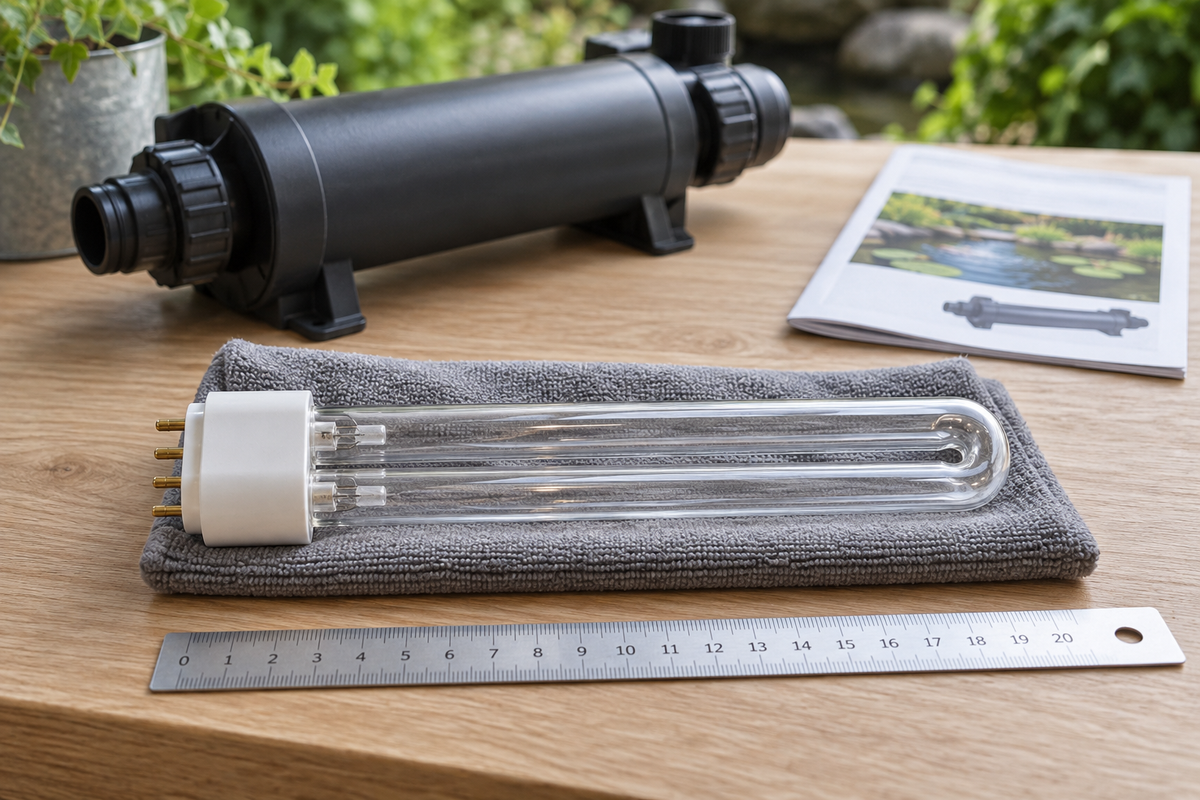
| Base shape and pin layout | The mechanical and electrical connection. |
| Total length and tube shape | Clearance in the designated housing. |
Dimensions are a secondary check. Two tubes that look alike may have different electrical characteristics. The right approach is to start with the manufacturer’s nomenclature, then compare the details of the proposed part.
When photographing the base, show its entire shape and the pins. For the length, specify whether the measurement includes the base. Only perform these measurements after unplugging, cooling, and disassembling according to the manual.
Why "a 55W lamp" is not enough
A search engine may suggest lamps of the same wattage for very different devices. The base, length, technology, and associated power supply can vary. A pond UV-C lamp is not chosen like a household light bulb.
The OASE 56636 reference illustrates the value of precise identification. The manufacturer associates it specifically with the Bitron C 55, Bitron C 110, Bitron Gravity 55, FiltoClear 30000, and Vitronic 55 included in its compatibility list. This indication does not make all 55W lamps interchangeable.
Another useful detail: a device advertised at 110W may use two 55W lamps. You must check the number of lamps and their individual references. Ordering a 110W bulb because that figure appears on the housing would be an incorrect deduction.

Lamp, quartz sleeve, or complete device: which part is missing?
The lamp is the replaceable electrical element. The quartz sleeve is the transparent tube that separates it from the water in many devices. The complete clarifier also includes a body, fittings, and a power supply.
If the outer transparent tube is cracked, buying just a lamp will not fix the defect. You must find the compatible sleeve and check the seals specified by the manual. Any trace of water in the electrical section requires shutdown and a proper inspection before any restart.
If you wish to increase the performance of an insufficient UV unit, do not install a more powerful lamp in its housing. Replacing the device should be based on flow rate, pond volume, fish stock, and filtration.
A lamp that lights up may have lost efficiency
The useful output of a UV-C lamp changes over its operating time. The absence of a visible failure does not prove that it maintains the expected performance.
Manufacturers provide replacement intervals specific to their lamps and devices. JBL mentions, for certain lamps, a lifespan of around 6,000 to 8,000 hours. Follow the instructions for your specific model: a value read for a different technology is not a general rule.
Note the date of the change and the periods of use. A UV unit used all year round does not accumulate the same hours as a device shut down for several months. This small written note avoids relying solely on the memory of last spring.
Before blaming the lamp, look at the circuit
Persistent green water can have several causes. The lamp is one possibility, but a quartz sleeve covered in deposits, an unsuitable flow rate, or insufficient water circulation in the device can also reduce the result.
Check the cleanliness of the quartz according to the manual, the operation of the pump, and the flow range of the clarifier. The UV acts on the water passing through its chamber. It does not remove leaves, sludge, and filaments attached to the walls.
Mechanical filtration must also be maintained. A clogged basket or slowed outlet can modify the entire circuit. Start with these observations before making unnecessary purchases and treatments.
Replacing the lamp without improvising
- Consult the procedure for the exact model and prepare a dry, stable, and clear surface.
- Unplug the device and associated equipment before intervention. Turning it off with a button does not replace unplugging it.
- Let it cool down if necessary, then disassemble in the order indicated.
- Inspect the quartz sleeve, seals, and accessible parts. Replace any damaged part with the specified reference.
- Install the compatible lamp without forcing and avoid touching the glass with bare hands.
- Close it properly, restart water circulation, and check for leaks according to the manual before powering the UV.
Never operate a UV-C lamp outside its protective casing. Do not bypass the safety device that prevents ignition when the device is open. A test "to see if it lights up" is not a safe inspection method.
If a cable, electrical head, or housing is damaged, have the equipment checked. Replacing a bulb does not justify an improvised repair of the power supply.
What to do with the old lamp?
Discharge UV-C lamps must go to a suitable recycling channel. In Belgium, Recupel provides collection points for lamps, particularly in stores or at recycling centers. They do not go into the glass recycling bins intended for packaging.
Store the used lamp in packaging that prevents breakage during transport. If it breaks, follow the collection and cleaning instructions from Recupel; do not use a vacuum cleaner to pick up debris from a lamp containing mercury.
Frequently asked questions when ordering
Can I rely on the bulb already installed?
It is a useful clue, especially if the installation was working correctly. Verify its reference against that of the device anyway: an incorrect part may have been fitted previously.
Must a compatible lamp have the exact same appearance?
A manufacturing change may alter visual details. Documented compatibility and the reference number take priority. Conversely, an almost identical appearance does not guarantee compatibility.
Should I change the entire UV unit when the water stays green?
Not automatically. Assess the age of the lamp, the condition of the quartz, the flow rate, and the sizing. These checks make it possible to distinguish a maintenance need from a device that has become insufficient for the pond.
Find the right reference
Prepare a photo of the device's nameplate and the markings on the old lamp. Then compare them with the part's data sheet and its compatibility list.
View the OASE 55 W lamp, reference 56636 →
View the lamp offered for FiltoClear 11000 in 11 W →
Sources
- OASE — UV-C replacement lamp 55 W, reference 56636: compatible models.
- JBL — UV-C lamps and frequently asked questions: aging and handling precautions.
- JBL — ProCristal UV-C manual: protection, replacement, and maintenance.
- Recupel — Collection and handling of lamps: end of life and breakage.
- Aquishop data sheets for lamps linked in the article.