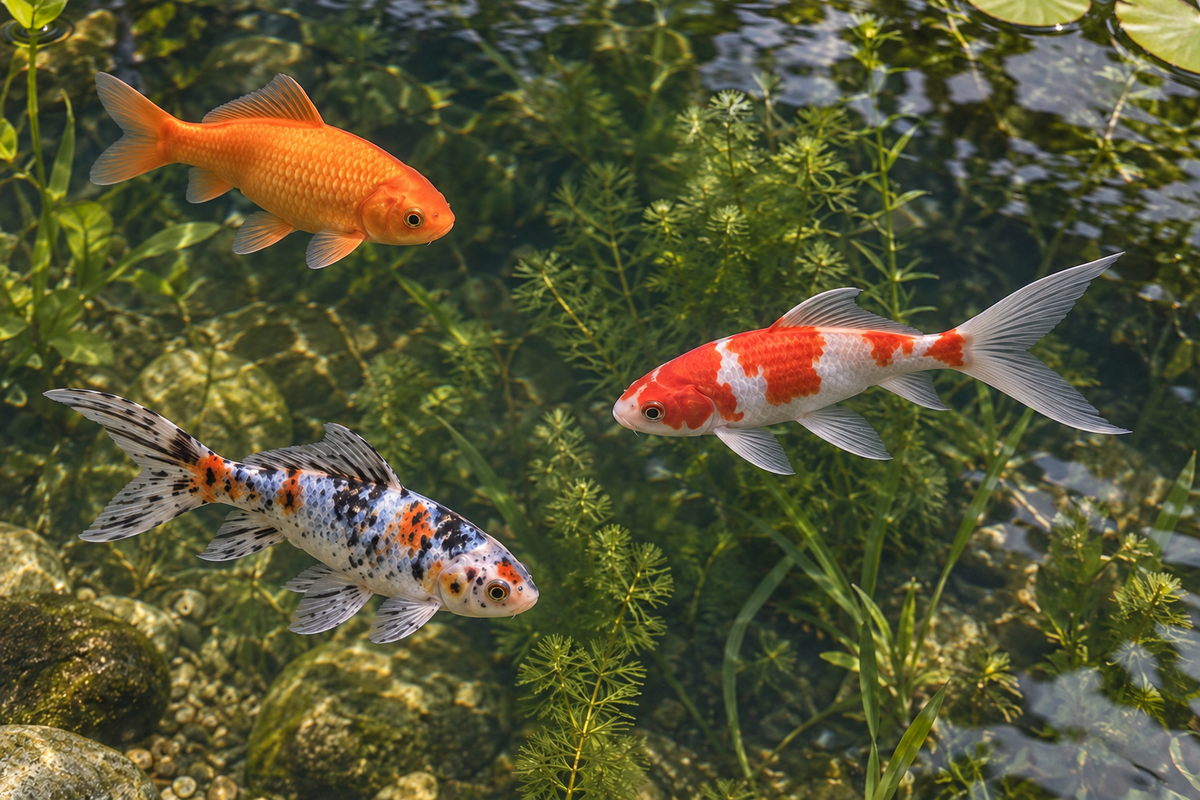
A Comet darts quickly across the pond. An Oranda moves more leisurely, with its rounded body and characteristic head growth. Both are goldfish, but their silhouettes already signal different needs.
The best goldfish for your setup is one whose adult size, swimming habits, diet, and overwintering needs you can accommodate. Color comes second. This guide covers eleven varieties, from the common goldfish to the Bristol Shubunkin, to help you recognize their characteristics and prepare for their arrival.

One species, very different shapes
Domestic goldfish belong to the species Carassius auratus. Successive selective breeding has produced long or short bodies, single or double tails, specific eye types, and various colors.
A single tail remains a single caudal fin, even when it features two lobes clearly separated by a fork. A double tail corresponds to a different structure, sought after in several "fancy" varieties.
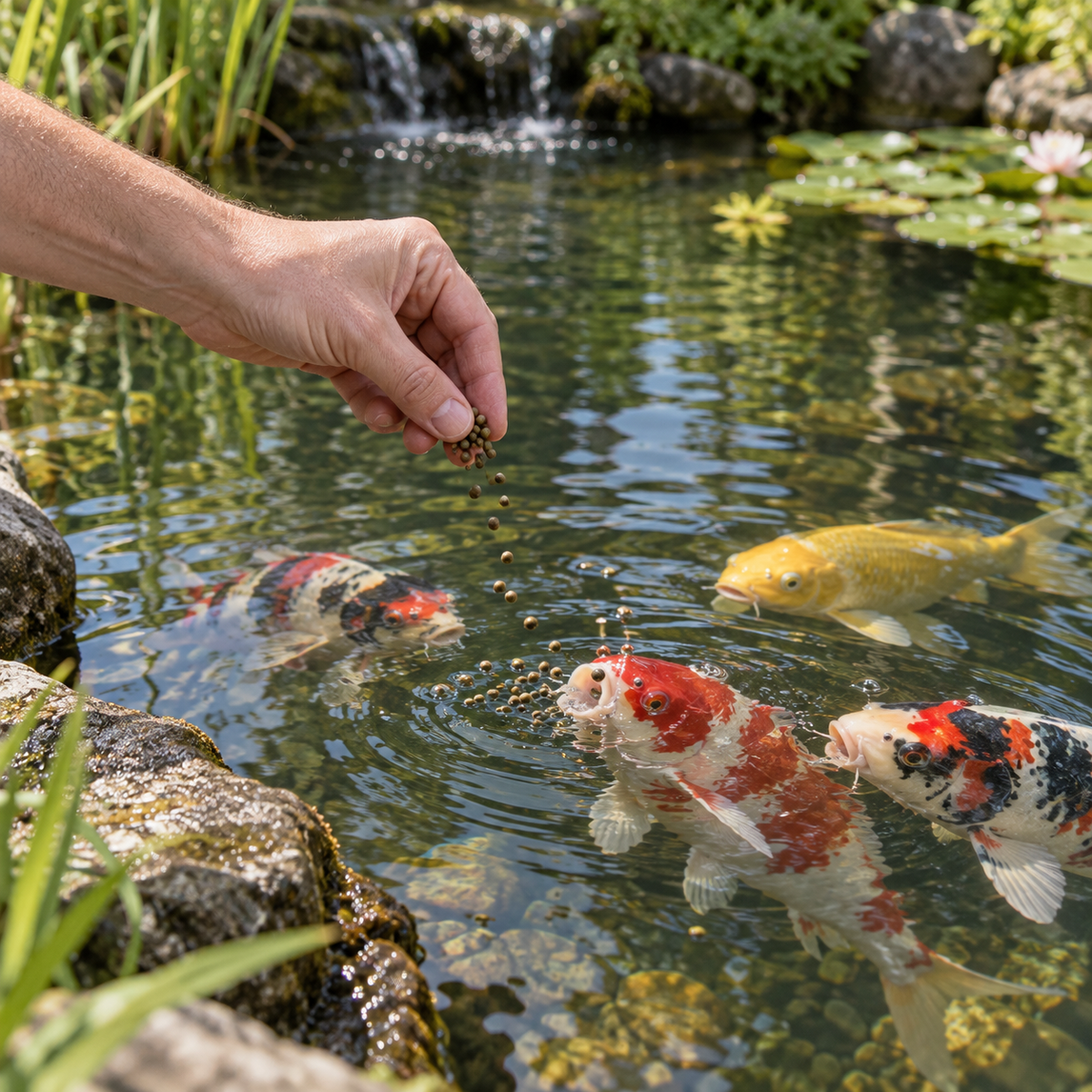
Also, do not confuse goldfish with koi carp. Koi belong to a different group and, notably, possess barbels around their mouths. The presence of red and white is not a sufficient criterion for identifying them.
1. The Common Goldfish
Its long body and relatively short fins make its silhouette easy to recognize. The orange color is the most familiar, but there are also common goldfish that are white, yellow, or feature several colored patches.
It can significantly exceed the size of the small fish sold in stores: plan for an adult that can reach about 30 cm, with individual variations. A small container is not an acceptable method for limiting its growth.
In a suitable pond, it is a common choice for those who appreciate active swimming and viewing from the bank. Its hardiness does not exempt you from providing filtration, sufficient volume, and water monitoring.
2. The Shubunkin
The Shubunkin is distinguished by a calico pattern, combining spots of several colors on a background that can appear bluish. The patterns vary greatly: it is interesting to look at the fish from several angles and in natural light.
The name covers different forms. The London Shubunkin resembles the common variety in its silhouette and fins; other lineages feature a more developed caudal fin. Therefore, you should not define all Shubunkins by an identical long tail.
These active fish are commonly intended for ponds and spacious setups. The choice must account for their adult growth and cohabitation with fish of a comparable pace.
3. The Comet
The Comet has a slender body and a clearly elongated single tail, generally forked with pointed tips. This silhouette results in a lively and ample swimming style.
They exist notably in orange, red, white, or red and white. A red and white pattern may be referred to as Sarasa depending on the commercial presentation; however, you must look at the shape of the fish to identify its variety.
The Comet needs swimming space. Avoid pairing it thoughtlessly with very slow fish: during feeding, its speed may allow it to take the majority of the food.
4. The Fantail and the distinction from the Veiltail
The Fantail has a shorter, taller body than common forms, with a double tail held like a fan. The length of the fins varies according to the lineage.
The term "veiltail" is sometimes used broadly in the trade. However, the Veiltail is a distinct variety: its long, wide caudal fin droops more like a veil. Confusing the two prevents a clear understanding of the expected proportions and behavior.
To choose, observe an individual that swims freely, maintains its balance, and reaches its food. The beauty of the fins must come with the ability to live comfortably in the intended setup.
5. The Ryukin
The Ryukin has a high body and a marked rise of the back behind the head. This silhouette distinguishes it from the Fantail, whose profile is more gradual.
There are Ryukins with shorter or longer fins, and in several colors. Two fish bearing this name can therefore have quite different appearances.
Plan for a spacious aquarium, with circulation compatible with their swimming style and well-chosen companions. A compact shape does not mean that a small volume is sufficient.
6. The Oranda
The Oranda is recognizable by its fleshy head growth, called a wen. Its size evolves with the individual and the lineage; it is not appropriate to promise an identical appearance at a specific age.
The Redcap is a well-known form, with a white body and a red zone on the top of the head. Other Orandas feature red, orange, dark, or calico patterns.
When choosing, verify that the fish swims, sees, and feeds correctly. If the head growth obstructs the eyes or mouth, seek expert advice. Do not attempt to modify it yourself.
7. The Ranchu
The Ranchu features a compact body, a dorsal line without a dorsal fin, and head growth. It occupies an important place among the varieties appreciated by enthusiasts of selective-bred goldfish.
Its back and proportions allow it to be distinguished from other similar forms, such as the Lionhead. Breeding standards contain nuances; for a private owner, the fish's condition and ease of swimming remain priorities.
A stable environment, suitable filtration, and compatible companions are essential. Do not choose a Ranchu assuming that its small size at the time of purchase will be permanent.
8. The Telescope, including the Black Moor
Telescopes have prominent eyes. The Black Moor is a well-known dark form, but fish with telescope eyes also exist in other color patterns.
This feature requires consideration of the decor and access to food. Remove sharp surfaces and passages where the fish could get injured. Also, observe competition with other inhabitants.
Eye changes, injury, or feeding difficulties are not solved by automatically adding a product to the water. Have the problem and keeping conditions assessed.
9. The Celestial Eye
Its eyes are oriented upward and it lacks a dorsal fin. This combination makes it very different from common goldfish.
It requires carefully chosen housing and cohabitation. Effective access to food must be verified: the presence of pellets in the aquarium does not prove that every fish can find and consume them.
This variety is for someone ready to follow these specific needs. Before buying, inquire with a specialist who understands the care of this type of fish.
10. The Bubble Eye
The Bubble Eye has fluid-filled sacs under its eyes. These delicate structures require an environment designed to limit injuries.
The decor, filtration intakes, and companions deserve special attention. A fish whose swimming or feeding is difficult should not be chosen solely for a spectacular feature.
As with other highly selected forms, prepare the housing before arrival and ask for specific advice on the filtration model and layout. Stable, clean water remains essential.
11. The Bristol Shubunkin
The Bristol is a form of Shubunkin developed in the United Kingdom. Its large caudal fin, with rounded contours, can evoke a heart or the letter B depending on the lineage and standards.
It has a single tail. Therefore, it is not a double-tail fish of the Fantail type. Its reference pattern is calico, and it can grow quite large.
The Goldfish Council describes active fish that can grow large, including in a pond. It would be misleading to systematically present the Bristol as a small fish reserved for the aquarium because of its tail. Check the lineage's needs and breeding conditions with the seller.
Outdoor pond or indoor aquarium?
Commons, Comets, and Shubunkins are typical choices for suitable ponds. Delicate varieties require more precautions: the OATA recommends indoor keeping for fancy-type goldfish.
Frost, rapid fluctuations, food competition, and predators must be factored into the decision. A device that maintains an opening in the ice does not turn all varieties into hardy fish.
In an aquarium, the volume must be considered for the adults and the complete population. As a benchmark for fancies, the OATA recommends at least 100 liters for an adult, plus 50 additional liters per fish. This figure does not replace the assessment of swimming surface, filtration, and compatibility, and does not apply as a universal rule to all forms.
Monitored water and accessible food
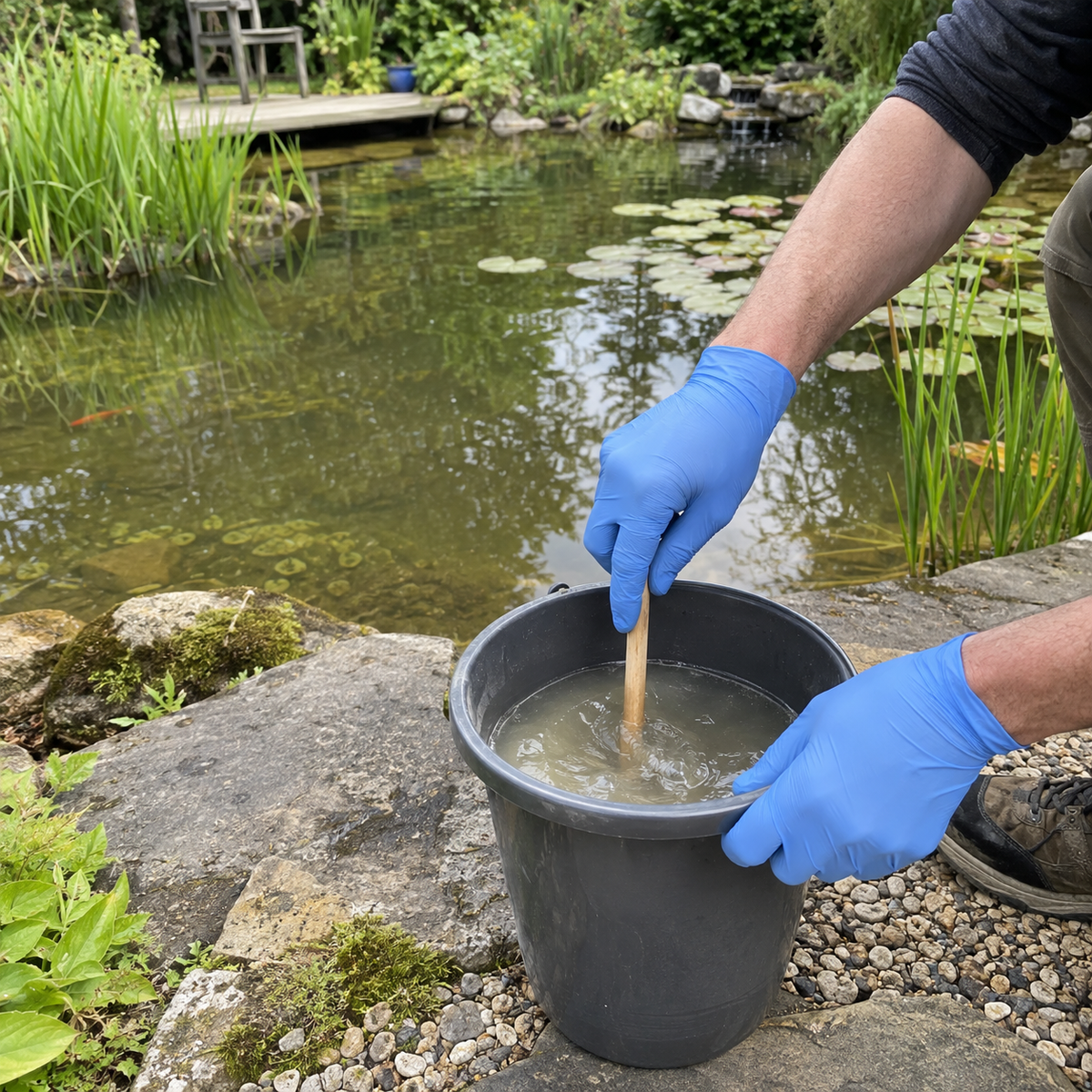
Prepare an established biological filtration system before introduction and add fish gradually. Check for ammonium/ammonia and nitrites, as well as parameters suitable for the system. Transparent water is not an analysis.
The JBL ProAquaTest CombiSet Pond kit covers several useful pond measurements, including pH, KH, GH, ammonium, and nitrites. It does not contain a dissolved oxygen or nitrate test.
For pond goldfish capable of taking floating food, Aquifood Pond Fish Food Mix Goldfish 3 mm allows you to monitor consumption. Adapt the size, formula, and portions to the population and the season.

For delicate forms, the feeding method may require a different formula, notably sinking. Verify that each individual eats without difficulty and that the faster ones do not monopolize the meals.
The checklist before choosing
- Identify the variety and anticipate its adult size.
- Check the available volume, swimming surface, and filtration.
- Plan for overwintering before setting the fish outside.
- Observe balance, respiration, eyes, and fins.
- Choose compatible companions and organize health monitoring for new arrivals.
- Plan for long-term maintenance: a well-kept goldfish can live for many years, sometimes more than twenty.
Never release a goldfish into the wild. If your setup is no longer suitable, seek a responsible rehoming solution with a professional or a competent organization.
Prepare for their arrival before choosing the color
A coherent population and a suitable pond allow you to enjoy your fish in good conditions. Start by checking the water and the needs of the varieties that interest you.
Sources
- Goldfish Society of Great Britain — Varieties: distinctions between silhouettes and fins.
- Bristol Aquarists’ Society — Goldfish Varieties: classification of simple and double forms.
- The Goldfish Council — Bristol Shubunkin: single caudal, shape, and development.
- OATA — How to Look After Fancy Goldfish: housing and compatibility.
- Aqueon — Goldfish Care Guide: species, pond, and maintenance.
- RSPCA — Fish Health: observing fish.
- Aquishop product sheets for the tests and foods mentioned.