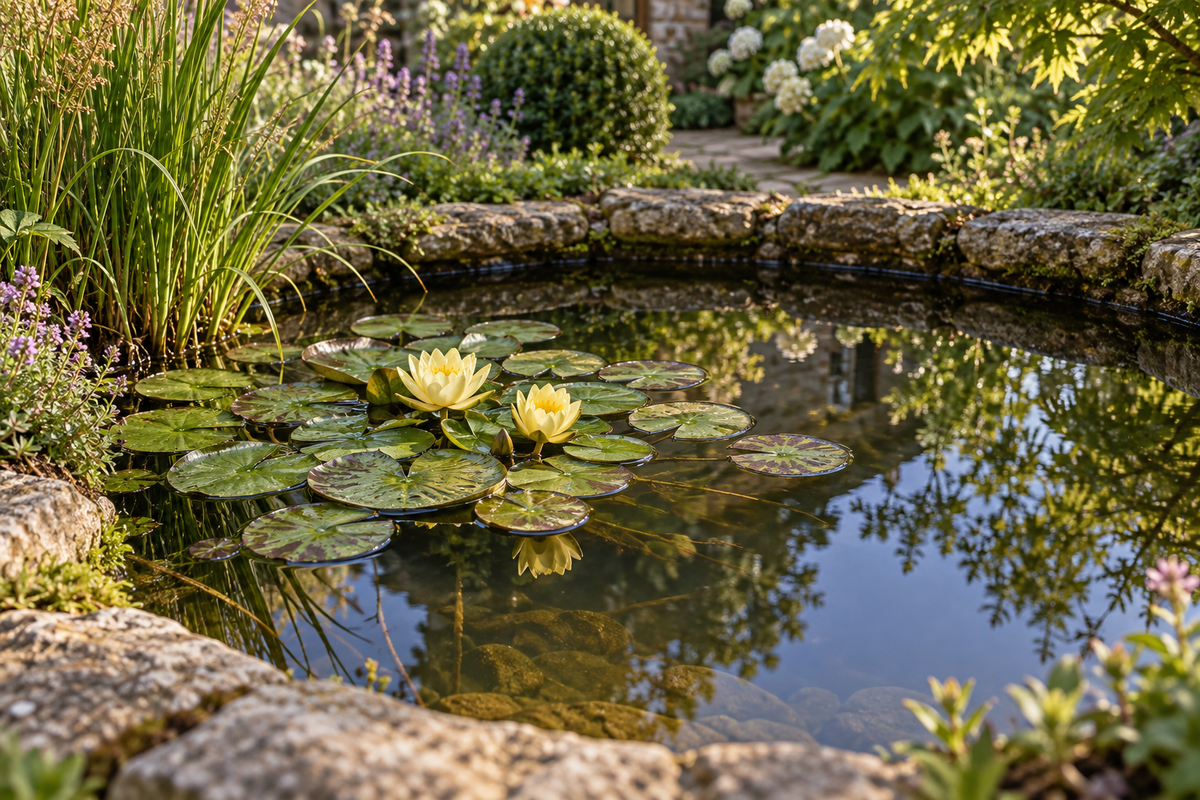
A few round leaves, a flower opening to the sun, and a visible water surface: a compact water lily can be enough to add character to a small pond. However, choosing one requires more than just falling in love with a color.
A dwarf water lily is a plant whose growth remains suited to a small space. A young plant sold in a small pot can eventually become very large. Before purchasing, check the name of the variety, its mature spread, and its planting depth.

Start by measuring the small pond
Note the available surface area, the total depth, and the height of the basket you will be able to install. Also, identify the shelves and other plants. The space useful for the water lily corresponds to what will remain for its foliage once it grows.
In a container, take into account the volume occupied by the basket and the substrate. In an in-ground pond, measure the depth at the intended spot. A deeper bottom in another corner does not provide the right information for the plant.
Finally, record the sun exposure periods. A terrace that is bright at noon may remain in the shade for a large part of the day. Water lilies generally appreciate a sunny location and calm water; splashes from a fountain placed right next to them may hinder their establishment.
The word "dwarf" does not replace the variety name
The terms miniature, dwarf, and compact are used to describe reduced growth, but they do not provide a precise dimension. Ask for the stated mature spread and the recommended depth for the chosen reference.
As a botanical example, the RHS describes Nymphaea ‘Pygmaea Helvola’, also presented as Nymphaea × helvola, as a miniature water lily with yellow flowers and purple-marked leaves. Its indicated spread falls within the 10 to 50 cm category.
The RHS selection also cites ‘Pygmaea Rubra’ among water lilies suitable for shallow depths. These names provide leads to examine with a specialist; their presence in this guide does not constitute an announcement of availability on Aquishop.
A color is therefore not enough: two yellow water lilies can have very different dimensions. Keep the botanical name on a label and in your garden journal.
Understand the depth indicated on the product sheet
It is necessary to distinguish the total height of the pond from the water height located above the plant's growing point. The basket and substrate take up part of the available depth.
For example, in a container with 40 cm of water, a basket with the growing point 15 cm above the bottom leaves about 25 cm of water above this point. This calculation makes it possible to compare the container to the variety's needs, but it does not constitute a universal depth recommendation.
The indications may vary according to the product sheets and the age of the plant. For ‘Pygmaea Helvola’, the RHS describes an initial installation in shallow water, followed by a gradual lowering as the plant establishes itself. Follow the method provided for your plant rather than a single depth applied to all water lilies.
Choose a basket that remains accessible
The basket facilitates substrate management, relocation, and future operations. Its width, height, and capacity must be suitable for the rhizome and the available space. A smaller container does not turn a vigorous variety into a dwarf one.
The square planting baskets offered on Aquishop come in several sizes. Choose the format after confirming the water lily's needs, then verify that it can fit in, rest stably, and be removed without significant disassembly.
For a narrow container, draw the location of the basket as seen from above. Keep space for other plants and to monitor the level. Avoid filling the entire volume immediately with several large containers.
What substrate should be used for the water lily?
Use a substrate adapted to aquatic plants and water lily cultivation. A lightweight potting soil intended for terrace pots may disperse or introduce elements that the pond does not need.
The Velda Lelite 10-liter is a growing medium intended for water lilies. Check its composition and usage instructions on the packaging: different versions exist in the manufacturer's range.

Depending on the basket, a liner intended for aquatic planting helps to retain the soil. A layer of clean gravel, placed according to the recommendations, can complement this support. Moisten the whole assembly and lower it gently to avoid a cloud of particles.
Install the plant without burying its growing point
Prepare the basket according to the shape of the rhizome and the planting instructions. The growing point must remain in the recommended position, near the surface of the substrate. Avoid indiscriminately covering the entire plant.
For a young hardy water lily, a gradual installation in depth can help the leaves reach the surface. If a temporary support is necessary, it must be stable and adapted to the pond, without any sharp edges against a liner.
After placement, observe the plant without moving it every day. Note its position and the date. The first leaves and the growth rhythm will then provide benchmarks for adjusting the depth according to the variety's recommendations.
Why is a dwarf water lily not blooming?
Start by checking the conditions before increasing products. Is the plant well-established? Is it receiving suitable exposure? Has its basket become too crowded? Does the depth correspond to the variety?
Also observe the leaves. Very dense growth with overlapping leaves may signal a lack of space. A recently divided or moved plant may take time to regain its rhythm.
Nutrition is part of the diagnosis, but it does not correct a poor location. If an application is justified, use an aquatic fertilizer according to its instructions, placed in the intended manner. In a small volume, uncontrolled additions can quickly change water conditions.
Maintaining a small pond without intervening every day
Remove degraded leaves and accessible faded flowers. Monitor the level during dry periods, as the water height above the basket changes with evaporation. Maintain conditions consistent with the plant and any other potential inhabitants.
Plan for divisions when they become necessary, at the appropriate time for the variety. A compact water lily also grows: the word "dwarf" does not mean that no maintenance will be necessary.
Keep part of the surface free. The plant provides shade and shelter, but it does not by itself replace all the functions of a fish pond. A small planted container is not automatically suitable for housing koi or goldfish.
Can a hardy water lily stay outside in winter?
A hardy variety can remain in an adapted pond, but a small container fully exposed to frost requires special attention. The risk concerns, in particular, the freezing of the entire volume around the rhizome.
Prepare for wintering according to the climate, the container, and the plant. Tropical water lilies have other temperature needs. Do not infer hardiness from the size of the flower or the word "miniature" alone.
Information to ask for before buying
- The exact name of the variety and its mature spread.
- The planting depth, with its reference point.
- Hardiness and wintering needs.
- The basket size recommended for the supplied plant.
- The required exposure and planting period.
On some Aquishop product sheets, water lilies are sold by color without selection of a precise cultivar. If your pond requires a dwarf variety, have this criterion confirmed before ordering. A sketch and some measurements make it possible to prepare a consistent choice.
Prepare for planting
Once the compact variety is confirmed, choose the basket and substrate that match its needs and your pond.
Sources
- RHS — Nymphaea × helvola: example of a miniature water lily.
- RHS — Choosing pond plants: varieties and depths.
- RHS — Water lilies: exposure, space, and calm water.
- RHS — Growing water lilies: planting, maintenance, and wintering.
- Velda — Lelite: substrate function and setup tips.
- Aquishop product sheets for square baskets, Lelite 10-liter, and water lily sold by color: formats and selection terms.