A pump advertised at 8,000 liters per hour may provide significantly less once connected to the filter and waterfall. This is not necessarily a breakdown: flow rate depends on the work demanded of the pump. The figure printed on the box describes a limit, not the result guaranteed in your garden.
Making the right choice starts with two questions: what flow rate is needed, and what resistance does the installation impose on it? The volume of the pond, the fish, the filter, and the pipes then help to specify these requirements.

First define the pump's task
A pump can supply a filter, a stream, a water jet, or several outlets. Describe this usage before comparing power ratings. Particle passage, necessary pressure, and operating rhythm will not always be identical.
For filtration, start from the flow range recommended for the filter and the pond's load. For a waterfall, the desired flow rate also depends on its width and the intended effect. A thin curtain of water requires a different result than a torrent over rocks.
If a single pump supplies two branches, the flow is divided between them. Adding a fountain to the circuit can change what reaches the filter. Draw the branches and planned settings in order to verify the assembly.
Volume provides a benchmark, not a complete answer
A 6,000-liter pond with a few goldfish does not automatically impose the same requirements as another identical volume housing koi. The population, its future size, and feeding influence the sizing of the filtration.
The ratio between volume and flow rate expresses a theoretical passage time. For example, 6,000 liters divided by a real flow rate of 3,000 liters per hour equals two hours. This does not mean that every liter will have actually passed through the filter once after two hours: the water mixes, and some areas circulate less well.
Therefore, avoid turning this calculation into a universal rule. Check the useful flow rate for your filter, its capacity, and the distribution of movement in the pond.
Correctly measure the height to be overcome
In a standard setup with return to open air, the static head corresponds to the difference in level between the surface of the pond and the return point at height. The depth at which the pump is submerged does not simply add to this difference.
If the top of the waterfall is 1.20 meters above the water, this elevation constitutes a first element of the calculation. You must then add the losses related to the circuit. The height of the waterfall alone is therefore not enough to select the model.
A specific setup, a pressure filter, or a circuit containing multiple pieces of equipment requires adapted analysis. Distinguish between the actual height difference and hydraulic resistance instead of adding all lengths as if they were vertical meters.
Understanding head loss without getting lost in calculations
Water encounters resistance in pipes, elbows, valves, and devices. This resistance increases with circuit constraints. Aquascape and OASE integrate these losses into the calculation of the total head used to choose a pump.
Length, inner diameter, and hose type matter. A long, narrow hose can penalize flow more than a shorter, wider path. Reduced fittings and tight elbows also add obstacles.
Do not use a universal equivalence such as "one meter of hose equals one centimeter of height." Losses depend in particular on the desired flow rate and diameter. A table or a calculation adapted to the setup is more useful than a coefficient applied at random.
Before replacing a pump deemed too weak, inspect the circuit. A crushed hose, a reducer fitting, or a clogged strainer can explain part of the observed decrease.
Reading the performance curve
The curve relates the flow rate to the head that the pump can overcome. Locate the estimated total head of your installation, then read the corresponding flow rate on the exact model's curve.
Maximum flow rate and maximum head are not achieved simultaneously. The maximum head corresponds to a limit where the flow becomes zero or near zero. Choosing a pump whose limit coincides with your height requirement would leave too little margin for circulating the water.
Method example: your filter requires a specific useful flow rate, and the circuit calculation results in 1.80 meters of total head. You are looking for the pump that provides this flow at 1.80 meters, not the one whose maximum flow simply seems large enough.
For an adjustable pump, examine the curves or data corresponding to the intended settings. A setting reserve can be practical, but power far exceeding the requirement does not waive the need for proper sizing.
A real example: AquaMax Eco Classic 8500
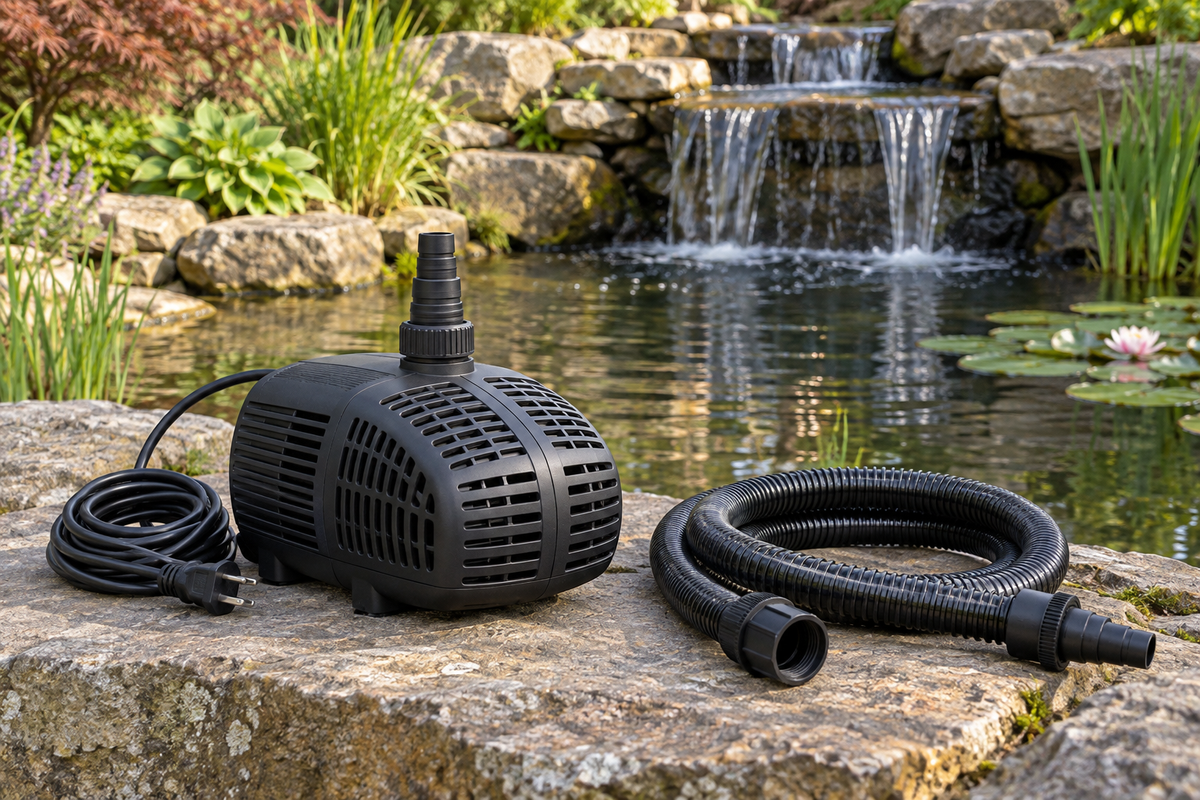
The OASE AquaMax Eco Classic 8500 presents, on its Aquishop sheet, a maximum flow rate of 8,300 l/h, a maximum head of 3.20 m, and an advertised consumption of 80 W. These three data points describe the model, without promising 8,300 l/h at 3.20 m.

The sheet indicates the transport of particles up to 8 mm and possible immersion or dry installation depending on mounting conditions. Dry operation here designates an installation out of the water with a properly fed circuit; this does not authorize running the pump without water.
This model is indicated as not electronically adjustable. Do not add a dimmer that is not intended for it. The suffixes and generations of a range can change the specifications: always compare the exact reference.
Filtration, waterfall, and water jet: choosing the right functions
A filtration pump must transport materials compatible with the system. Its cage protects the intake but does not replace complete mechanical and biological filtration. A pump is not a filter simply because water passes through openings.
A decorative jet requires a nozzle and a flow rate adapted to its shape. Fine openings can be sensitive to waste. For a waterfall, check the result at the planned height, then the capacity of the stream bed to contain this flow without water loss.
A separate pump can be relevant when decorative schedules must differ from filtration schedules. This allows for designing each circuit according to its need, taking into account the extra cost and maintenance.
Calculate consumption over your duration of use
The formula is simple: power in watts ÷ 1,000 × number of hours = consumption in kWh. Then multiply the kWh by the price applicable on your contract to estimate the energy cost.
| Constant power used as an example | Duration | Calculated consumption |
|---|---|---|
| 80 W | 24 h for 365 days | 700.8 kWh |
| 100 W | 24 h for 365 days | 876 kWh |
| Difference of 20 W | Same duration | 175.2 kWh |
These examples assume constant power and a 365-day year. An adjustable pump, seasonal operation, or different measured consumption change the calculation. Compare devices by the useful flow rate required, not just the smallest number of watts.
Plan for access and maintenance from the moment of choice
Check the cable length, fittings, location, and the possibility of removing the pump without emptying the pond. The manual must confirm installation and winterizing conditions. A swimming pond installation requires explicitly adapted equipment and assembly.
Also prepare for a flow check after commissioning. Keep a photo of the normal return and the part numbers. You will have a point of comparison if performance decreases later.
Prepare your choice with the right measurements
Gather the volume, fish, filter model, head, and pipe lengths and diameters. This data allows the Aquiflor team to compare a pump to your installation.
Sources
- OASE — How to Choose the Perfect Pump: flow, total dynamic head, and operating point.
- Aquascape — Pond Pumps: head, piping, and head loss.
- OASE — Hoses and Connectors: influence of diameter.
- OASE — Pond Pumps: pump families and uses.
- Aquishop — AquaMax Eco Classic 8500: data for the presented model. Consumption examples are illustrative calculations.