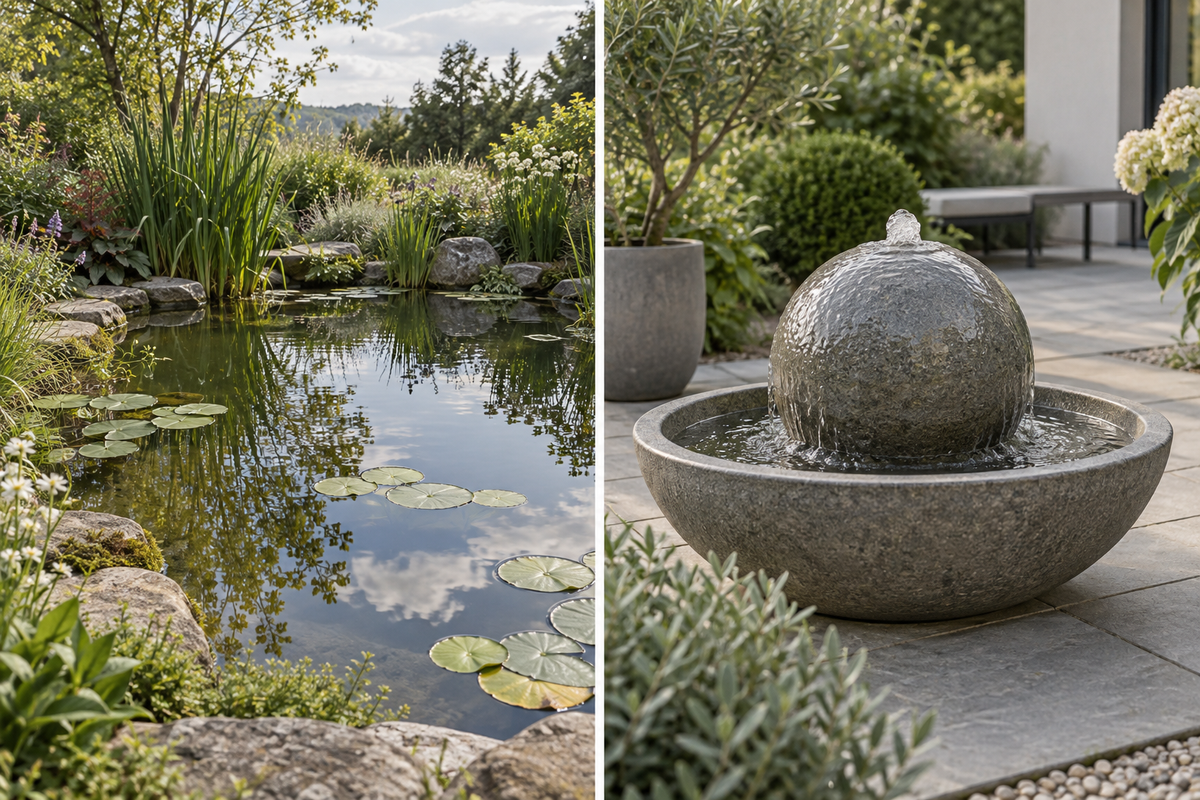
Choose a pond if your primary goal is to grow aquatic plants and observe a living environment. Choose a fountain if your priority is the movement and sound of water in a specific space. Both can be combined, but this initial distinction helps avoid a purchase that doesn’t meet your needs.
A pond isn’t necessarily large, and a fountain isn’t necessarily maintenance-free. The right choice depends on the space, the surface it rests on, the presence of children, the accepted equipment, and the amount of time you wish to dedicate to the garden. Here are the points to compare before you decide.

Comparing uses at a glance
| Your priority | Option to consider | Point to verify |
|---|---|---|
| Observe plants throughout the seasons | Planted pond or patio pond | Depths and mature growth of the plants |
| Hear a gentle trickle | Fountain or small water feature | Actual sound level and splash containment |
| Support aquatic wildlife | Fish-free pond with accessible banks | Water quality, refuges, and exits |
| Create a compact decorative feature | Fountain suited to the location | Water reservoir and pump access |
| Raise fish | Pond sized for the species | Volume, filtration, oxygenation, and wintering |
| Avoid large excavation | Above-ground pond or self-contained fountain | Total weight and surface load-bearing capacity |
The pond: a garden that evolves
A pond offers a surface where reflections, leaves, and blooms change over the months. It can be very geometric or have more natural banks. You can design it without fish, featuring plants and space for the wildlife that discovers it.
Its value does not rely solely on perfectly clear water. Shallow zones, vegetation, and transitions with the garden create habitats. For an ecological pond, Natagora recommends, in particular, accessible banks and the absence of fish to encourage amphibians.
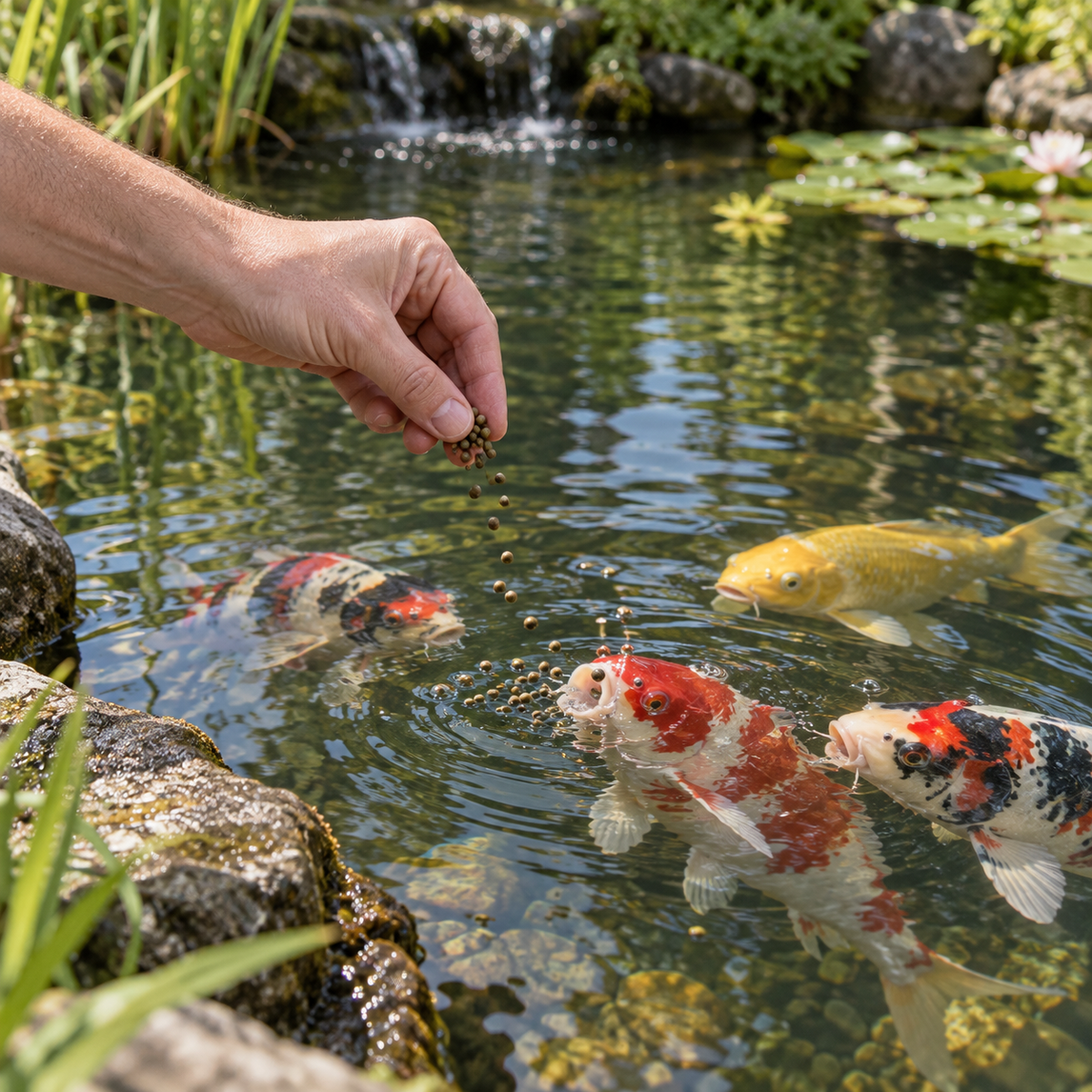
A fish pond requires more preparation: adult population, waste management, feeding, filtration, and water quality. If your goal is primarily to look at a small aquatic garden near the patio, you can maintain a simpler planted project.
The fountain: a water effect in a chosen spot
The fountain focuses attention on a water flow. This can be a subtle bubbling, a trickle over a stone, or a more visible jet. Some units have an open basin; others collect water in a reservoir hidden beneath a device designed for this purpose.
The closed-circuit operation means that water is reused. It does not eliminate losses through evaporation or splashing. A small reservoir exposed to the sun may require regular topping up, and the pump must always remain within its operating conditions.
The fountain is well-suited for a specific vantage point: an entrance, courtyard, resting area, or patio axis. Its placement must, however, allow access to the reservoir and the pump. A beautiful decorative feature sealed around an inaccessible device can make simple cleaning very complicated.
How much space should you actually plan for?
For a pond, account for the surface area of the water, finishing elements, and access. Baskets and equipment also occupy volume. A tall, narrow container might seem compact but may offer fewer planting possibilities than a more open shape.
For a fountain, observe the actual footprint of the moving water. The wind can shift a jet and wet the surrounding patio tiles. A reception area that is too small leads to water loss and can make the walkway slippery.
In both cases, calculate the weight of the setup when filled. On a raised terrace, balcony, or rooftop, have the structure validated. Neither the word "compact" nor the presence of a base proves that the installation is suitable for the surface.
What daily maintenance is acceptable?
A planted pond requires monitoring the water level, removing excess leaves, and controlling plant growth. With fish and filtration, one must add water testing, feeding, and equipment maintenance. The frequency depends on the installation and the season.
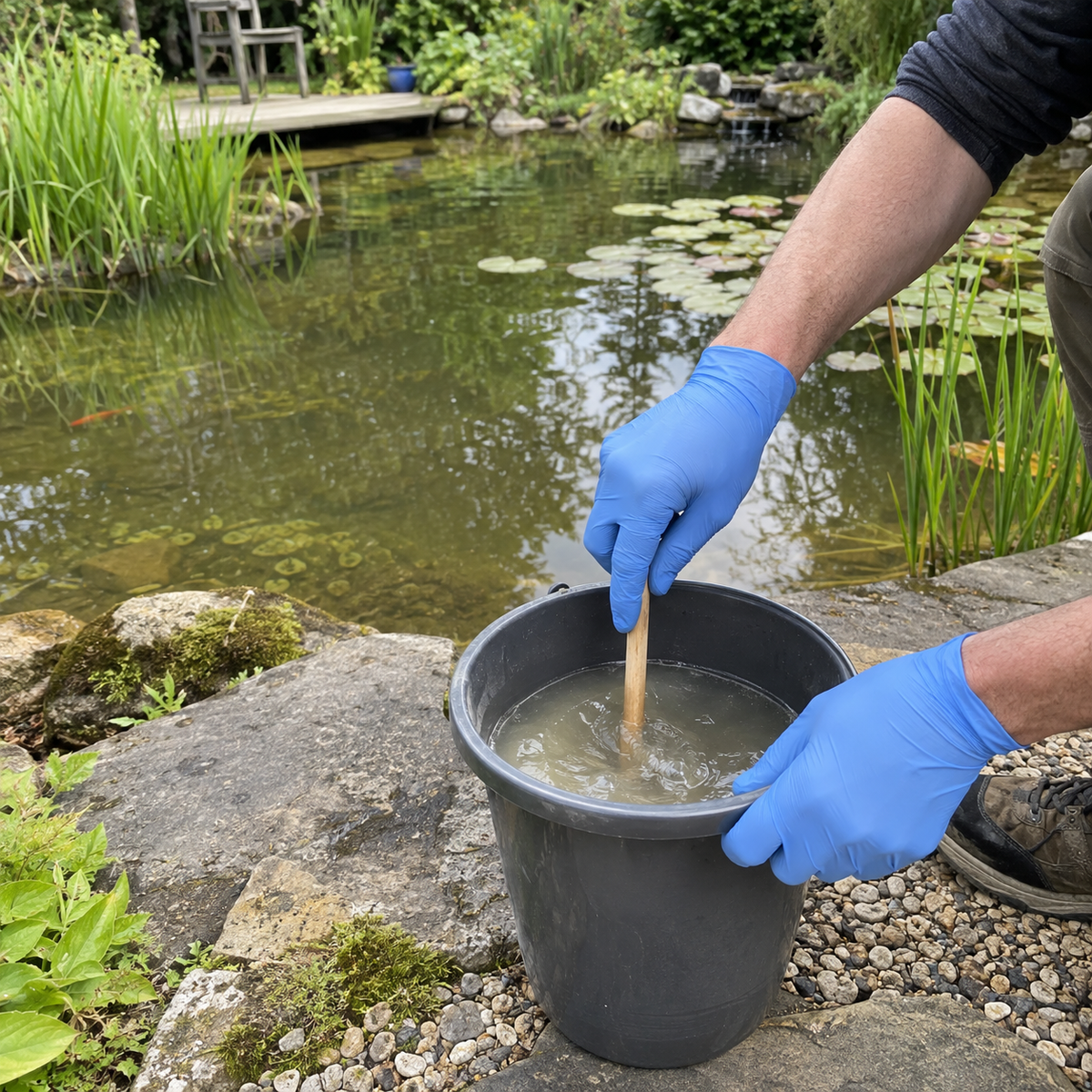
A fountain requires cleaning the pump, water passages, and sometimes mineral deposits. Algae can also grow on lit surfaces. Use only methods and products compatible with the material, the pump, and animals that might drink from it.
If the fountain is connected to a living pond, a cleaning product for the decor must not be added without verification. Mechanical cleaning out of the water, followed by the rinsing recommended by the manufacturer, is often a step to check before any chemical intervention.
Choosing a pump suited to the desired effect

The Aquarius Universal Classic 600 OASE is intended for small water features. Its specifications state a maximum flow rate of 600 l/h, a maximum head height of 1.20 m, and a power of 7 W. The maximum flow rate and maximum height are not achieved simultaneously.
Measure the required lift and the path of the hose before choosing. The pump must provide the expected effect in your actual circuit. This model is not a universal solution for filtering a fish pond or powering a large waterfall.
For a larger project, the choice of equipment must integrate pressure losses and the requirements of the accessories. A pump that is too powerful can cause splashing; a pump that is insufficient might leave a spillway flowing across only part of its width.
Comparing consumption beyond just the purchase price
The operating cost depends on power and usage time. For example, a 7 W pump used eight hours a day for 180 days theoretically consumes 10.08 kWh. Multiply this amount by your electricity rate to estimate this scenario.
Add any other possible devices: lighting, UV-C, filtration, or aeration. A purely decorative fountain might have a different schedule than biological filtration required for fish. Do not turn off the latter simply to follow the hours of a decorative piece.
The budget also includes wear parts, consumables, and top-ups. Compare installations that meet the same purpose: a small fountain and a large koi pond cannot be judged solely on the price of their pump.
Sound and safety are part of the choice
Listen to a model in operation whenever possible. The sound depends on the flow rate, the height, and the surface area of the receiving basin. A gentle trickle might be suitable near a table, while a more significant waterfall becomes very prominent in the evening.
Any water feature requires thought regarding access for children and pets. Shallow depth does not eliminate the risk. A fountain with a protected reservoir can suit certain projects, provided the device is designed and installed for this use.
Electrical connections must comply with manuals and applicable regulations. Also, plan for winter: some decor and containers must be emptied or protected, while the needs of a living pond are managed according to its design.
And if you want both?
A pond can accommodate a small water flow, but keep areas calm for plants and wildlife. Avoid placing a jet directly on water lily leaves. The movement must remain compatible with the volume and the species present.
An independent decorative circuit can facilitate adjustments and scheduling, especially with fish. You can thus work on the sound without compromising the essential functions of the pond. The hydraulic plan must be prepared before choosing the equipment.
To choose, send a photo of the location and indicate your priority: plants, wildlife, fish, or the sound of water. Contact support@aquiflor.com with the dimensions and the type of support to prepare a coherent set.