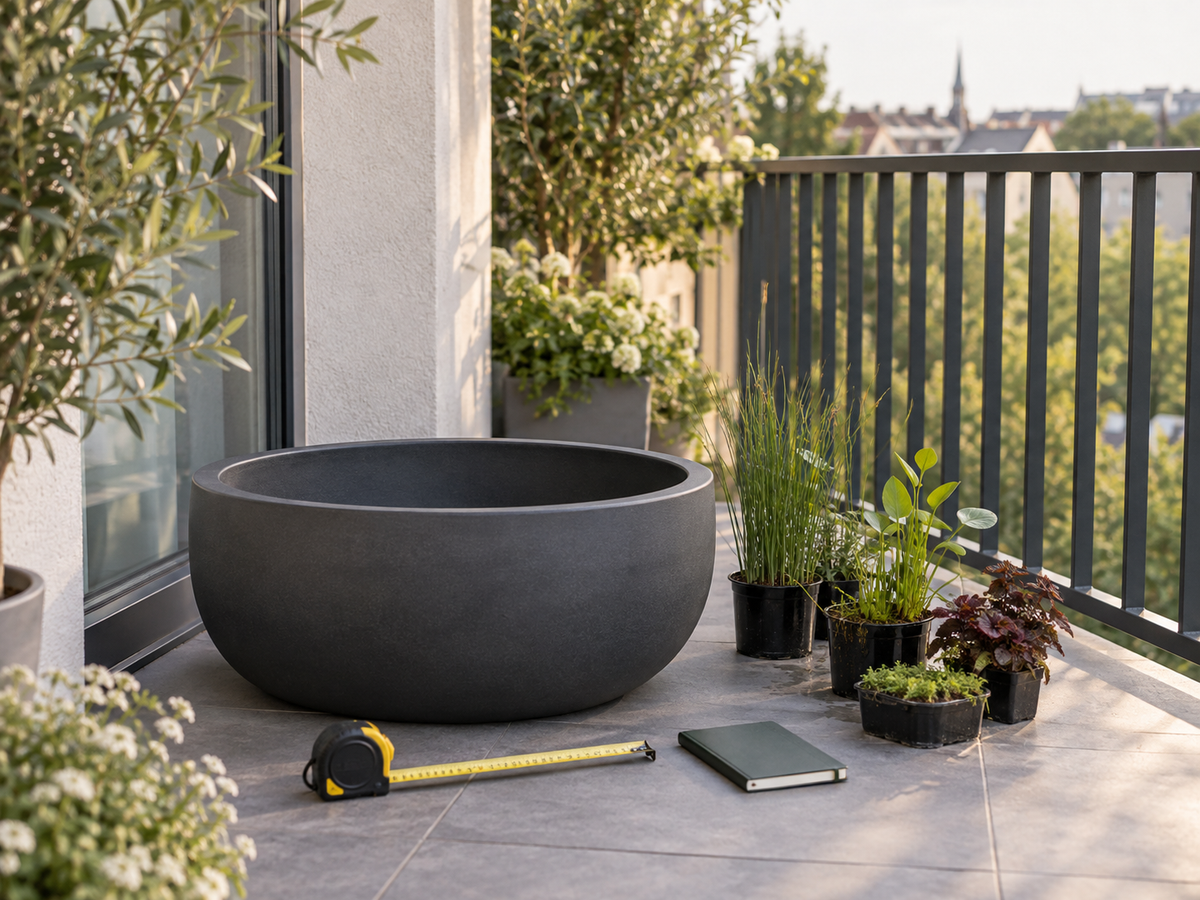
A pond on a balcony can be feasible, but the structure's capacity must be verified before filling. The weight of the water, the container’s points of support, and the chosen location matter just as much as its dimensions. A photo of the balcony or a general value found online is not enough to validate the project.
The right approach is to prepare a small dossier: water volume, weight of materials, dimensions, type of support, and a positioning plan. Once feasibility is confirmed, you can choose the plants and organize a water garden suited to the exposure and your use.

Calculate what will actually be placed on the balcony
One liter of water weighs approximately one kilogram. This is a starting reference, to which the basin, baskets, substrate, stones, and equipment are added. The stated weight of an empty container therefore only describes part of the future load.
Let’s look at a preparation example: 80 liters of water, an 8 kg container, and 12 kg of plants, supports, and accessories result in approximately 100 kg in total. This calculation does not mean that a pond of this weight is authorized or suitable for your balcony. It serves to communicate a total load to the person who will verify the structure.
Also count other elements present: furniture, planters, storage, and people. A project should not be evaluated by isolating the pond from the rest of the layout. Also, account for the maximum possible water level, especially in the event of rain.
Why a kg/m² figure is not enough
The balcony may be cantilevered, supported by a structure, or part of a loggia. Its age, condition, and design influence the assessment. A permanent load concentrated in one spot cannot be reduced to a weight distributed evenly over its entire surface.
The bottom of the container and its points of support are also important. A pond resting on a few feet does not transmit its load like a flat-bottomed basin. The visible surface itself may rest on pedestals or a secondary structure.
Do not deduce feasibility by simply dividing the weight by the total area of the balcony. A board added under the basin does not constitute validation either: its ability to distribute the load and the constraints of the support must be examined.
Who to ask for verification?
Gather the documents available from the landlord, the building manager, or the syndic: plans, characteristics of the structure, and any usage instructions. Then present the project to a professional qualified in structures, who will be able to indicate the necessary information and checks.
Request an answer regarding the specific pond envisioned and its precise location. A vague phrase like "the balcony is solid" does not provide the same elements as an evaluation of the volume, load, and supports. If the position or size changes, confirm that the conclusion remains valid.
Also consult your lease and the building's rules. A layout may raise questions regarding visible modifications, water drainage, noise, or common access. Procedures depend on the situation; have them clarified before purchasing a set that is difficult to return.
Prepare a clear project file
| Information | What to provide |
|---|---|
| Container | Model, dimensions, empty weight, and support type |
| Water | Useful volume and planned maximum level |
| Decor | Weight of stones, baskets, substrates, and accessories |
| Position | Dimensioned plan with facade, railing, doors, and drains |
| Support | Type of slab, covering, or pedestals, if known |
| Usage | Plants, potential pump, maintenance, and presence of children |
A few photos complete the file but do not replace a technical examination. If you observe cracks, concrete spalling, signs of corrosion, or instability in the railing, report them to the manager before adding a load. Do not fill the pond to "test" its sturdiness.
Consider drainage and waterproofing
The balcony must keep its water drains free and accessible. A basin installed in front of a drain can complicate cleaning or mask an obstruction. Water stagnation against a facade and infiltration are among the problems described by the Agence Qualité Construction.
Plan how to manage the overflow, a leak, and water changes. Water should not be poured onto the facade, the balcony below, or passersby. Have the solution confirmed as compatible with the building; do not randomly connect a hose to a drain.
Maintain access to the underside or perimeter of the container depending on its design. Persistent moisture hidden under a large decoration can remain unnoticed for a long time. Materials placed between the basin and the floor must comply with the manufacturer's requirements and the support's needs.
Choose a proportionate project after validation
Once feasibility is established, a small planted water garden is often the simplest project to organize. Choose a container designed to hold water long-term and compatible with outdoor conditions. Check its frost resistance and behavior under the sun.
Avoid stacking stones and heavy accessories that serve no purpose for planting. They increase the load and reduce the volume of open water. Basket supports must remain stable and adapted to the basin.
Maintain comfortable circulation to the balcony door and equipment. The container should not become a step near the railing. Access safety is prepared with the complete layout, especially when children frequent the area.
Which plants to consider?

The Acorus gramineus ‘Ogon’ can provide low-growing foliage in a suitable damp area. The water forget-me-not is another option for very shallow depths. Each plant must be positioned according to its needs at the crown.
Limit the number of plants to keep space available. A plant in a small pot can become invasive in a restricted container. Accessible baskets facilitate growth monitoring and adjustments without moving the entire pond.
Observe the actual exposure of the balcony. Wind, warm walls, and shaded periods can produce different conditions than those of a garden pond. A hardy species does not automatically benefit from the same protections in a small above-ground basin.
Should you add a fountain or fish?
A fountain adds an electrical circuit, noise, and a risk of splashing. If you choose to include one, select an effect highly proportionate to the water reserve and have the connections installed correctly. Test the operation without wetting the walkways or the neighbors.
Fish require a separate evaluation: swimming space, volume, water quality, temperature, filtration, and wintering. A planted balcony pond should not automatically receive goldfish. Koi are not suitable for a mini-container as a permanent habitat.
Without fish, you can still observe the plants and visiting insects. The RHS notes that container water gardens can be used by flying insects, even in urban spaces. Their presence remains linked to the environment and is not guaranteed.
Plan maintenance before installation
Plan how to transport water, remove a basket, and protect the container in winter. A full basin cannot be moved for simple floor cleaning. Interventions must remain possible from a stable position, without leaning dangerously over the railing.
Monitor levels, leaks, the condition of the visible support, and the drains. Respect the wintering instructions for the container and equipment. If feasibility remains uncertain, keep the project at the planning stage and examine a lighter solution adapted to the space with the professional.
Aquiflor can help you choose plants and equipment after the support has been validated. Send the authorized volume, dimensions, and exposure to support@aquiflor.com. The capacity of the balcony must be confirmed by the building professional competent for your structure.
Sources and references
- Agence Qualité Construction: maintenance, permanent loads, and balcony issues. French technical document; generic loads cannot be transposed to your building.
- Buildwise: technical benchmarks for building imposed loads.
- RHS: container water gardens and visiting insects.
- Aquishop: needs of the ‘Ogon’ sweet flag.