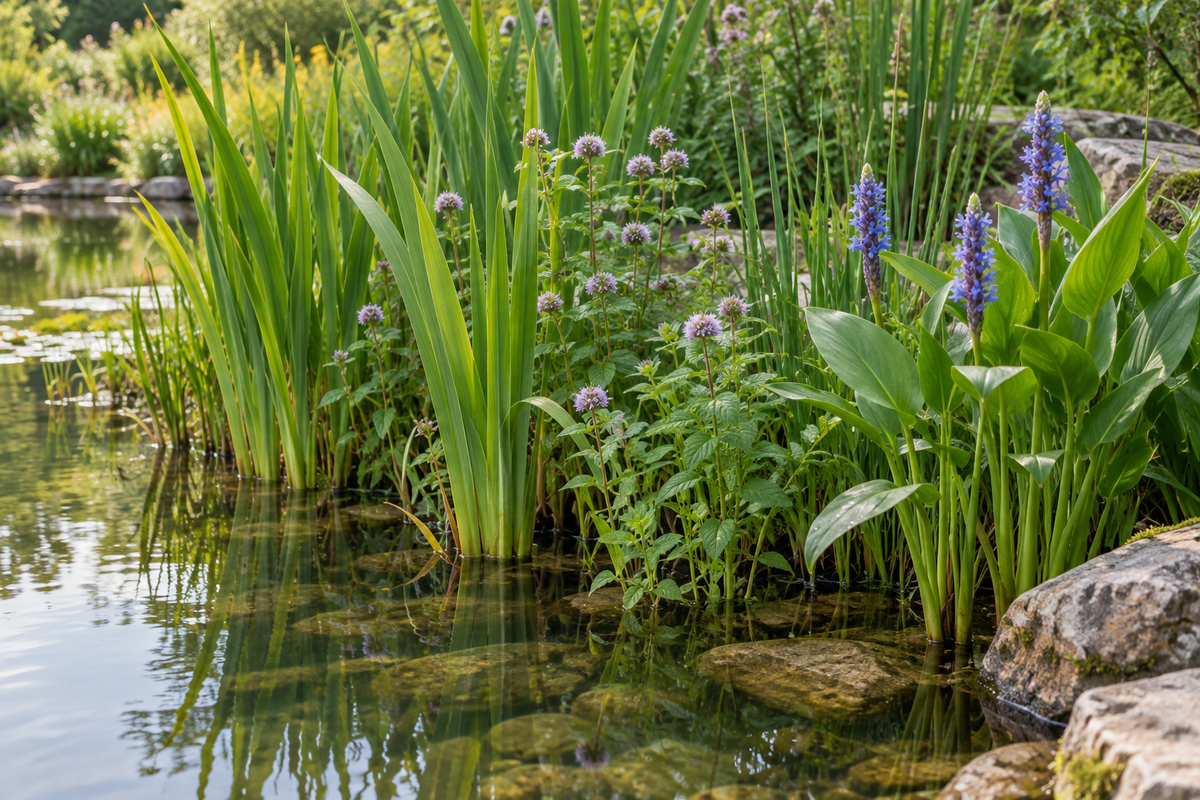
Good filtration plants are those that grow well in the spot where you plant them. A properly placed water mint provides more benefit than a large clump of iris dying at the bottom of the pond. Before filling your basket, measure the depths, note the sun exposure, and distinguish between the moist bank, the lagooning zone, and the open water.
The selection below is based on the plants offered in the Aquishop catalog and their uses in a water garden. It will help you create a cohesive planting scheme for an ornamental pond or the vegetated zone of a natural swimming pool. For a swimming area, the planting plan must remain integrated into the chosen treatment system.

What do filtration plants actually do?
Plants use nutrients to build their tissues. Their roots and the surrounding media also host organisms that contribute to the functioning of the environment. In practice, planting supports water circulation, waste management, and the biological activity of the pond.
This process has its limits. Plants do not instantly remove all silt, replace filtration adapted to a large fish population, or disinfect a swimming pool. Their growth varies with the season. A vegetated zone that seems effective in June does not work exactly the same way in the heart of winter.
Removing some of the pruned vegetation helps export material out of the pond. If all the leaves die and decompose in the water, some of the elements they contain return to the environment. Maintenance is therefore part of the plant's filtration role.
Start with the planting depth at the crown
Planting depth is not always measured from the bottom of the basket. The useful reference point is generally the crown, at the junction between the roots and the aerial parts, or the point specified for the species. A ledge located 30 cm underwater can result in shallow immersion at the crown if the basket is tall.
Make a small survey before purchasing: depth of the ledge, height of the container, and usual water level. Also, account for level variations. A damp-soil plant does not become an aquatic plant just because it is sold among water plants. If in doubt, have the exact position confirmed based on its botanical name.
A selection for your planting scheme
| Plant | Suggested placement | Point of vigilance |
|---|---|---|
| Yellow iris, Iris pseudacorus | Marsh or lagooning zone with room for a vigorous clump | Plan for its growth and access for dividing the clumps |
| Water mint, Mentha aquatica | Moist to slightly submerged edge | Contain its spread in small installations |
| Small reedmace, Typha minima | Shallow zone depending on the planting substrate | Check the species: not all cattails have the same footprint |
| Flowering rush, Butomus umbellatus | Shallow aquatic zone suited to its needs | Allow space for underground parts and future stems |
| Bogbean, Menyanthes trifoliata | Aquatic edge and transition zone | Plan for its spread rather than squeezing it between dominant plants |
| Pickerelweed, Pontederia cordata | Shallow submerged zone with emergent foliage | Respect the depth indicated for the delivered plant |
| Marsh marigold, Caltha palustris | Moist soil and very shallow edge | Attractive for spring flowering, to be combined with other plants |
| Acorus gramineus ‘Ogon’ | Moist edge for a low-growing silhouette | Do not install it at the bottom like a submerged plant |
This list suggests complementary roles; it does not rank species according to a number of "filtered" liters. This type of performance cannot be attributed to an isolated plant without knowing the system, the inputs, and the growth conditions.
Three easy-to-integrate choices for your plan
Water mint for a vibrant edge
The water mint provides aromatic foliage and a flowering appreciated in the garden. The Aquishop spec sheet indicates installation from the moist zone to about 10 cm of water at the crown. In a small pond, an accessible container makes it easier to control its spread and divide it.
Pickerelweed to provide height
The heart-leaf pickerelweed is suitable for a composition where you want emergent foliage and vertical flowering. Despite the word "submerged" present in some commercial descriptions, its foliage develops above the water. The spec sheet places it in shallow depths, to be adapted to the plant and its installation.
Marsh marigold to start the season
The marsh marigold adds interest to the bank in the spring. It complements plants whose visual effect comes later. Place it at a depth compatible with its needs, without trying to make it occupy the same level as a water lily or pondweed.
A pack for planting a lagooning zone

The Aquipond pack of 64 filtration plants includes, depending on its catalog composition, 16 yellow irises, 16 small reedmace, 10 flowering rushes, 10 water mints, 6 softstem bulrushes, and 6 bogbeans. Check the composition and availability at the time of ordering.
The "approximately 4 m²" mention describes the proposed planting surface for the pack. It does not mean that these plants are sufficient to filter any swimming pool or a specific volume of pond. The lagooning must be sized based on its substrate, hydraulics, the load to be treated, and its cleaning capabilities.
Before planting, distribute the pots on the plan or dry on the prepared area. Group species in a readable way, keep the tallest ones out of the main views, and maintain access to water inlets. Avoid covering a hatch or a drain with a vigorous species.
What about oxygenating plants and water lilies?
Submerged plants complement the edge vegetation. The hornwort, for example, has no real roots and can grow freely in the water. It is not planted like an iris in a soil basket.
So-called oxygenating plants produce oxygen in the light, but they also respire. Their presence therefore does not guarantee sufficient oxygenation for fish, especially at night or during hot weather. Managing the population and, if necessary, aeration remain important.
Water lilies provide shade and surface cover. Choose a variety suited to the size of the pond and the available depth. In a natural swimming pool, their placement must leave the swimming area and suction organs clear.
Planting without unnecessarily overloading the water
Use the support provided by the lagoon designer or a substrate suitable for aquatic plants in appropriate containers. Enriched and loose potting soil can release materials and nutrients into the water. Do not add fertilizer to the entire area out of habit: needs should be reasoned according to the system.
In an ornamental pond, planting baskets make it easy to move and divide clumps. In a planted filter designed for direct planting, conversely, follow the planned assembly. Mixing these two methods without verifying water circulation can complicate operation.
Maintaining plants and managing deposits
Monitor water passages, remove accessible waste, and divide plants that are suffocating their neighbors. Intervene in zones to maintain refuges in ponds favorable to wildlife. Pruning residues must not be abandoned in a stream or natural environment.
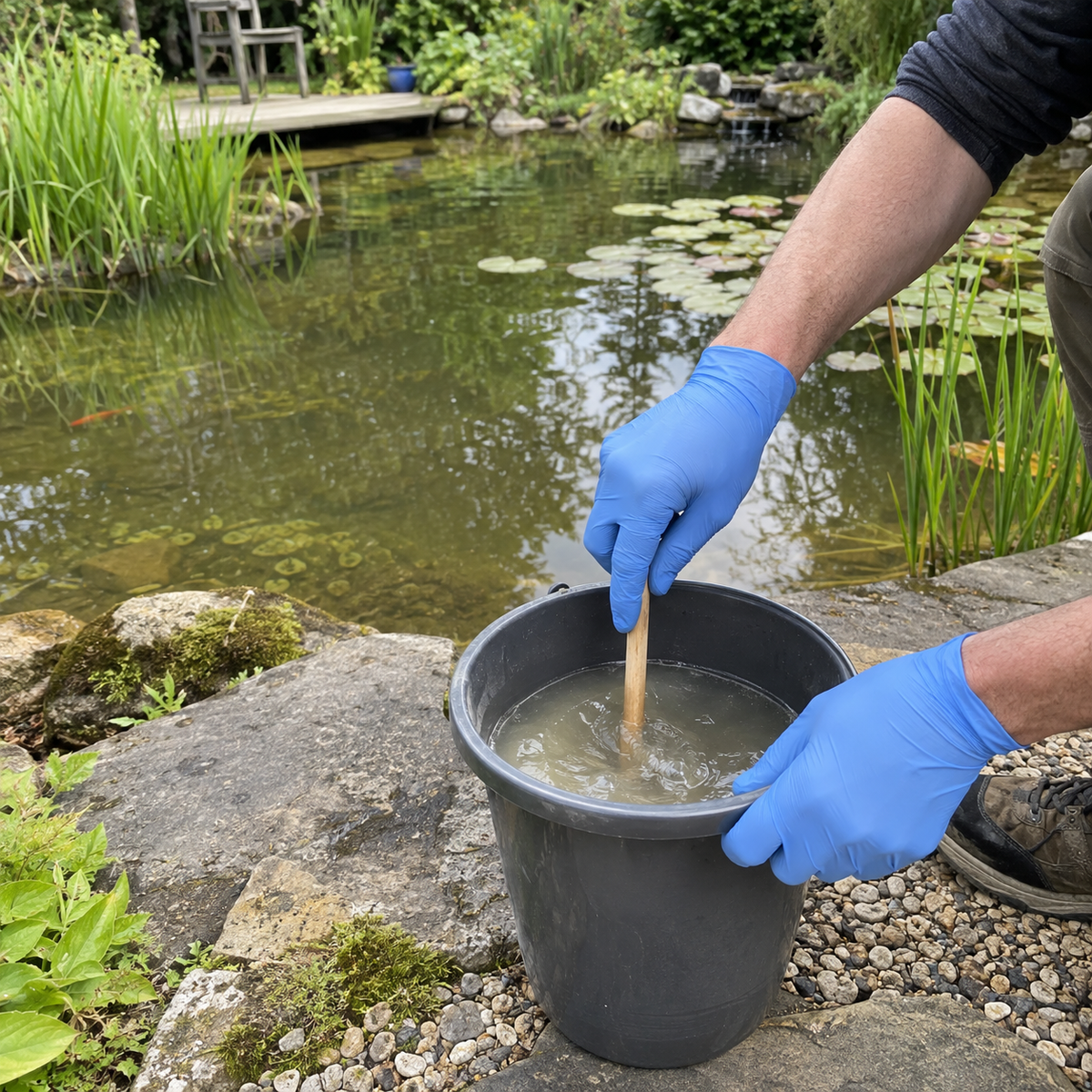
If sediment accumulates, first investigate its origin and the state of the pre-filtration. In an ornamental pond, a PondoVac helps remove accessible deposits. Aquipond Bactovase can assist with organic matter management according to its instructions; it does not eliminate gravel or sand. For a natural swimming pool, confirm the compatibility of any treatment before use.
Need an adapted selection? Send your depths, dimensions, and photos to support@aquiflor.com. A well-placed planting will be easier to maintain and more durable than a list of species chosen without considering the pond.
Sources and selection
- Royal Horticultural Society: choosing plants according to zones and depths.
- Biotop: integrating the vegetated zone into the design of a natural swimming pool.
- Aquishop: composition of the Aquipond filtration plant pack.
- Aquishop botanical spec sheets for the plants linked in this article, for planting references.