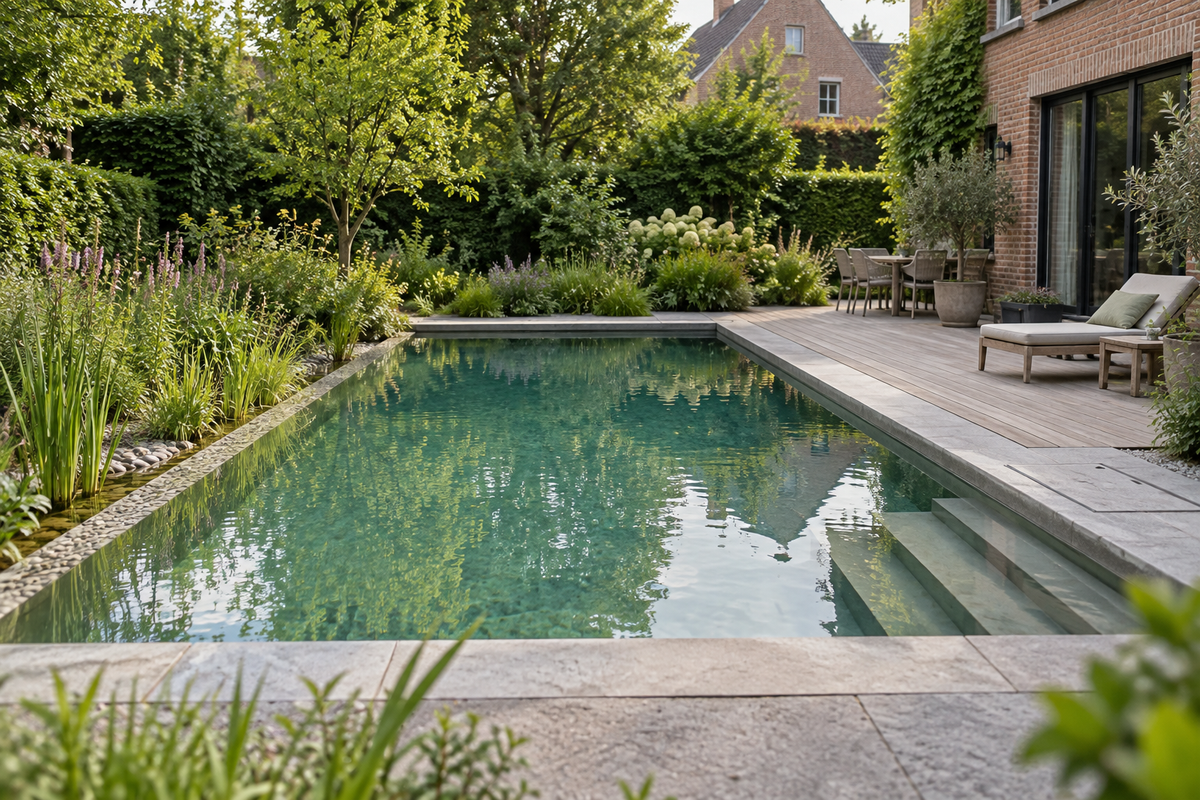
Yes, a small natural pool can be a viable option, provided you choose a system designed for the available space and the intended use. Simply reducing the dimensions of a large swimming pond is not enough. The treatment zone, usage frequency, and technical access must all maintain a coherent capacity.
In a city garden, the real issue is not just the water surface area. You need to know where to install the equipment, how to maintain the entire setup, and what level of swimming comfort you truly wish to achieve.

What does "small natural pool" mean?
The word "small" depends on the garden and your expectations. A pool might be suitable for cooling off while being too short for comfortable swimming. An area that seems generous on a plan can also shrink once you draw in the stairs, coping stones, and areas not intended for swimming.
Start by describing your usage in one precise sentence: "we want to swim as a pair after work" or "we wish to swim regularly." These are not the same projects. The number of occasional bathers also matters: an installation sized for limited family use does not necessarily have the capacity to host large gatherings.
Ask the designer to distinguish three areas in their plan: the water used for swimming, the treatment zones, and the total developed footprint. This presentation makes proposals much easier to compare.
Two biological approaches to consider
A pool with a planted regeneration zone
This approach gives significant space to aquatic vegetation and the organization of the environment. Depending on the system, it is accompanied by pre-filtration and circulation. The planted zone occupies an area that must be factored into the project, with access provided for removing debris and maintaining the plants.
The planted natural pool system presented by Biotop uses its own sizing rules, particularly regarding the ratio between swimming and regeneration. These guidelines do not constitute a universal recipe for shrinking any pool down to a few square meters.
A biological pool with compact technical treatment
Other designs focus treatment more heavily on dedicated equipment. The Biotop Living Pool, for example, combines biological filtration with a phosphorus management device. This organization allows for different layouts than a large planted lagoon.
A compact solution shifts some of the constraints toward the technical side: access, maintenance, consumables, and circuit operation. It must be described as a coherent whole. A pump and a few plants added to a small tank do not replicate this principle.
Are there any small-scale projects?
Yes. For example, Biotop documents a 30 m² water surface family project, completed in Germany in 2022 using a Living Pool design. This example confirms the existence of compact projects without establishing a minimum surface area valid everywhere.
For your garden, ask for references similar to your constraints: narrow access, proximity to the house, sloping terrain, or limited technical space. A beautiful photograph does not always show the machinery or ancillary structures. Plans and maintenance requirements are therefore just as interesting as the landscape result.
Calculating the space actually needed
Let’s take a purely geometric example: a 5m by 3m water area represents 15 m². This describes neither the volume, the treatment surface, nor the surroundings. Adding a walkway, a coping stone, and a technical room can significantly change the total footprint. This example serves to help you read a plan, not to validate a biological pool of that specific size.
Mark out the entire project on the ground before deciding. Simulate the path to the garden, the opening of doors, and access for cleaning the filter. Also check the views from the house and the space remaining for other terrace activities.
| Element | Question to ask about the plan |
|---|---|
| Stairs or water access | How much space does it take from the usable zone? |
| Biological treatment | Where is it located and how can it be serviced? |
| Circulation around the pool | Do the walkways remain practical and safe? |
| Equipment | Can it be replaced without breaking up the surroundings? |
| Construction site | Can machinery and materials reach the location? |
A small volume requires careful monitoring
With identical bathing loads, substances are distributed in less water. Operation must therefore be sized for actual use, with management of particles and nutrients. Leaves, runoff, and products brought in from the surroundings are factors to anticipate.
Choose a layout that limits the entry of dirty water from the terrace or lawn. Keep garden soil and fertilizers away from the circuits. The quality of the refill water must also be known before selecting the system.
Sanitary monitoring remains necessary even when the water looks clear. Domestic chemical tests provide information on certain parameters but do not replace appropriate microbiological analyses. Define the program with the designer and a qualified laboratory according to how the pool will be used.
What pump and equipment should be provided?
A compact pool does not automatically call for the smallest pump in the catalog. The actual flow rate depends on the filtration, the pipes, and the pressure loss. You must also use equipment explicitly intended for use in a swimming pool.
The OASE AquaMax Eco Premium 6000 in 12 V, reference 50730, is among the pumps presented for this use. Its maximum flow rate of 6,000 l/h is not a sanitary treatment capacity or an automatic recommendation for your volume. Its suitability must be verified against the complete circuit.

Mains power supply and protections must be installed in accordance with the manual and applicable rules. Have everything checked by a competent professional. A "12 V" label on the pump does not in itself validate the project's sockets, cables, and suction systems.
Plan for cleaning right from the design stage
In a small pool, every hard-to-reach corner becomes quickly apparent during maintenance. A clear floor, accessible angles, and reachable equipment simplify interventions. Discuss cleaning before choosing a highly intricate shape just for its appearance.
The PondoVac 4 can be considered for vacuuming deposits when the depth, lining, and drainage conditions are suitable for its use. Its use must be organized when no one is swimming, in accordance with its manual. Plan for dry storage and a drainage path for the extracted water.
Ask for a written maintenance schedule, including the approximate time required and tasks assigned to a service provider. Biological or anti-algae products must be explicitly compatible with the installation and swimming before any use.
The budget does not decrease exactly with the surface area
Certain items remain present in a compact project: study, site access, equipment, safety, connections, and commissioning. Halving the surface area does not automatically halve the quote. Compare the scope of services and predictable operating costs.
Also ask which elements are excluded: soil removal, garden restoration, electrical connections, analyses, or initial maintenance. The price of the tank alone does not describe the budget for a usable and monitored pool.
Have a small natural pool studied with Aquiflor: prepare the available dimensions, photos, and your usage. If the space does not allow for a coherent swimming experience, this same information will be used to consider a water garden adapted to the actual space.