A pond planted solely to look beautiful in June can seem very empty in March and lose all appeal by the end of the summer. To create an attractive arrangement for longer, combine staggered flowering times, foliage of different shapes, and plants whose needs match the available locations.
Outdoor pond plants should also be chosen based on their annual cycle. Some sprout early, others take over in the summer, while marginal plants extend the color into autumn. In winter, forms, stems, and open water become more prominent. Here is how to prepare for this succession without overcrowding the pond.

Start with depth and light
The flowering calendar should not make you forget the location. A plant chosen for its autumn bloom will not grow properly if it is installed at a water depth incompatible with its needs.
Note the depths of the shelves and measure the water height above the future crown. Also, observe the sunlight in spring and summer: a tree that is still leafless in March may heavily shade the pond a few weeks later.
Then, save room for adult development. The goal is to stagger the points of interest, not to install a different plant every month in every basket. Some clumps will maintain a visual role long after their flowering period.
In spring: accompanying the resurgence
Spring reveals new shoots and early foliage. Before adding plants, identify those that are still dormant. A spot that seems empty may belong to a perennial that starts later.
The Caltha palustris, or marsh marigold, can open the season with its yellow flowers. Its Aquishop datasheet indicates a flowering period from April to June, a height of 30 to 40 cm, and planting near the water level.
The water forget-me-not can then accompany the shallow edges. Its flowering is listed from May to September, with low growth. These dates provide a guide for composing the pond; weather and growing conditions can shift them.
The period when the water warms up, from mid-spring to early summer depending on the plant, is generally favorable for new installations. Take this opportunity to check the baskets and divide clumps that need it, without disturbing the entire pond in one go.
In summer: composing volumes and maintaining open water
Plants reach their greatest size at this time. Floating leaves, upright stems, and submerged vegetation create different atmospheres. A balanced composition also leaves room to see the water and access equipment.
The Pontederia cordata brings mauve spikes, listed from June to September, above heart-shaped leaves. It should be placed on a shelf compatible with its planting depth, 10 to 30 cm underwater according to the datasheet.
A white water lily can complete the scene in another area. Check the variety received, its depth, and its spread: a vigorous water lily can occupy much more space than one might imagine at the time of purchase.
Remove accessible dead leaves and gradually limit excess growth. During heatwaves, keep a close eye on ponds with fish. Plants produce oxygen in the light, but they also breathe at night; their presence does not guarantee sufficient oxygenation.
In autumn: extending the flowering at the edges

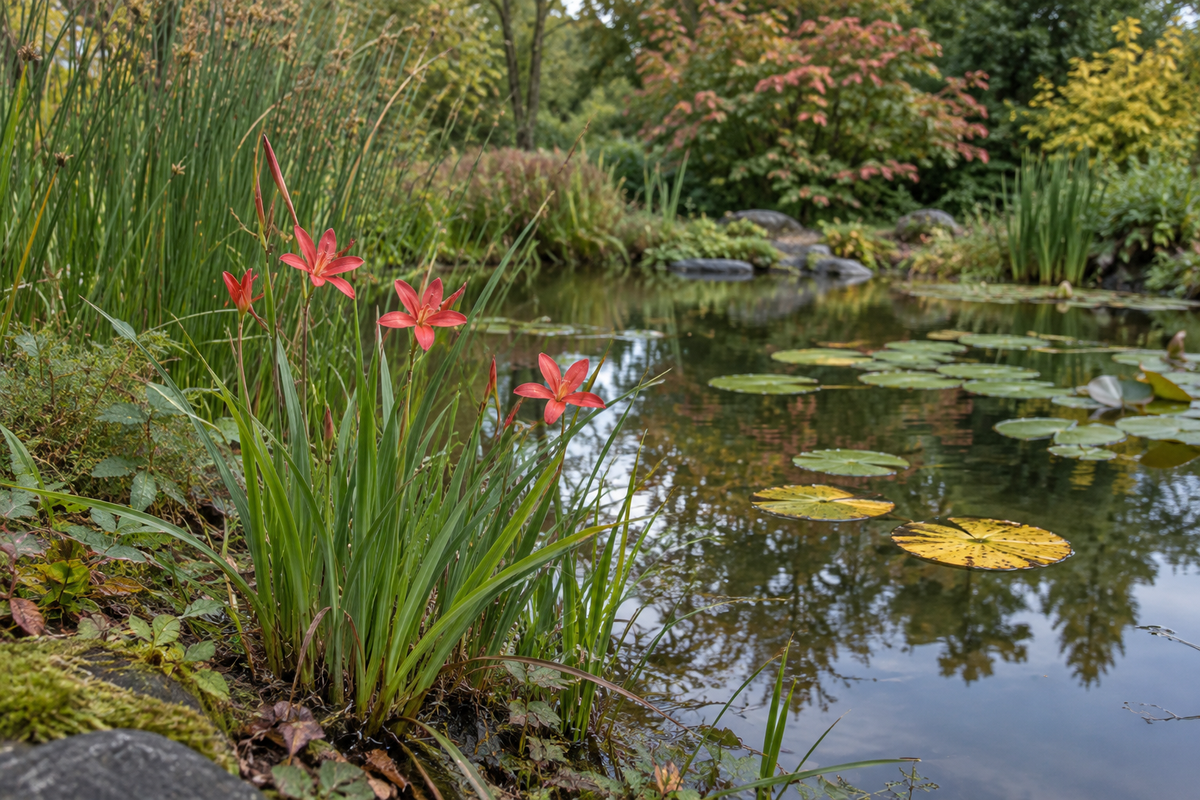
The Hesperantha coccinea ‘Major’, sold under the name Schizostylis, helps extend the color with red flowers. The Aquishop datasheet indicates a flowering period from August to November. An early frost or unfavorable exposure can naturally shorten this period.
This plant is suitable for a damp border near the water level; it should not be planted like a fully submerged aquatic plant. The RHS recommends a sunny location, moist but well-drained soil, and shelter from cold, drying winds.
At this time of year, remove leaves that detach and risk accumulating in the water. However, keep refuges and useful stems in areas where they do not interfere with the pond's function. Maintaining a border can be done in stages.
In winter: recognizing dormancy and protecting sensitive plants
Dieback of foliage is not necessarily a sign of dying. Hardy water lilies enter dormancy and resume growth when conditions become favorable. Tropical plants, however, require different wintering conditions.
Do not infer hardiness solely from the color of a flower or the word "aquatic." Keep the exact names and ask for the appropriate conditions for each reference. In a small above-ground container, cold can reach the roots more easily than in a large, in-ground pond.
A hardy plant still requires an installation compatible with the local frost. Specifically, check that the parts to be protected are not at risk of freezing completely. For sensitive species, prepare their protection before the first cold spell rather than improvising when they are already damaged.
The remaining stems and foliage can add texture to the garden, but they should not prevent monitoring of the water or the maintenance required for the fish.
A simple calendar to prepare your composition
| Period | Interest to look for | Example to study | Useful action |
|---|---|---|---|
| Spring | Resurgence and first flowers | Caltha palustris | Identify new shoots and check locations |
| Late spring and summer | Flowering edges and developed foliage | Forget-me-not, pickerelweed, adapted water lily | Keep open water and monitor oxygenation |
| Late summer and autumn | Late-season marginal flowering | Hesperantha coccinea ‘Major’ | Gradually remove leaves that fall into the water |
| Winter | Silhouettes and vegetative rest | Hardy plants already adapted to the pond | Check protections and prepare for the next season |
This table is used to organize purchases. It does not guarantee flowers every week nor an identical quantity of plants for all ponds.
Combining heights without masking the pond
Place the tallest plants while considering the main viewpoint and their shade. Low plants can highlight a border near the patio, while floating leaves occupy a portion of the surface.
The aquatic baskets of different sizes facilitate adjustments and divisions. However, they must remain stable and large enough for the plant. Avoid multiplying small containers simply to add more varieties.
If you want a pond composed only of native species, please indicate this before choosing. Some ornamental plants mentioned, such as pickerelweed and Hesperantha, do not meet this criterion.
Observe for a year before changing everything
Take a few photos from the same spot over the months. They will show the periods that are too empty, areas that have become dense, and plants that are hiding their neighbors. You will then be able to complete the composition with a specific goal.
A disappointing bloom also deserves a diagnosis: light, depth, crowding, and the state of the plant. Adding fertilizer without checking these points may enrich the pond unnecessarily. When fertilization is justified, use a product intended for aquatic plants according to its instructions.
To compose a planting scheme adapted to your pond and the seasons, contact the Aquiflor team with depths, exposure, and a few photos. We can help you distribute the species and plan their maintenance throughout the year.
Sources and useful reading
- RHS — choosing pond plants and seasonal maintenance.
- RHS — growing and wintering hardy and tropical water lilies.
- RHS — Hesperantha coccinea, exposure and growing conditions.
- Penn State Extension — dissolved oxygen basics.
- Aquishop datasheets for the plants mentioned: indicative flowering periods, depths, and stated dimensions.